In the distant past, when the lands of Eastern Europe were vast, untamed, and waiting to be claimed, there lived three brothers whose names would echo through generations, Lech, Czech, and Rus.
They were bound not only by blood, but by a shared purpose. The lands they had known were no longer enough, and within each of them stirred a quiet calling, to seek new territories where their people could grow, thrive, and build lives of their own.
So, together, they set out.
They traveled across wide plains and through dense forests, over rivers that cut silver paths through the earth, and beneath skies that seemed to stretch without end. Their journey was not hurried, for they carried with them not only their belongings, but their hopes and the future of those who would follow them.
Though united in purpose, each brother felt the pull of destiny in a different way.
As they journeyed, the land began to change. Paths that once seemed shared slowly began to diverge, each leading toward a different horizon.
One day, they came to a place where the road no longer remained one.
Before them lay three directions, each offering its own promise, its own uncertainty.
The brothers stopped.
For a long moment, they stood in silence, understanding what lay ahead.
It was time to part.
Czech, thoughtful and steady, looked toward the lands that stretched to the west. There, the hills rose gently, and the forests opened into fertile valleys.
“I will go this way,” he said. “There is something here that calls to me.”
Rus, whose spirit was drawn to vastness and distance, turned his gaze toward the east, where the land seemed endless, rolling onward beyond sight.
“Then I will go this way,” he said. “My path lies there.”
Lech remained still, his eyes moving slowly across the northern horizon.
“I will continue forward,” he said at last.
There were no grand speeches, no sorrowful farewells. The bond between them did not require words.
They embraced, and then, without hesitation, each brother set forth on his chosen path.
Lech traveled on alone.
The land before him was both beautiful and wild. Forests grew thick and tall, their branches weaving together to form a canopy that filtered the sunlight into soft, shifting patterns. Rivers wound through the earth, their waters clear and steady.
Days passed, and then more. Yet Lech did not falter. He moved with purpose, guided by something he could not fully explain, but trusted completely.
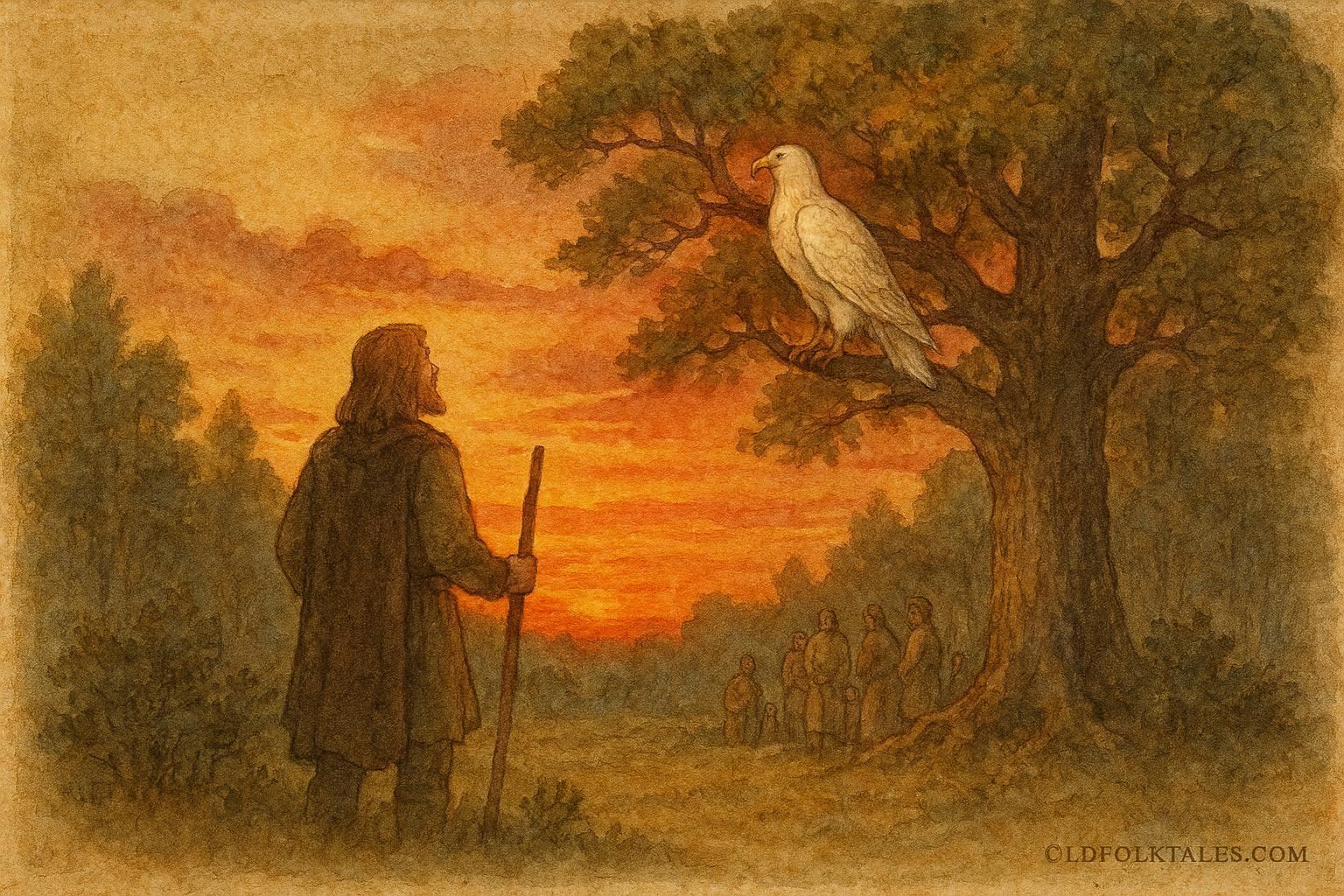
One evening, as the sun began its descent, casting a warm glow across the land, Lech entered a clearing unlike any he had seen before.
The trees opened wide, and at the center stood a great oak, ancient, strong, and deeply rooted in the earth.
Lech slowed his steps.
There was something about this place that felt different.
The air was still, yet alive.
The light was soft, yet radiant.
And then, he saw it.
High upon the branches of the great oak, silhouetted against the sky, was a bird.
A white eagle.
Its wings were spread wide, catching the last light of the setting sun. The sky behind it burned in shades of red and gold, and in that moment, the eagle seemed not merely a creature of the earth, but something greater, something symbolic, something destined.
Lech stood motionless.
The eagle did not flee.
It remained there, strong and unyielding, its presence commanding the space around it.
The red glow of the sky framed its white form, creating a vision so striking that it seemed almost unreal.
Lech felt a certainty settle within him.
This was the place.
Not because it was the easiest land, nor because it was the most fertile, but because it spoke to something deeper, something that could not be measured or explained.
“This is where I will stay,” he said quietly.
He stepped forward, his gaze still fixed upon the eagle.
“This is where my people will build their home.”
As the sun dipped lower, the light deepened, and the image before him became etched into his memory, the white eagle against the red sky, standing above the land that would become his.
In time, others came.
Drawn by Lech’s call, his people gathered in the clearing. Together, they built homes, shaped the land, and laid the foundations of a settlement.
They named it Gniezno, inspired by the nest of the eagle they had seen, a place of beginnings, of shelter, and of life.
The eagle remained more than a memory.
It became a symbol.
Lech chose it as the emblem of his people, a sign of strength, vigilance, and identity. The white eagle, set against a red field, would come to represent not only the land they had claimed, but the spirit with which they had done so.
Years passed, and the settlement grew.
What began as a single vision in a quiet clearing became a thriving center, a place where people lived, worked, and built their future.
And though Lech’s brothers had gone their separate ways, their shared origin was never forgotten.
Czech, in the west, established his own lands, where hills and valleys shaped the life of his people.
Rus, in the east, claimed vast territories, where rivers and plains stretched endlessly.
Together, though separated by distance, the three brothers became the founders of nations, linked by ancestry, divided by destiny, yet united in origin.
Lech, standing in the land of the white eagle, carried that unity within him.
He ruled not with force alone, but with the understanding that his people were part of something larger, something that began long before the clearing, before the journey, before even the parting of the paths.
And so, the image of the eagle remained.
Not only in banners or symbols, but in the hearts of those who called the land their home.
A reminder of where they had come from.
And of the moment when one man looked to the sky, saw a sign, and chose to follow it.
Discover Polish, Russian, Ukrainian, and Belarusian folktales where magic and morality meet
Moral Lesson
Destiny often reveals itself through moments of clarity. True leadership lies in recognizing these signs and building a future that honors both vision and heritage.
Knowledge Check
1. Who were Lech, Czech, and Rus in the folktale?
They were three brothers who set out to find and establish lands for their people.
2. What caused the brothers to separate?
They reached a point where their paths diverged, and each followed a different direction based on their destiny.
3. What vision did Lech see that influenced his decision?
He saw a white eagle perched against a red sunset sky, which he took as a sign to settle there.
4. What is the significance of the white eagle in the story?
It became the emblem of Lech’s people and a lasting symbol of Poland’s identity.
5. What does the name Gniezno represent?
It refers to a “nest,” symbolizing the place where Lech established his settlement.
6. What theme does this legend primarily convey?
It highlights destiny, leadership, and the formation of national identity through shared origins.
Source: Wincenty Kadłubek, Chronica Polonorum (c. 1190–1208)
Cultural Origin: Greater Poland (Gniezno region)