On the borderlands where Salzburg meets Bavaria, there rises a mountain both grand and mysterious, the Untersberg. Its slopes are cloaked in forests, its peaks often veiled in mist, and its caves run deep into the earth like hidden veins. To the people who lived in its shadow, the Untersberg was more than stone and soil. It was a place of secrets, of stories whispered across generations, and of a legend that spoke of time itself standing still.
They said that within the mountain, far beyond the reach of ordinary paths, there lay a hidden kingdom. Not a kingdom of the living, but one suspended between waking and sleep. There, an emperor rested, surrounded by his loyal knights, waiting for a moment foretold, a time when the land would fall into great disorder, and he would rise again to restore it.
No one could say exactly how long they had slept. Some believed it had been centuries, others claimed time did not touch them at all. Yet the story endured, carried by shepherds, travelers, and those who claimed to have glimpsed something extraordinary within the mountain.
One such tale tells of a young shepherd who tended his flock along the lower slopes of the Untersberg. He was a simple man, accustomed to the quiet life of the hills, where days passed in the company of sheep and the steady rhythm of nature. He had heard the stories, of course, every child in the region had, but like many, he considered them little more than old tales meant to pass the long evenings.
One afternoon, as the sun drifted behind a veil of cloud, one of his sheep wandered farther than the rest, disappearing toward a rocky outcrop. The shepherd followed, calling out softly, until he reached a narrow opening in the mountainside, a cave he had never noticed before.
From within, there came a faint glow.
Curiosity stirred within him. Leaving the safety of the open hillside, he stepped inside.
The passage was cool and silent, its walls smooth as though shaped by unseen hands. The glow grew brighter as he ventured deeper, guiding him through twisting corridors that seemed to stretch far beyond the mountain’s surface.
At last, he entered a vast chamber.
What he saw there left him breathless.
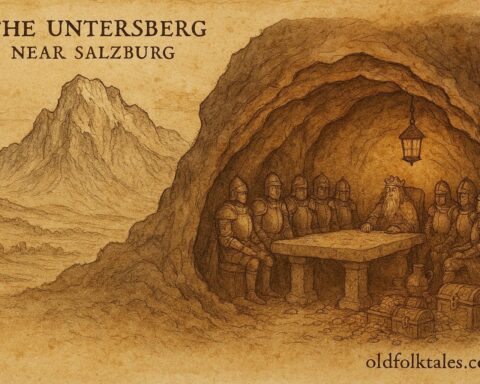
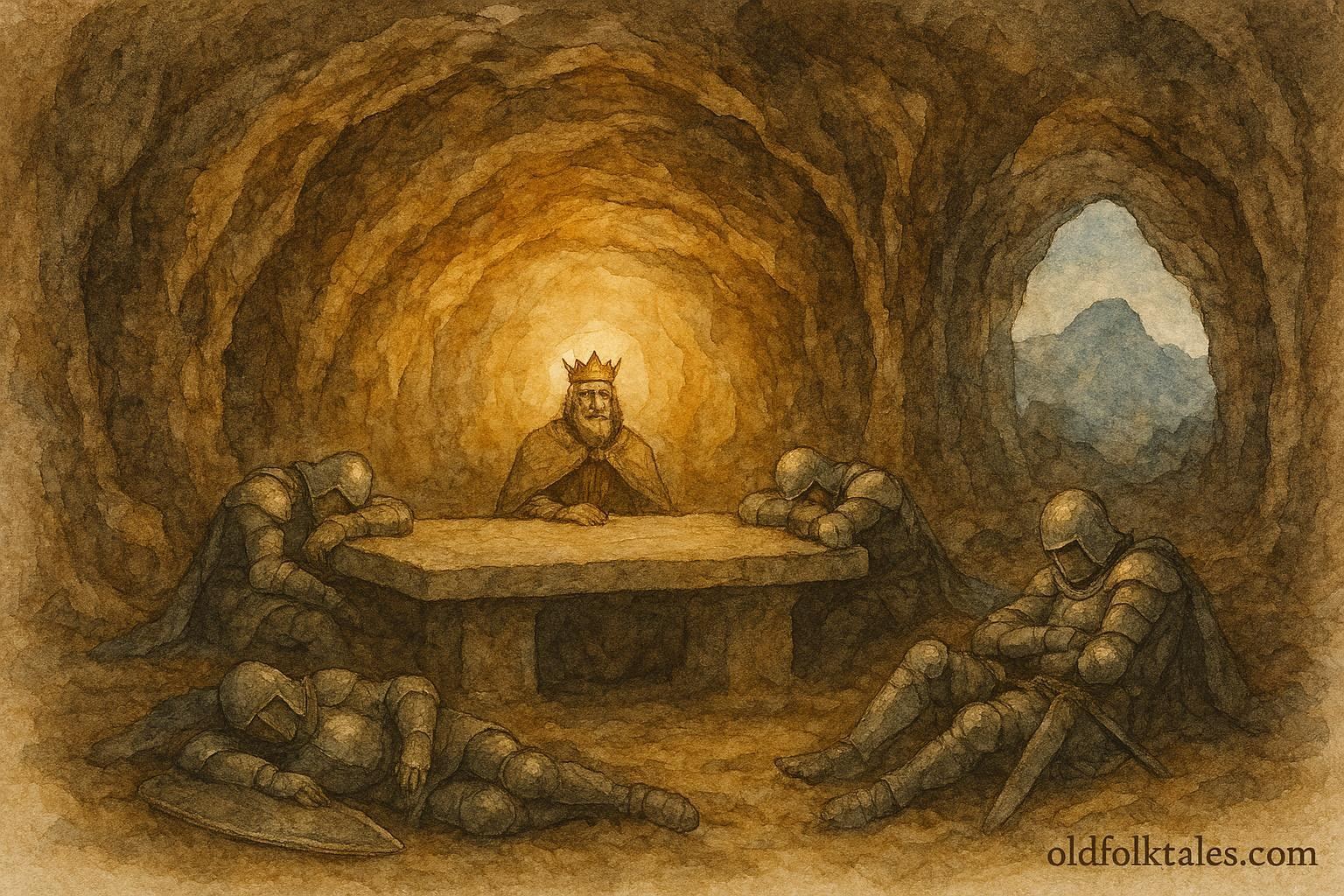
Before him stood a great hall, illuminated by a soft, golden light. At its center was a long stone table, and seated around it were figures clad in armor, knights, motionless, their heads bowed as if in deep sleep. At the head of the table sat a man of regal bearing, his crown resting lightly upon his head, his beard long and flowing, reaching down toward the stone.
The shepherd knew, without being told, that this was the emperor.
The air was still, untouched by time. No dust lay upon the armor, no decay marked the hall. It was as though the moment had been paused, waiting only for something to set it in motion again.
As the shepherd stood in awe, one of the knights stirred slightly. The movement was subtle, almost imperceptible, yet it sent a chill through him. Then the emperor’s eyes opened.
They were calm, steady, and filled with a depth that seemed to hold the passage of centuries.
“Is it time?” the emperor asked, his voice low but resonant.
The shepherd, trembling, shook his head. “No, my lord,” he managed to say. “The world above is still as it has been.”
The emperor regarded him for a moment, then nodded slowly. “Then we must sleep a while longer,” he said.
His eyes closed once more, and the hall returned to its silent stillness.
The shepherd, overwhelmed, turned and fled, retracing his steps through the glowing passage until he emerged once again into the open air. The sunlight struck his eyes, and for a moment, he wondered if what he had seen had been nothing more than a dream.
But when he returned to his village and told his story, the elders listened with grave attention. They did not dismiss his words. Instead, they nodded, as though he had confirmed something they had long believed.
“You have seen what few are permitted to see,” one of them said. “The emperor and his knights sleep still, waiting for the day they are needed.”
Stories like this spread throughout the region, each adding to the legend of the Untersberg Sleepers. Travelers spoke of wandering into caves and losing all sense of time, only to emerge hours, or days, later, unsure of how long they had been gone. Some claimed to hear distant voices echoing through the mountain, while others reported glimpses of armored figures in the shadows.
There were even tales of those who ventured too far and never returned, as though the mountain itself had claimed them.
Yet the legend was not one of fear alone. It carried with it a sense of hope, a belief that, no matter how troubled the world might become, there remained a force waiting to restore balance. The emperor and his knights were not gone; they were merely waiting.
As the years passed, the story became a symbol of endurance. In times of hardship, when wars or struggles weighed heavily upon the land, people would look to the Untersberg and remember the sleeping king. They would say that when the need was greatest, when justice had faltered and order had been lost, the emperor would rise, his knights awakening at his side, ready to bring peace once more.
The mountain itself seemed to guard this secret closely. Its mists would gather without warning, its paths would shift in ways that confused even experienced travelers, and its caves remained as mysterious as ever. Those who approached with respect often found their way safely, while those who treated it lightly sometimes found themselves lost among its slopes.
Generations came and went, yet the legend endured. Children grew up hearing the tale, passing it on as they became elders themselves. The Untersberg stood unchanged, a silent witness to the passage of time, holding within it the promise of something yet to come.
Some said that signs of the emperor’s awakening could be seen in subtle ways, the stirring of winds, the shifting of clouds, or the echo of distant sounds beneath the earth. Others believed that the time had not yet come, that the world above had not reached the moment of need foretold in the stories.
And so the emperor sleeps, his knights beside him, their armor gleaming in the golden light of the hidden hall. The table remains set, the moment suspended, as though awaiting a signal that only time itself can give.
Above them, life continues. Seasons change, people come and go, and the world moves forward. Yet beneath the mountain, all remains still.
The Legend of the Untersberg Sleepers is not merely a story of what lies hidden, but of what may yet come. It speaks of patience, of faith in the future, and of the enduring belief that even in the darkest times, there is something waiting, something that will rise when it is needed most.
And so the people of Salzburg and Bavaria continue to look upon the Untersberg with a mixture of awe and quiet hope, knowing that beneath its silent slopes, a kingdom sleeps, and an emperor waits.
Moral Lesson
The Legend of the Untersberg Sleepers teaches that hope endures even through long periods of uncertainty. It reminds us that renewal and restoration may come in their own time, and that patience and faith are essential in the face of change.
Knowledge Check
- Who are the Untersberg Sleepers?
- An emperor and his knights who sleep בתוך the mountain, awaiting the time to restore order.
- Where is the Untersberg located?
- On the border between Salzburg (Austria) and Bavaria (Germany).
- What triggers the emperor’s awakening?
- A time of great disorder when the land needs restoration and justice.
- What do travelers report about the mountain?
- Strange caves, lost time, and glimpses of a hidden kingdom.
- What themes are central to this legend?
- Hope, restoration, passage of time, and national identity.
- What does the emperor symbolize?
- The promise of renewal and the enduring hope for justice and order.
Source: Austrian oral tradition, documented in 19th-century Alpine folklore anthologies
Cultural Origin: Salzburg and Bavarian border regions