Long before the green hills of Ireland were mapped and measured, when warriors rode beneath open skies and poets were honored as much as kings, there lived a hero named Oisín. He was not only a warrior of the Fianna, those famed champions of Irish legend, but also a poet whose verses carried the memory of battle, beauty, and sorrow alike.
It was on a day of quiet hunting, when mist lay gently across the plains and the air shimmered with late sunlight, that Oisín first saw her.
Across the rolling fields rode a woman unlike any he had ever beheld. Her hair shone like molten gold beneath the sun. Her garments glimmered with colors no earthly loom could weave. She rode upon a white horse so radiant it seemed born of sea foam and light. The warriors of the Fianna paused in astonishment, yet it was Oisín whom she approached.
Her name, she said, was Niamh of the Golden Hair.
She came from Tír na nÓg, the Land of Youth, a place beyond the western sea where sorrow was unknown, where no man aged and no flower faded. There, laughter rang eternal, and the air itself shimmered with joy. She had heard of Oisín’s courage and poetry, and she had come to invite him to her realm.
For Oisín, whose life had been forged in loyalty and adventure, the offer stirred something deeper than curiosity. Niamh’s presence was like music in stillness. The promise of Tír na nÓg shimmered before him, a land beyond time, beyond death.
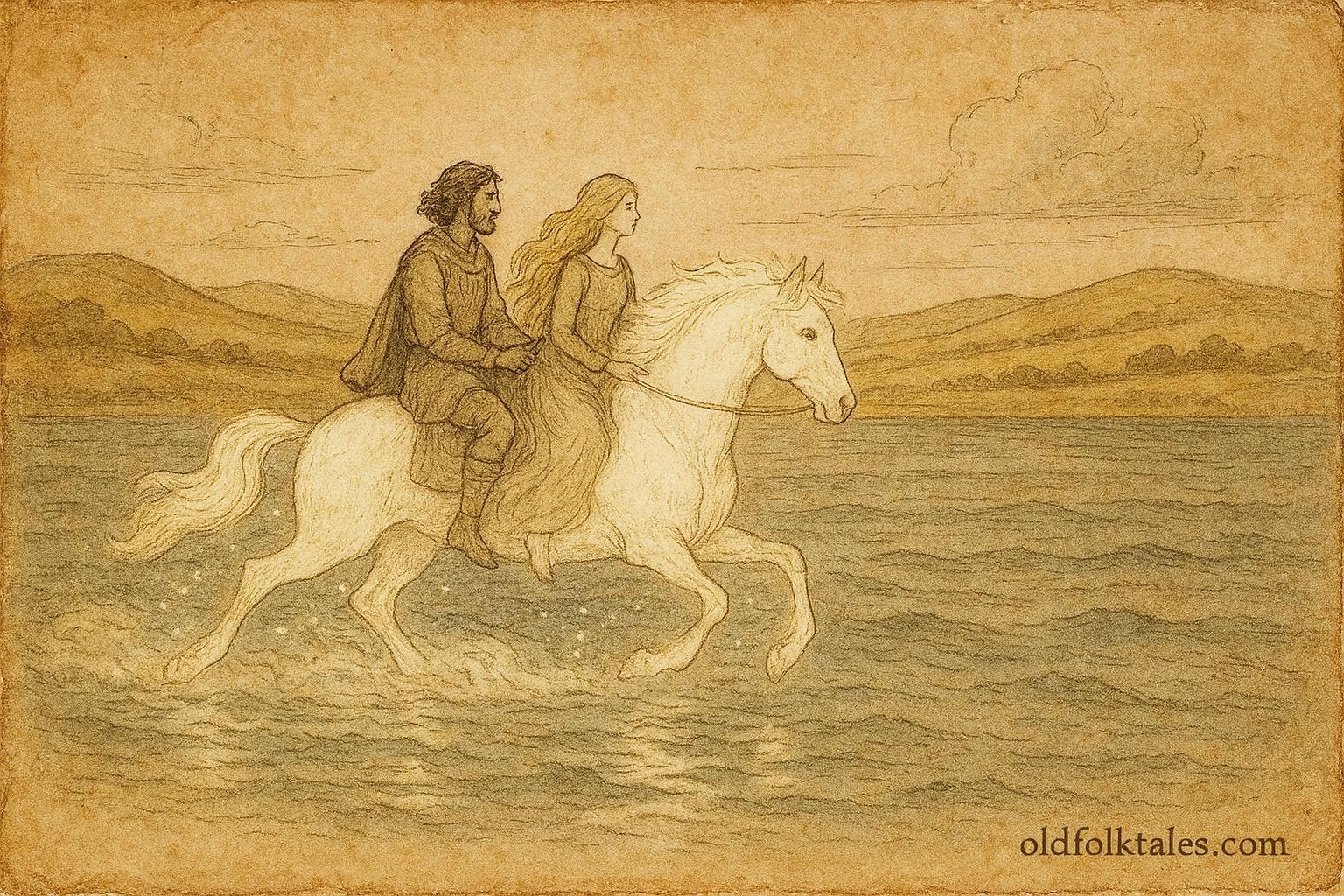
Without hesitation, he mounted the white horse behind her. The creature leapt forward, and together they crossed the sea as though riding over glass. Waves parted beneath them, and Ireland’s green shores faded behind.
Beyond the horizon lay Tír na nÓg.
The land they entered seemed painted from dreams. Hills rolled in endless bloom. Trees bore fruit and blossom together. Rivers ran clear as crystal, reflecting skies untouched by storm. Laughter carried on gentle winds, and the music of unseen harps drifted through golden fields.
Oisín felt strength surge within him. His limbs were light. His spirit soared. Time, that quiet thief of mortal life, had no power here.
He dwelled in Tír na nÓg as husband to Niamh. They hunted in forests untouched by decay, feasted in halls bright with song, and wandered meadows where twilight never fell too swiftly. Years passed, though in that place they felt like moments.
Oisín did not age. His hair remained dark. His arm stayed strong. His heart beat with the steady rhythm of youth unbroken.
Yet memory, even in paradise, does not sleep.
Sometimes, at the edge of laughter, Oisín would think of Ireland, of the Fianna riding beneath stormy skies, of the voice of his father Fionn mac Cumhaill, of the scent of peat fires and the wild cry of hounds across moorland. Though joy surrounded him, a quiet longing grew.
Niamh saw it in his gaze.
At last, Oisín spoke his wish: he desired to return to Ireland, if only for a short while, to see his homeland once more.
Niamh’s face grew grave.
She warned him gently that time moved differently between worlds. Though only a few years seemed to have passed for him, centuries might have unfolded in Ireland. The Fianna he remembered might be gone. The land itself might have changed.
Still, she loved him and would not deny him.
She brought forth the white horse once more and gave strict warning: he must not set foot upon Irish soil. So long as he remained mounted, he would be protected by the magic of Tír na nÓg. But if his feet touched the earth, even for a moment, time would claim him.
Oisín promised.
The white horse carried him across the sea again. Ireland’s shores rose from mist, yet they seemed altered. Forests had thinned. Settlements had grown. Silence hung where once the Fianna had ridden.
He called out for his father. No answer came.
He searched for familiar hills and found them scarred by change. He spoke to strangers who knew nothing of Fionn or the Fianna. To them, those names were legends of distant centuries.
Grief struck him like a blade.
Three hundred years, they told him, had passed.
The Ireland he loved existed only in memory.
As he rode through fields heavy with sorrow, he saw men struggling to lift a heavy stone. Their efforts failed; the weight would not yield. Moved by instinct and kindness, Oisín leaned from his saddle to assist them.
He forgot the warning.
As he bent, the saddle strap broke. His feet struck the earth.
In that instant, the magic vanished.
The years he had escaped rushed upon him with merciless force. His dark hair whitened. His strong back bent. His skin withered like leaves in autumn wind. Before the astonished villagers stood not a warrior of youth, but a frail old man, burdened by centuries.
The white horse vanished.
Oisín lay upon the ground, aged beyond mortal measure.
He was carried gently away, no longer hero but relic. He spoke of Tír na nÓg, of Niamh and eternal fields. Some listened with awe; others with doubt. Yet his sorrow was undeniable.
He had glimpsed immortality and returned to mortality.
His tale became one of Ireland’s enduring legends, a story not only of wonder but of loss. Tír na nÓg remained across the sea, untouched by decay, while Ireland continued its turning seasons of birth and death.
Oisín had known a land where time stood still. But he learned that even paradise cannot sever the bond between a heart and its homeland.
In the end, he belonged to Ireland, and to time.
Moral Lesson
The Legend of Tír na nÓg teaches that no paradise can erase the pull of home, and that time, though relentless, gives life its meaning. Immortality may glitter like gold, but memory and love anchor us to the mortal world.
Knowledge Check
1. What is Tír na nÓg in Irish folklore?
Tír na nÓg is the Celtic Land of Youth, an Otherworld where time stands still and inhabitants never age.
2. Who was Oisín in Irish legend?
Oisín was a warrior-poet of the Fianna and son of Fionn mac Cumhaill.
3. Who brought Oisín to Tír na nÓg?
Niamh of the Golden Hair invited him to the magical Otherworld.
4. Why did Oisín age suddenly upon returning to Ireland?
He touched Irish soil, breaking the magical protection that preserved his youth.
5. How much time had passed in Ireland?
Approximately three hundred years had passed while Oisín believed only a few years had gone by.
6. What is the central theme of The Legend of Tír na nÓg?
The tale explores time, mortality, longing for home, and the bittersweet nature of immortality.
Source: W.B. Yeats, Fairy and Folk Tales of the Irish Peasantry (1888).
Cultural Origin: Ireland (Celtic folklore).