In a village nestled among the rolling hills of Serbia, where the forests were thick with oaks and the streams ran clear and cold, there lived an old man whose body had grown weak with age. His sons, two young men, loved him dearly, but the old man’s strength waned each day, and illness shadowed his steps like a persistent winter fog. The brothers, though close in birth, were different in heart and mind. The elder was ambitious and clever, often impatient with his younger sibling. The younger, however, was calm, sincere, and gentle, beloved by neighbors for his kindness and thoughtfulness.
One evening, as the village slept under a moonlit sky, the old man’s condition grew critical. His sons, desperate to save him, recalled the tales of the forest spirits and enchanted springs whispered by traveling storytellers: there existed two miraculous waters, the Living Water and the Dead Water. The Living Water could heal wounds, cure illness, and restore health. The Dead Water had a stranger power, it could bring the lifeless back to life. Legends told that both were hidden deep in the forests, guarded by fierce beasts, enchanted trials, and unseen forces that tested a seeker’s heart.
Discover the timeless charm of French, Dutch, and Belgian stories filled with cleverness and heart
The brothers agreed to embark on the quest together. They packed lightly, bread, a flask of wine, and a dagger each, and set out at dawn, leaving the village silent behind them. The sun rose behind the hills, spilling gold across the fields, as if blessing their journey, though neither knew what dangers awaited.
The Journey Begins
For days, they traveled through tangled forests where sunlight scarcely touched the mossy floor. Birds sang above, their songs a delicate warning and a guide. They crossed narrow streams, climbed steep slopes, and navigated valleys where shadows lingered longer than the day. At each step, they encountered signs of enchantment: a deer that spoke in riddles, a wolf whose eyes glimmered like amber, and flowers that glowed faintly under the shade of ancient oaks. The elder brother scoffed at these wonders, wishing only to reach the magical waters and claim their power. The younger brother observed quietly, respectful of the forest and its subtle lessons.
After a week, the brothers reached a steep cliff beside a deep, mist-filled gorge. In the legend, the entrance to the waters lay beyond such a chasm. As they gazed down, a bridge of twisting vines and roots appeared, alive with a soft light. The elder, impatient and bold, strode forward without caution, testing each vine carelessly. The younger moved with careful steps, listening to the wind, feeling the sway of the bridge beneath him. That night, they camped beneath a giant oak, sharing bread and water, and the elder’s irritation with caution grew, while the younger felt a quiet certainty that patience would guide them safely.
The First Trial: The Guardian Beast
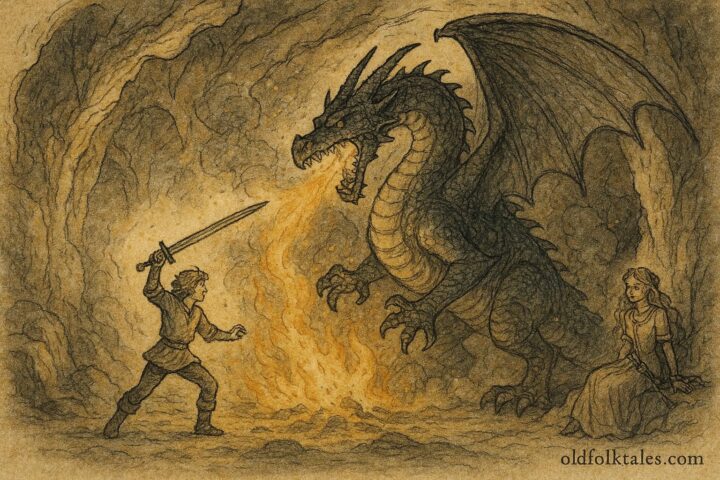
In the following days, the brothers reached a grove shrouded in silver mist. A roar split the air, the guardian beast of the waters had awakened. Its scales shimmered like black glass, its eyes burned with fire, and its claws dug deep into the mossy earth. Many had attempted to reach the waters before, but none had returned. The elder brother charged forward recklessly, trying to strike the beast with his dagger. The creature lashed out, and he barely avoided its claws, though his pride was wounded more than his body.
The younger brother, seeing his sibling’s folly, did not attack. Instead, he kneeled and spoke softly, offering respect and humility. He bowed, his voice clear and gentle, acknowledging the guardian’s strength. Slowly, the creature’s gaze softened, and it stepped aside, revealing a path that glimmered faintly in the moonlight. The elder, ashamed and humiliated, followed silently, recognizing for the first time that force and cleverness alone could not conquer every challenge.
The Living Water
Finally, they reached the first spring. Its waters shimmered like molten crystal, pouring from a stone basin surrounded by glowing ferns. The elder brother leaped forward, dipping a hand hastily into the liquid. The water healed a minor cut on his arm, and he marveled at its magic. The younger brother filled a small flask carefully, thanking the forest and the guardian that allowed them passage. Though tempted to use the water for his own gain, he kept his intention pure: to save his father.
They drank, and the vigor of the Living Water coursed through them. Fatigue faded, and strength returned. Yet even in this triumph, a shadow of caution remained, the Dead Water still awaited, and its power could revive life itself, but only a heart free of selfishness could wield it correctly.
The Dead Water and the Test of Heart
Beyond a valley shrouded in mist, they found the Dead Water. Its surface was eerily still, reflecting the twilight like polished obsidian. As they approached, the legend’s true test appeared: a vision of their father lay beside the water, lifeless and cold. The elder brother, driven by impatience and ambition, seized the flask recklessly. “I will bring him back at once!” he cried, ignoring the forest spirits’ warnings that misuse of the water could bring disaster.
The younger brother intervened, placing a gentle hand on his sibling’s arm. “We must act with care,” he said. “The water’s power answers the heart, not the hand.” But the elder pushed forward and poured the water carelessly onto the vision of their father. Nothing happened. The water’s surface rippled, then sank back into silence, mocking the misuse of power.
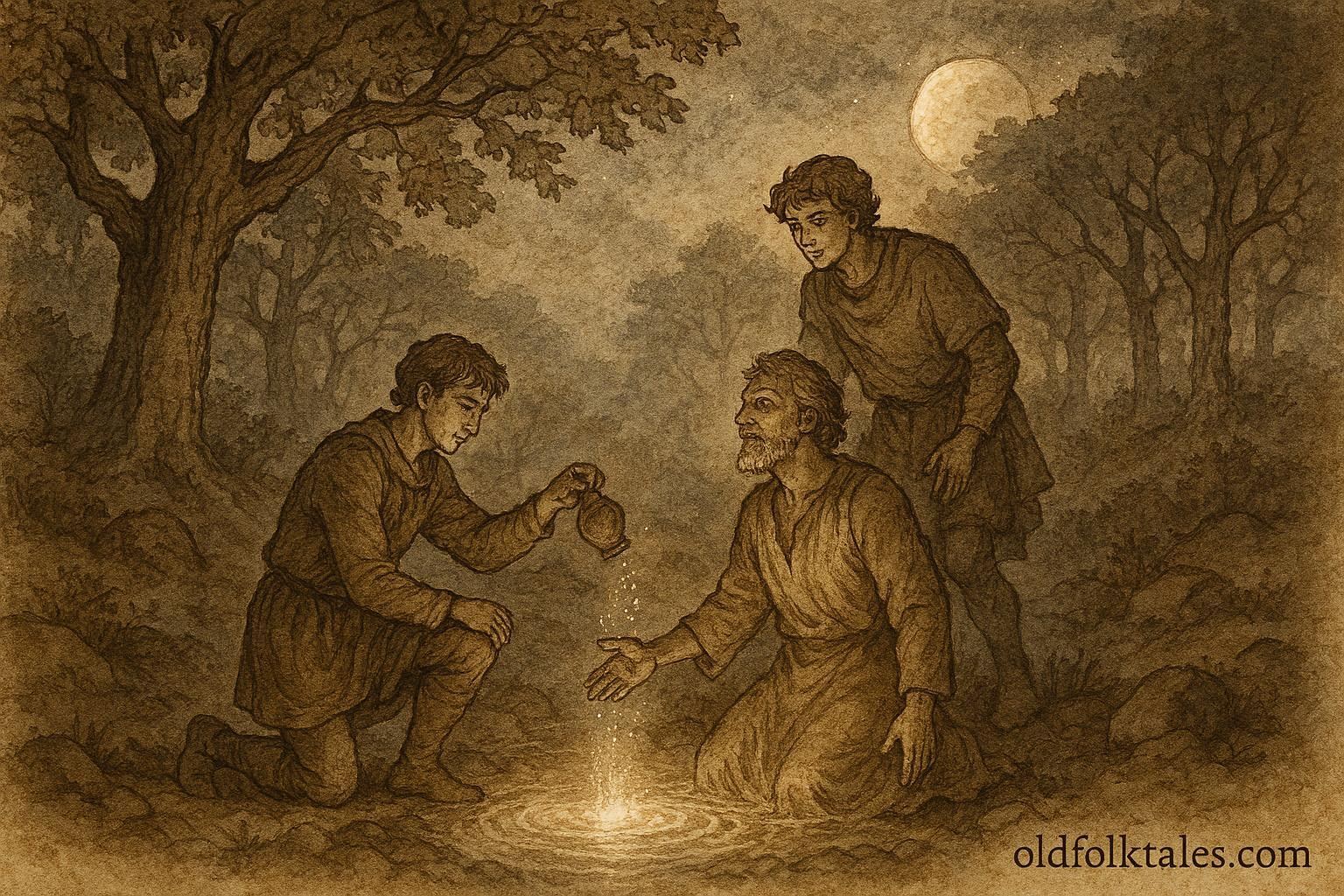
The younger brother knelt beside the Dead Water, closed his eyes, and spoke softly with honesty and love in his heart. He whispered a prayer to the spirits of the forest, acknowledging his father’s life, the sacredness of death, and the purity of intention. Slowly, the water shimmered and glowed. When he sprinkled it over his father’s image, life returned gently, as if dawn itself had touched the lifeless form. The elder brother stood in awe, finally understanding that the greatest magic of all resided in the purity of one’s heart, not in ambition, cunning, or speed.
Betrayal and Forgiveness
The elder brother, humiliated and ashamed, tried to seize credit for the success. He accused his younger sibling of slowing him down and plotting to take the reward for himself. Yet the younger only shook his head gently. “The power of the waters does not answer pride or envy. Only love and humility can heal,” he said.
Faced with such honesty and courage, the elder’s anger faded, replaced by remorse. Together, they carried their father back to the village, each step a lesson in patience and care. Along the way, the elder reflected on his own faults, how his impatience and greed had blinded him to what truly mattered. By the time they reached home, he was a changed man, capable of forgiveness and understanding, not only toward his brother but toward himself.
Return to the Village
When the brothers entered the village, carrying their father alive and well, the townspeople marveled. They recounted the story of the Living and Dead Waters, of the guardian beast, the trials of the forest, and the elder brother’s folly. All eyes turned to the younger brother, whose humility had unlocked the waters’ magic. Yet he refused to boast, sharing praise instead with the forest, the spirits, and the lessons learned along the journey.
The old man, now healed, blessed both sons and praised the younger for his wisdom. The elder, ashamed but enlightened, vowed to live with patience and honesty, understanding that true power is not measured by cunning or strength but by moral clarity and love. From that day forward, the village never mocked the simple-hearted again, recognizing that wisdom often wears a humble face, and that the purity of intention can accomplish miracles.
Moral Lesson
This Serbian folktale teaches that life’s greatest power lies in a pure heart. Ambition, pride, and selfishness cannot unlock true healing, while patience, humility, and love can restore what is lost and reconcile what is broken. Sacrifice, forgiveness, and moral integrity guide one through trials that force both mind and spirit to grow.
Knowledge Check
-
What are the two magical waters in the story?
The Living Water, which heals, and the Dead Water, which revives the dead. -
Why does only the younger brother succeed?
Because his heart is pure, humble, and guided by love, not ambition. -
What does the guardian beast symbolize?
The trials that test courage, humility, and respect for unseen powers. -
How is the elder brother’s character transformed?
Through witnessing the power of moral purity, he learns patience, humility, and forgiveness. -
What is the primary theme of the folktale?
Sacrifice, moral integrity, and the power of a pure heart to restore life and harmony. -
What is the cultural origin of the tale?
Serbian oral tradition, part of South Slavic folklore, compiled by Vuk Karadžić.
Source: Serbian oral tradition compiled by Vuk Stefanović Karadžić (1820s–1850s)
Cultural Origin: Serbia (Balkan Slavic folklore)