In the far northern lands of Finland, where lakes mirror the sky and forests stretch endlessly beneath drifting clouds, there lived a poor farmer with his wife and children. Their home stood near the edge of a vast woodland, close to a quiet lake whose surface lay still even when the wind moved through the trees. Life there was harsh and spare. Winters were long and dark, summers brief but bright, and every blessing came only through patience and hard work.
The farmer rose before dawn each day, cutting wood, tending a thin patch of soil, and fishing when the waters allowed. Though his hands were cracked and his back bent from years of labor, his heart remained gentle. He believed the forest listened, that the lake remembered, and that nothing living should be harmed without need.
One early morning, as pale mist lifted from the lake, the farmer went out to check his fishing nets. The water lay silent, broken only by the soft call of birds waking among the reeds. As he approached the shore, he noticed something unusual, a swan, white as new snow, tangled helplessly in a thicket near the water’s edge.
Its wings beat weakly, and its dark eyes shone with fear.
The farmer stopped.
He knew well the old stories, how swans were sacred creatures, messengers between worlds, bound to magic older than memory. Many would have turned away in fear or seized the bird for meat or feathers. But the farmer felt only concern.
“Be still,” he said softly, though he did not know why he spoke aloud. “I will not harm you.”
The Swan Revealed
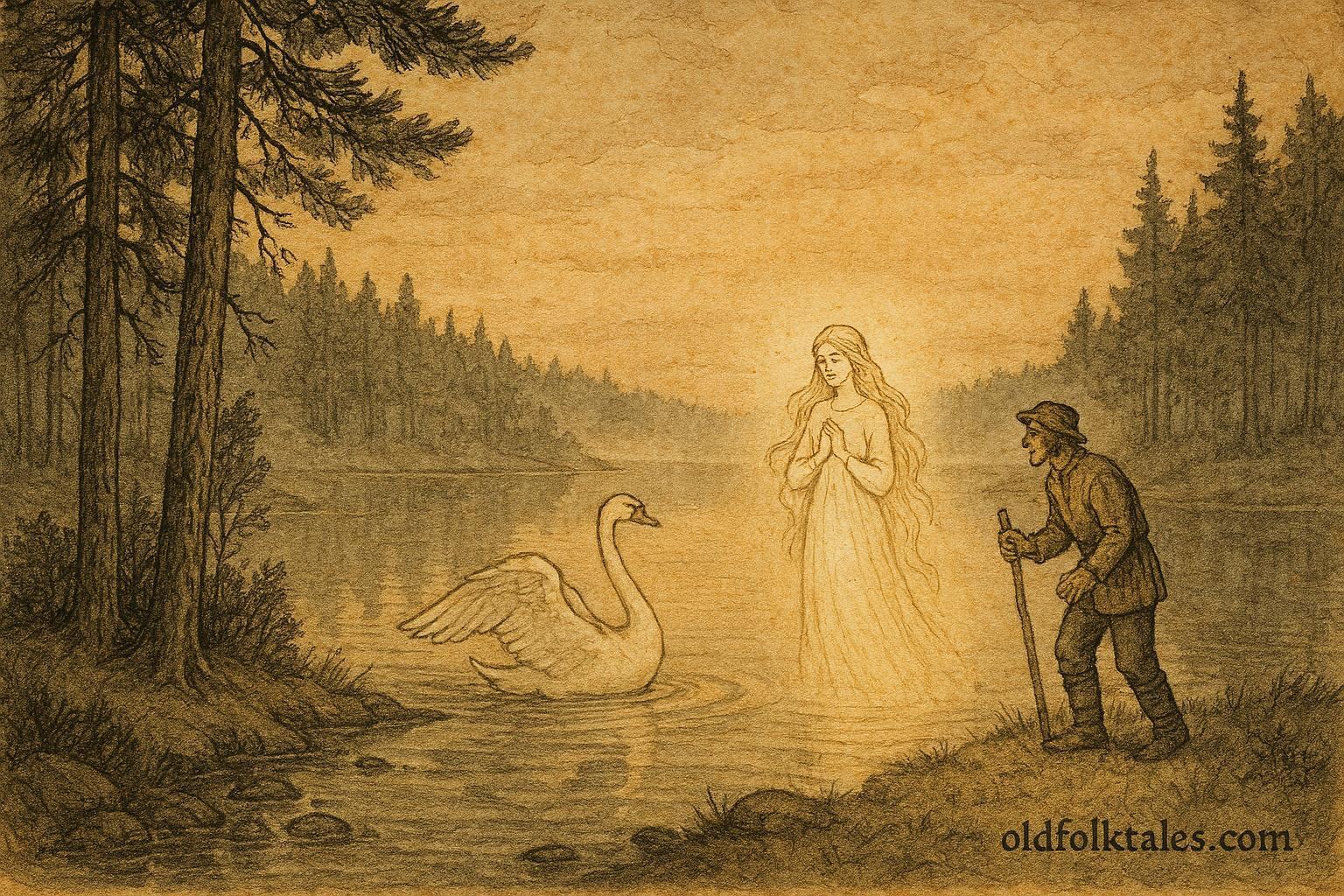
Carefully, he approached and freed the swan from the branches. As his hands touched its feathers, the air around them grew strangely warm, and the mist thickened. The bird stilled, and in a breath longer than a heartbeat, the swan transformed.
Before him stood a young maiden, pale and radiant, her hair shining like moonlight on water. She wore no crown, no fine garments, yet her presence carried quiet power, as if the lake itself had risen to speak.
The farmer staggered back in awe.
“Do not fear,” the maiden said, her voice gentle as wind through reeds. “I am bound to the shape of the swan, but I am not wholly of this world.”
The farmer bowed his head, trembling.
“You were trapped,” he said simply. “That is reason enough to help.”
The maiden smiled.
“Few would have done as you did,” she replied. “Greed and fear often guide human hands.”
A Pact of Trust
The maiden explained that evil forces, dark spirits jealous of her freedom, sought to bind her forever in animal form. She had fled to the lake, but even there they pursued her.
“You protected me without knowing who I was,” she said. “For that, I will stay and bring fortune to your house, so long as you never betray my trust.”
The farmer agreed without hesitation.
“My home is poor,” he said, “but you will find no cruelty there.”
Thus, the maiden came to live among them, moving between swan and human form as the seasons turned. She worked quietly beside the farmer’s wife, mended nets, gathered herbs, and taught the children songs that seemed to echo with ancient rhythms.
Soon, strange blessings followed.
Fortune Through Harmony
The fields grew richer than they ever had before. Fish filled the nets. The forest yielded berries and game in abundance, yet never more than was needed. The farmer noticed that whenever he took only what was necessary, the land responded with generosity.
The maiden often walked alone by the lake at dawn and dusk, speaking softly to the water and the wind. The farmer did not ask questions. He remembered his promise.
But word spread.
Neighbors whispered of the family’s good fortune. Some came to observe; others came to spy. Envy crept quietly through the village like frost through soil.
One night, the farmer overheard strangers speaking near the lake, murmuring of capturing the swan and forcing her magic for their own gain.
Fear tightened his chest.
Confronting the Darkness
That very night, the evil forces returned.
The lake churned beneath a blackened sky. Cold wind lashed the shore, and shadows gathered between the trees. The maiden stood at the water’s edge in swan form, trembling.
“They have found me,” she said. “Their power grows when humans desire what is not theirs.”
The farmer stepped forward, planting his feet firmly on the ground.
“You will not take her,” he said, though terror filled him. “This land does not belong to you.”
The shadows hissed and recoiled, not from strength, but from resolve. The farmer had chosen protection over gain, loyalty over fear.
At dawn, the storm passed. The lake stilled. The forest breathed again.
The Swan’s Gift
When morning came, the maiden appeared one final time.
“My time among humans must end,” she said softly. “But because you honored trust and balance, your family will never know hunger or despair.”
She returned to the lake, transforming once more into the white swan. With a final glance, she glided across the water and vanished into the mist.
From that day on, the farmer’s family lived in quiet prosperity. They spoke little of the swan, but every spring, when white birds returned to the lake, they bowed their heads in gratitude.
And the land remembered them kindly.
Moral Lesson
This folktale teaches that kindness given without expectation invites harmony, and that true fortune flows from respect for nature, trust, and restraint rather than greed or force.
Knowledge Check
-
Why does the farmer help the swan?
Because compassion guides him, not fear or greed. -
What does the swan symbolize in Finnish folklore?
A sacred bridge between nature, magic, and humanity. -
Why does fortune come to the farmer’s family?
They live in harmony with nature and honor trust. -
What threatens the swan maiden?
Evil forces driven by jealousy and human greed. -
Why does the maiden eventually leave?
Balance must be restored between worlds. -
What cultural value does the story emphasize?
Respect for nature and moral restraint.
Source: Collected in Suomalaisia Kansansatuja, 1880s
Cultural Origin: Finnish oral storytelling tradition