In a quiet Norwegian valley surrounded by pine forests and silver rivers, there once lived a poor widow and her three sons. Though their cottage was small and their meals were simple, the mother raised her boys to value honesty, hard work, and courage above all riches.
As the sons grew into young men, it became clear that the valley could not support them all. One by one, they set out to seek their fortunes.
The eldest found work with a carpenter. He labored faithfully and, after serving diligently, received an unusual reward: a simple wooden table. At first glance, it appeared plain. But his master told him, “Speak the words, ‘Table, set yourself,’ and you shall never know hunger again.”
The young man tested it and gasped in wonder. At his command, the table covered itself with roasted meats, fresh bread, steaming porridge, and sweet cakes. Grateful and proud, he began the journey home.
But on the road stood an inn where a sly and greedy innkeeper watched travelers carefully. When the eldest brother demonstrated the table’s power, the innkeeper’s eyes gleamed. That night, while the young man slept, the innkeeper swapped the magic table with an ordinary one.
When the brother returned home and proudly commanded, “Table, set yourself,” nothing happened. His mother looked at him in confusion, and shame burned his face. Believing he had been tricked by fate, he left again in disappointment.
Soon the second brother departed. He apprenticed himself to a miller and, after faithful service, received a donkey as his reward. It was no ordinary beast.
“Say the word ‘Bricklebrit,’” the miller told him, “and gold coins will fall from its mouth.”
The young man spoke the word, and shining gold pieces spilled onto the ground. Overjoyed, he hurried home, stopping at the same inn.
The innkeeper watched, calculating. That night, he exchanged the magical donkey for one just like it but entirely ordinary.
When the second brother arrived home and spoke the magic word, nothing happened. The donkey brayed stubbornly, and no gold appeared. His humiliation matched his brother’s, and he too left home in frustration.
At last, the youngest son, quiet but sharp-eyed, set out into the world. Unlike his brothers, he spoke little and observed much.
He entered service under a traveling craftsman who understood more of the world’s secrets than he first revealed. After a season of honest work, the craftsman handed him a plain sack.
“This,” he said, “contains justice. When you say, ‘Cudgel, out of the sack!’ it will leap forth and strike until you command it to return.”
The young man tested it carefully. At his words, a sturdy cudgel sprang out and began striking the air fiercely before returning to its place when dismissed. He nodded thoughtfully.
On his journey home, he too stopped at the inn.
The innkeeper, recognizing opportunity, prepared to steal again. But the youngest son was not as trusting as his brothers. He allowed the innkeeper to think he was careless. That night, as expected, the innkeeper crept into his chamber to exchange the sack.
Before the thief could finish, the young man awoke and calmly spoke the words:
“Cudgel, out of the sack!”
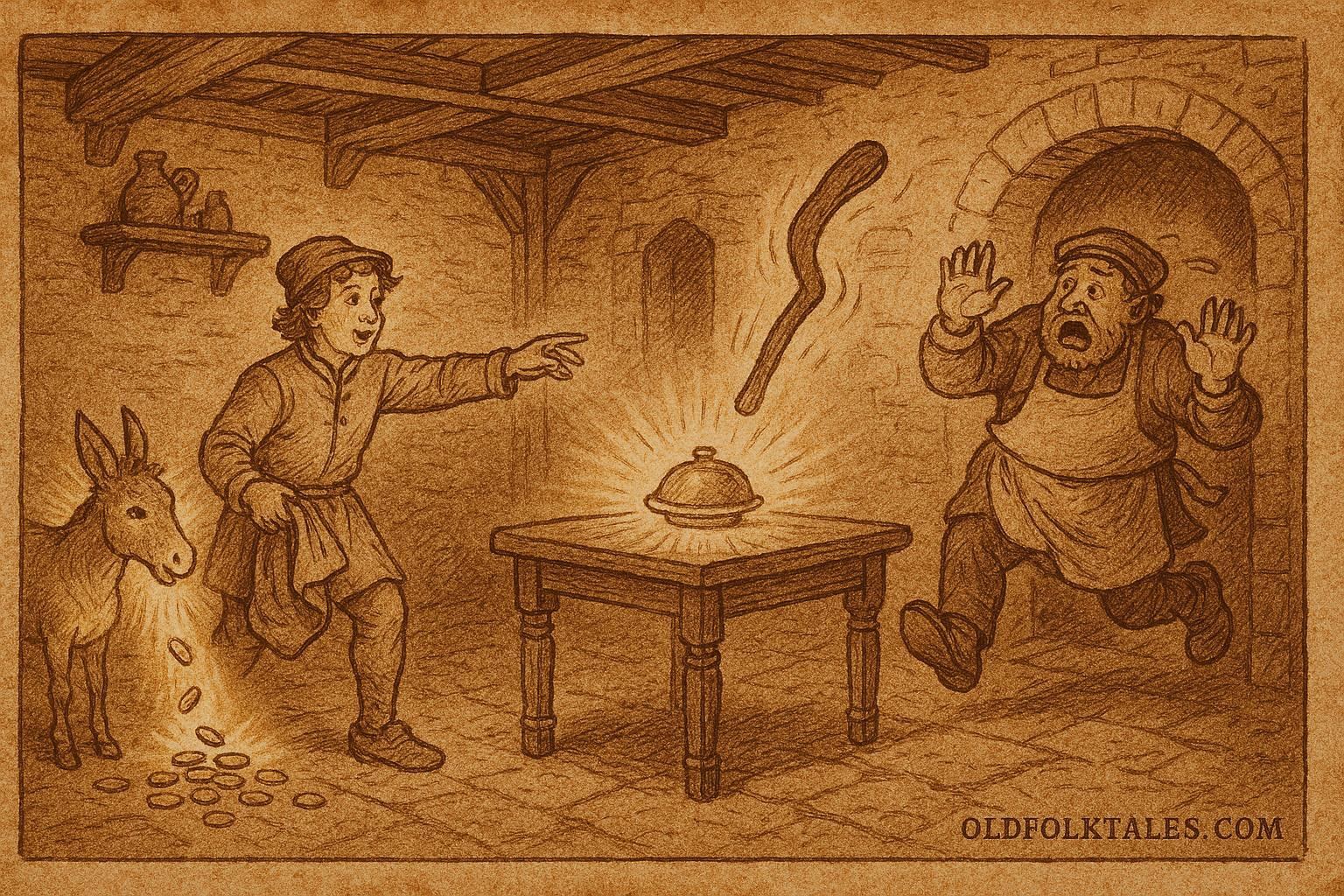
The cudgel burst forth with fury and began striking the innkeeper soundly. Tables overturned, chairs cracked, and the innkeeper howled for mercy.
“Stop it! Stop it!” he cried.
But the cudgel did not cease until the young man commanded it.
Bruised and trembling, the innkeeper begged forgiveness and returned the stolen magic table and gold-donkey at once.
Justice had found him.
The youngest son reclaimed his brothers’ rightful treasures and returned home triumphant. When the magic table set itself and the donkey produced shining gold, his mother wept with joy. The brothers embraced him, ashamed of their earlier doubts.
Word of these marvels spread far beyond the valley, reaching even the king’s ears. Curious, and somewhat suspicious, the ruler summoned the young man to court.
The king was a proud and often greedy man. When he witnessed the table’s bounty and the donkey’s gold, he began to scheme. He proposed impossible tasks, hoping to seize the treasures for himself.
But each time deception threatened, the young man quietly warned, “Cudgel, out of the sack,” and justice swiftly corrected dishonesty.
The court soon understood that the youth could not be cheated. Even the king recognized that fairness was wiser than greed.
Impressed by the young man’s courage, cleverness, and unwavering sense of justice, the king offered reconciliation instead of rivalry. In time, the youngest son earned the trust of the court — and the admiration of the princess.
She valued his intelligence and integrity more than his magical possessions. Their marriage was celebrated across the kingdom, and with the help of the enchanted objects, prosperity flourished not only for them but for the people as well.
The magic table ensured no one went hungry. The gold-donkey supported the poor. And the cudgel remained ready, not for cruelty, but to defend fairness when needed.
Thus, the once-poor youngest son rose not through strength alone, but through wisdom, patience, and justice rightly applied.
And in the valley beneath Norway’s vast skies, his story was told for generations as proof that cleverness guided by morality brings lasting prosperity.
Discover the moral heart and wild spirit of the north through timeless Nordic storytelling
Moral Lesson
True wealth lies not merely in magical gifts but in the wisdom to use them justly. Courage and cleverness can overcome greed and injustice, but integrity ensures that victory benefits everyone.
Knowledge Check
1. What magical objects does the youngest son possess?
A magic table, a gold-producing donkey, and a cudgel hidden in a sack.
2. What lesson does the cudgel represent in the story?
It symbolizes justice, power used to correct wrongdoing rather than to harm.
3. Who originally steals the magical items?
A greedy innkeeper who swaps them with ordinary objects.
4. How does the youngest son succeed where his brothers fail?
He uses observation, caution, and cleverness instead of blind trust.
5. What themes define this Norwegian folktale?
Justice triumphing over greed, cleverness defeating injustice, and responsible use of power.
6. Who collected this folktale and when?
It was collected by Asbjørnsen & Moe in 1845 as part of Norwegian folklore traditions.
Source: Norwegian folktale collected by Asbjørnsen & Moe, 1845
Cultural Origin: Norway