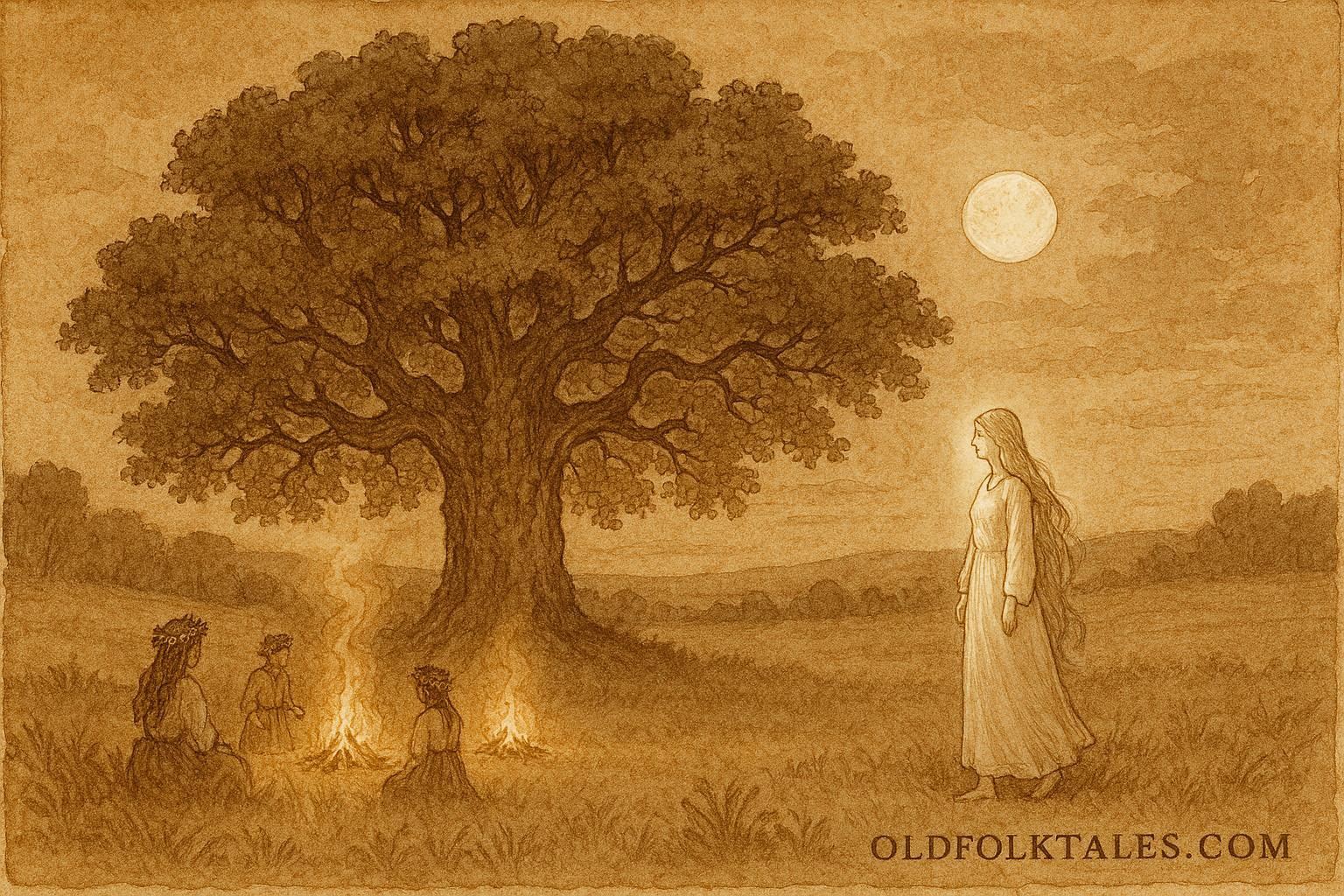
In the deep countryside of Belarus, where rolling meadows meet shadowed forests and rivers move like silver threads beneath the summer sun, there stands, so the elders say, an oak older than memory itself. Its trunk is wide as a cottage wall. Its bark is split with age. Its branches stretch outward like protective arms over the clearing where villagers gather each midsummer. Long before church bells rang across the land, long before crosses were raised above village chapels, this oak was already sacred. And beside it, on the night of Kupala, the Maiden appears.
The Night of Kupala
Kupala Night, celebrated at the height of summer when the sun lingers long and twilight glows like embers, has always held a special place in Belarusian life. It is a night of fire and water, of wreaths and songs, of memory and mystery.
Young women weave crowns of wildflowers, cornflower, chamomile, fern fronds. Young men gather wood for bonfires that crackle beneath the stars. Couples leap across flames hand in hand, testing the strength of their bond.
Some speak of hidden treasures that rise to the surface. Others search for the mythical fern flower, said to bloom only at midnight.
But the oldest villagers speak in quieter tones of something far older than treasure.
They speak of the Maiden of the Sacred Oak.
The First Whisper
No one remembers when she was first seen. The story travels through generations, carried like pollen on the wind.
“She stands beside the oak,” the grandmothers say. “Her hair is long as flax. Her dress moves like mist between branches.”
She does not speak loudly. She does not demand worship.
She watches.
And she blesses.
But only those who honor the old ways truly see her.
The Clearing Beneath the Oak
The oak stands at the edge of a meadow where wild grasses bow in the breeze. On Kupala Night, villagers bring garlands and set small offerings of bread and honey at its roots, customs older than the chapel bell that now tolls from the distant hill.
Christian prayers mingle with ancient songs. Crosses hang beside woven charms of straw. No one sees contradiction. The land remembers both.
As twilight deepens into violet dusk, flames begin to rise. Children laugh. Elders hum old refrains.
And sometimes, just sometimes, the air grows still.
That is when she appears.
The Maiden Revealed
Those who claim to have seen her describe her as neither ghost nor mortal woman.
Her presence is warm, yet distant. Her eyes hold neither anger nor mercy but knowing.
She stands beside the oak as if grown from its roots. The leaves above her shimmer without wind.
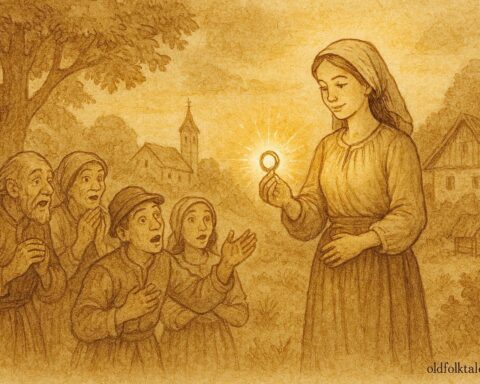
One year, a widowed woman approached the tree in quiet reverence. She pressed her palm to the bark and whispered gratitude for the harvest.
When she lifted her eyes, she saw the Maiden standing there.
The figure inclined her head gently. No words were spoken.
The next morning, the widow’s sick cow rose to its feet after weeks of weakness.
Another year, a young couple leapt the fire with sincerity, asking blessing for their union. The Maiden was glimpsed between the branches, wreaths glowing faintly in her hands.
Their marriage endured many winters.
But not all come with reverence.
The Mockery
As generations passed and towns grew larger, some returned from distant markets scoffing at village customs.
“It is only superstition,” they muttered. “Trees do not listen.”
One Kupala Night, a group of young men, half-drunk and careless, laughed loudly near the oak. They mocked the offerings of honey and bread.
One even kicked aside a wreath laid at the roots.
“Let your forest maiden show herself!” he jeered.
The wind shifted.
The bonfire sputtered low though the wood was dry.
For a moment, silence spread across the clearing like shadow.
No Maiden appeared.
But before dawn, one of the mockers wandered from the meadow into the forest and lost his way. Though he walked familiar paths, they twisted strangely. He did not find his village until sunrise.
When he returned pale and shaken, he spoke little.
Others who mocked found their wreaths drifted into the river and sunk instead of floating freely. Crops that year grew thin.
The elders did not scold.
They simply nodded.
“The oak remembers,” they said.
The Blending of Beliefs
Belarusian folklore often carries the echo of older faith beneath Christian prayer. The Maiden of the Sacred Oak is not named a goddess, nor called a saint.
She is something in between.
A guardian of continuity.
A witness to reverence.
The oak itself symbolizes endurance. In Slavic belief, sacred trees were meeting places between earth and sky. They were living altars long before stone churches stood nearby.
On Kupala Night, fire purifies. Water renews. And the oak stands as memory.
The Maiden’s appearance affirms that the past is not dead, it breathes beneath ritual.
A Year of Blessing
One midsummer, a young girl named Marta approached the oak alone. She had woven her wreath carefully, selecting each flower with intention.
Her family had fallen on difficult times. The winter had been harsh; grain stores were thin.
She knelt and laid her wreath at the roots.
“I do not ask for riches,” she whispered. “Only enough.”
As midnight bells from the chapel rang faintly in the distance, she felt warmth along her cheek, as if brushed by a gentle hand.
She opened her eyes.
The Maiden stood beside the oak, luminous in moonlight. Not solid, not shadow, something between.
For a heartbeat, the two regarded one another.
Then the figure faded like dew under morning sun.
That year, Marta’s family harvested more grain than expected. Their well never ran dry.
She never boasted of what she had seen.
And that is why, the elders say, her blessing remained.
The Meaning of Disappearance
The Maiden does not punish with spectacle. She does not curse openly.
She withdraws.
And in Belarusian belief, withdrawal of blessing is misfortune enough.
When villagers cease honoring Kupala traditions, when bonfires burn without gratitude, when wreaths are tossed carelessly, the clearing feels emptier.
The oak remains.
But the Maiden is unseen.
Not because she has vanished.
Because reverence has.
The Sacredness of Seasonal Rites
Kupala Night marks the height of life’s cycle. It is a reminder that seasons turn whether acknowledged or not. But communities who pause to honor the turning remain grounded in continuity.
The Maiden represents that continuity.
She blesses those who understand that traditions are not burdens but bridges, connecting ancestors to descendants.
Sacred trees stand longer than human memory. Ritual keeps memory alive.
And so, each year, even now, wreaths are woven. Fires are lit. Honey and bread are placed gently at the oak’s roots.
Some see nothing unusual.
Others claim the leaves shimmer though wind is still.
And somewhere between firelight and moonlight, the Maiden waits.
Discover Polish, Russian, Ukrainian, and Belarusian folktales where magic and morality meet
Moral Lesson
Traditions endure not through fear, but through reverence. When communities honor the sacred rhythms of nature and memory, harmony flourishes. When mockery replaces gratitude, blessings quietly fade.
Knowledge Check
1. Who is the Maiden of the Sacred Oak?
A folkloric spirit associated with Belarusian Kupala Night who blesses those honoring seasonal rites.
2. What does the oak tree symbolize in Slavic tradition?
Strength, continuity, and the connection between earth and sky.
3. Why do some villagers fail to see the Maiden?
Because mockery and disrespect close the path to her blessing.
4. What is Kupala Night in Belarusian folklore?
A midsummer celebration blending pagan and Christian traditions with fire, water, and wreath rituals.
5. How does the Maiden respond to irreverence?
She withdraws her blessing rather than delivering overt punishment.
6. What central theme does this folktale convey?
Reverence for tradition sustains harmony across generations.
Source: Mikhail Federowski, Folk Beliefs of the Belarusian People, 1901.
Cultural Origin: Belarusian Kupala Night midsummer ritual folklore.