In a quiet village nestled among the rolling hills of Wallonia, there stood an old mill by a narrow river. Its wooden wheel, once strong and steady, had begun to creak with age, and its sails turned more slowly with each passing season. The mill belonged to a man who had inherited it from his father, a hardworking miller who had known better days.
But now, fortune had abandoned him.
The harvests had been poor for years, and fewer farmers came to grind their grain. The sacks of wheat that once filled the mill lay replaced by empty corners and silence. The miller worked tirelessly from dawn until dusk, yet no matter how hard he labored, his earnings barely kept hunger from his door.
Inside the small cottage beside the mill lived his daughter, a bright and thoughtful young woman who shared her father’s burdens without complaint. Though their lives had grown difficult, she remained kind and hopeful, doing what she could to ease his worries.
Still, the miller’s despair deepened.
Night after night, he sat alone by the dim glow of a candle, staring at the worn wooden table, his mind consumed by one question: How could he escape this life of hardship?
It was on such a night, when the wind whispered strangely around the mill and the river seemed to murmur with unnatural voices, that a visitor came.
The Devil’s Offer
A knock sounded at the door, soft at first, then firmer.
The miller hesitated. Few people visited at such an hour.
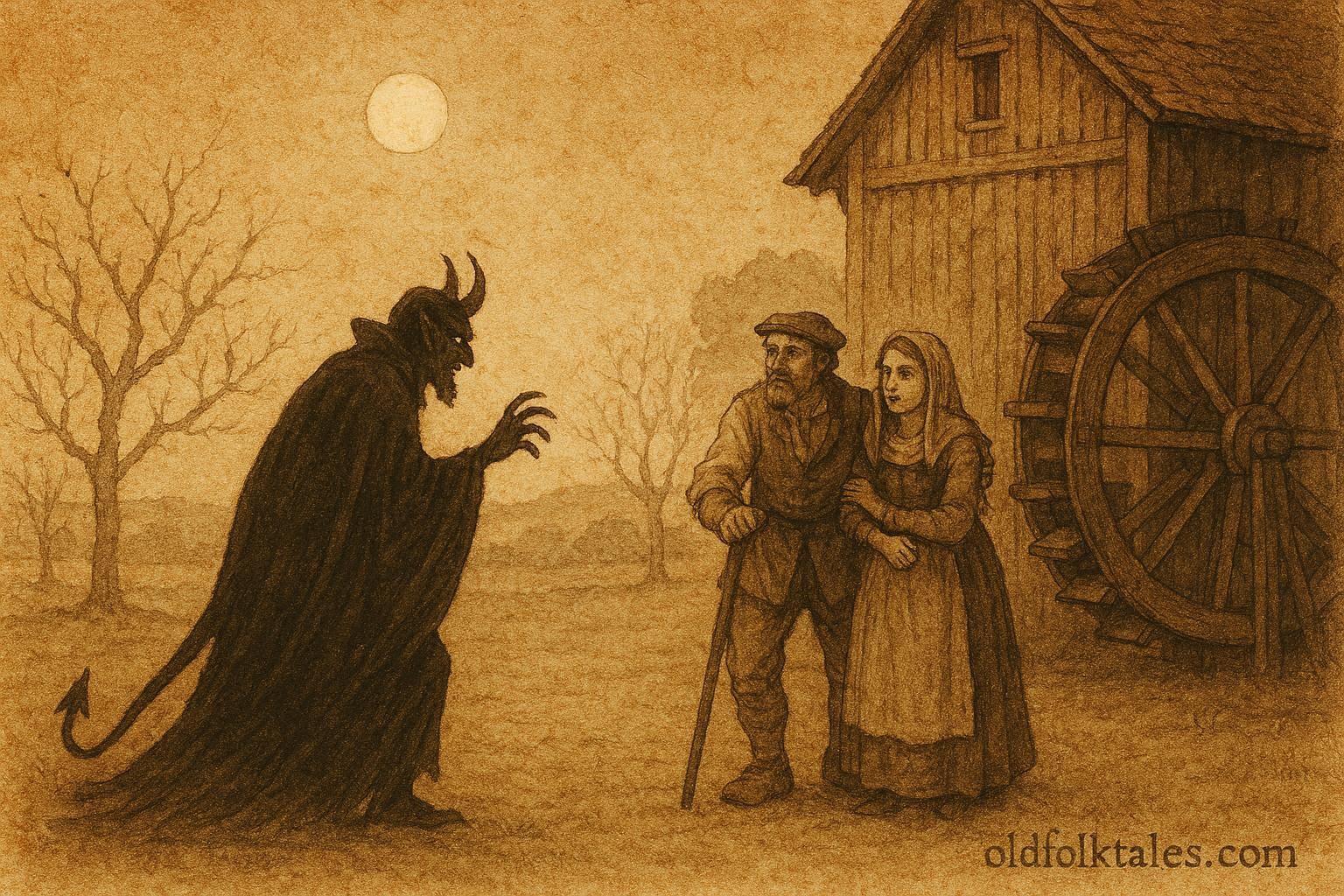
When he opened the door, he found a stranger standing in the darkness. The man was well-dressed, far more finely than anyone in the village, his coat untouched by dust or rain despite the weather. His eyes held a sharp gleam, and his smile was too smooth to be comforting.
“Good evening,” the stranger said, his voice calm and measured. “I have heard of your troubles.”
The miller stiffened. “There is nothing here worth your concern.”
“Oh, but there is,” the man replied, stepping inside without waiting for an invitation. “A man with such determination, such need… surely you would welcome a solution.”
The miller felt unease stir within him, yet he did not turn the man away.
“What kind of solution?” he asked cautiously.
The stranger’s smile widened.
“Wealth,” he said simply. “More than you could earn in a lifetime. Your mill restored, your home filled, your worries ended.”
The miller’s heart pounded.
“And what would you ask in return?” he said.
The man paused, as though savoring the moment.
“Only what stands behind your mill,” he answered.
The miller frowned. Behind the mill lay a small orchard, old trees that had long ceased to bear fruit of value. Compared to the promise of wealth, it seemed a trivial price.
“You may have it,” the miller said at last.
The stranger extended his hand.
“Then we have an agreement.”
Reluctantly, the miller took it.
The moment their hands touched, a chill ran through him. The candle flickered violently, and for a brief instant, the stranger’s shadow stretched unnaturally along the wall, twisting into something far darker than human.
Then the stranger was gone.
Wealth and Realization
By morning, everything had changed.
The mill wheel turned with renewed strength, its creaking replaced by smooth, powerful motion. The sails caught the wind as if guided by unseen forces. Inside, sacks of grain appeared as though delivered by invisible hands, and soon farmers began arriving once more, drawn by rumors of the mill’s sudden prosperity.
Gold filled the miller’s chest. Food lined his table. For the first time in years, he knew comfort.
But his relief did not last.
As he stood outside his mill one afternoon, watching the sunlight fall across the land, his daughter came walking from behind the building, carrying a basket of freshly gathered herbs.
She paused when she saw his troubled expression.
“Father, what troubles you?” she asked gently.
The miller’s breath caught.
Behind the mill.
The words echoed in his mind like a curse.
He looked at his daughter, his only child, who often spent her time tending the small space behind the mill.
A cold realization settled over him.
The orchard had not been empty after all.
It had been hers.
The Weight of the Bargain
The miller’s joy turned to dread.
Days passed, and though his wealth grew, he found no comfort in it. Every sound in the night made him start, every shadow seemed to move with hidden purpose. He avoided looking at his daughter, unable to bear the guilt that weighed upon him.
At last, he told her everything.
She listened in silence, her face pale but steady.
When he finished, the room felt unbearably still.
“You made a bargain with the devil,” she said quietly.
The miller bowed his head.
“I did not understand,” he said. “I thought it was only the orchard. I did not know…”
His voice broke.
His daughter placed a hand on his shoulder.
“What is done cannot be undone by regret alone,” she said. “But perhaps it can be undone by thought.”
The miller looked up, hope flickering faintly.
“You are not the first to be deceived,” she continued. “And the devil, for all his cunning, is bound by the bargains he makes.”
The Devil Returns
On the appointed night, the wind rose once more, carrying with it the same unnatural whisper.
The stranger returned.
This time, there was no pretense of courtesy. His presence filled the room with a heavy, suffocating weight.
“I have come to claim what is mine,” he said.
The miller trembled, unable to speak.
But his daughter stepped forward.
“You may claim only what was agreed,” she said calmly.
The devil’s eyes narrowed.
“And what was agreed,” he replied, “stands behind the mill.”
“Yes,” she said. “But you did not name it. And a bargain must be clear.”
A flicker of irritation crossed his face.
“I know what stands there,” he said.
“Do you?” she replied. “Then take it.”
The Clever Escape
The devil turned and walked toward the back of the mill.
The night air was thick with tension as he stepped into the orchard.
But what he found there was not what he expected.
The space had been cleared. The ground, once filled with trees and familiar paths, was now empty, altered so completely that nothing remained as it had been.
The daughter stood at a distance, watching.
“You see,” she said, “what stood behind the mill no longer stands there. The terms of your bargain have not been fulfilled.”
The devil’s expression darkened.
“You think to outwit me with tricks?” he said.
“I think only to hold you to your own words,” she replied.
For a long moment, the air seemed to tremble with unseen force.
Then the devil let out a low, cold laugh.
“You are clever,” he said. “Clever enough to escape this bargain.”
His gaze shifted to the miller.
“But remember this, such bargains always carry a cost.”
With that, he vanished, leaving behind only the echo of his voice and the fading whisper of the wind.
Freedom Restored
The miller collapsed with relief, his burden lifted at last.
The wealth that had come so suddenly began to fade, as though it had never truly belonged to him. The mill returned to its former state, not ruined, but honest, sustained once more by hard work rather than unnatural means.
Yet this time, the miller did not despair.
He worked with renewed purpose, guided by the lesson he had learned. His daughter remained by his side, her wisdom and strength a constant source of support.
Though they were no longer wealthy, they were free.
And in that freedom, they found something far greater than gold.
Discover the timeless charm of French, Dutch, and Belgian stories filled with cleverness and heart
Moral Lesson
This Wallonian folktale teaches that greed can lead to dangerous choices, but redemption is possible through wisdom and integrity. It also highlights the power of family loyalty and clever thinking in overcoming even the darkest bargains.
Knowledge Check
- What deal did the miller make in the Belgian folktale?
He made a bargain with the devil, trading what stood behind his mill for wealth. - Why did the miller regret his decision?
He realized too late that his daughter stood behind the mill and was part of the bargain. - How did the miller’s daughter outsmart the devil?
She argued that the agreement was unclear and changed the space behind the mill, preventing the devil from claiming anything. - What role does the daughter play in the story?
She represents wisdom and loyalty, ultimately saving her father through clever thinking. - What theme does the devil represent in this folktale?
He symbolizes temptation, deception, and the consequences of greed. - What is the main lesson of the Miller and the Devil’s Bargain?
That greed leads to danger, but cleverness and family support can bring redemption.
Source: Collected in Belgian Folk Tales and Legends by Eugène Monseur, 1892
Cultural Origin: Belgium (Wallonia region)