Along the rugged Atlantic coast of Portugal, where towering cliffs rise above restless waves and sea winds carry both salt and prayer, there stands a place long held sacred: Nazaré. Before it became known for its vast ocean swells and fishing traditions, it was remembered for something far more profound, a miracle granted at the very edge of a cliff.
This is the story of divine intervention, faith tested in a breathless instant, and gratitude that shaped a sanctuary.
Discover the moral heart and wild spirit of the north through timeless Nordic storytelling
The Hunt in the Fog
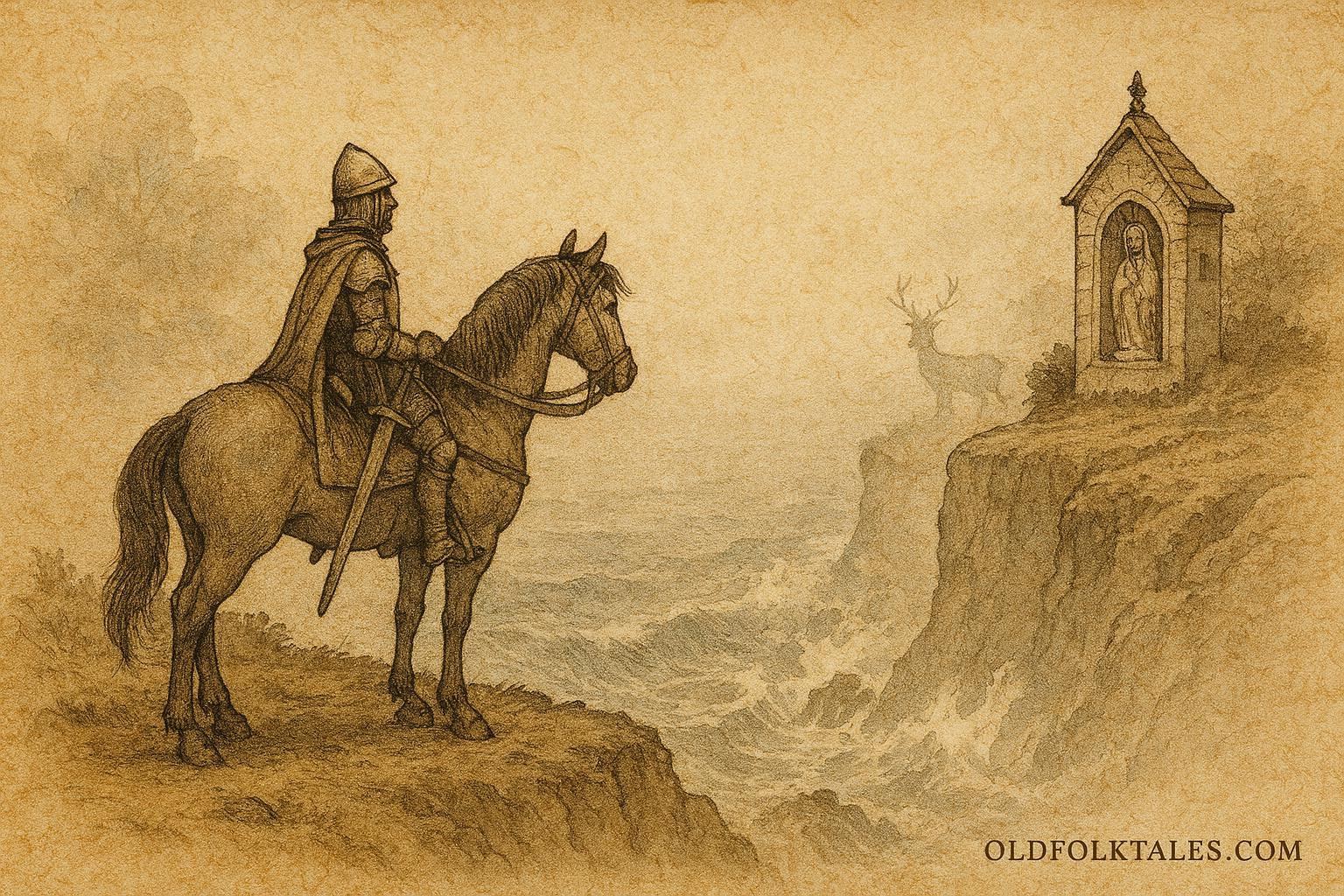
In earlier centuries, when Portugal’s knights still rode through pine forests and open hills in pursuit of game, a nobleman of rank and devotion set out on horseback near the cliffs of Nazaré. It was a day suited for the hunt. The earth was damp beneath hoof and boot, and the scent of the sea drifted faintly inland.
The knight was no reckless youth. He was known for courage, skill, and a sincere devotion to the Virgin Mary. Yet on that day, his focus was fixed on a deer, swift and graceful, its form darting between brush and stone.
The animal appeared almost luminous against the grey landscape. With hounds trailing and heart stirred by the chase, the knight urged his horse forward. The deer leapt across uneven terrain, weaving toward higher ground where the cliffs loomed beyond.
Then the fog came.
It rolled in from the Atlantic without warning, thick and blinding. Within moments, the horizon vanished. The forest thinned into open land, yet the knight saw only white haze before him. Still the deer’s faint shape flickered ahead.
Driven by instinct and momentum, he pressed on.
The Edge of the Cliff
The sound of the sea grew louder. Though hidden by fog, the crashing waves below struck the rocks with relentless force. The ground beneath the horse’s hooves shifted from soil to hardened stone.
And then, suddenly, the deer vanished.
There was no brush to conceal it, no turn in the path. It had simply disappeared.
The knight realized too late where he was. His horse surged forward one final stride, and the fog thinned just enough for him to see the terrible truth: he stood at the very edge of a towering cliff. Beyond lay open air and the churning Atlantic far below.
In that suspended moment between life and death, there was no time for skill, no strength sufficient to reverse the gallop. The drop was sheer; the path behind uncertain in the mist.
Faced with certain disaster, the knight did the only thing left within his power.
He prayed.
The Prayer
“Holy Virgin,” he cried, calling upon Our Lady with the devotion that had guided him throughout his life, “if it be Thy will, save me.”
There was no elaborate plea. Only faith spoken plainly in a heartbeat of desperation.
His horse halted.
Not gradually. Not with the sliding stumble of hooves on stone. The animal stopped as if anchored to the earth itself, its front legs poised at the very brink of the precipice. Pebbles scattered downward into the unseen depths, swallowed by the roar of waves.
The knight trembled in the saddle. Before him stretched emptiness; behind him lay the fog-veiled path he had taken without thought. One more step, and both horse and rider would have plunged into the sea below.
Yet they remained.
Silence, save for wind and water, filled the air.
Slowly, carefully, the knight guided his horse backward from the edge. When at last he reached safer ground, he dismounted and fell to his knees. The fog swirled around him like a curtain drawn between worlds.
He knew, beyond doubt, that he had been spared.
The Sacred Image
Not far from that very cliff there existed an image of the Virgin Mary long venerated in the region. Preserved through earlier generations and carried by devotion, it was already considered holy by those who knew its story.
In that hour of deliverance, the knight resolved that gratitude must take form, not remain merely in words. To be spared from certain death demanded remembrance and honor.
He returned home shaken yet alive. Word of his narrow escape traveled quickly through the region, woven with awe and reverence. Those who heard it did not speak only of chance. They spoke of intervention.
And so, in thanksgiving, a shrine was built near the site of the miracle. It stood close to the cliff’s edge, overlooking the vast Atlantic, both a memorial to the event and a testament to Marian devotion.
The place became known not merely for danger avoided, but for grace received.
A Site of Pilgrimage
As years passed, the story did not fade. It grew.
Travelers came to see the cliff where the knight’s horse had halted. They stood near its brink, gazing down at waves that still thundered against stone. The fog, at times, still rolled in heavy and swift, veiling land and sea alike.
The shrine stood as witness.
Within it, the sacred image of Our Lady of Nazaré drew pilgrims from villages near and far. Fishermen prayed for safety before launching into uncertain waters. Families offered candles in gratitude for answered prayers. Mothers brought children to kneel before the image, teaching them the story of the knight who had been saved by faith.
The site transformed from a place of peril into one of hope.
Where once a man nearly rode to his death, generations found reassurance that divine mercy could intervene at the very edge of disaster.
The Meaning of the Cliff
The legend of Nazaré endures not because of spectacle alone, but because it speaks to a universal human experience: the moment when control slips away.
The knight was skilled. He was brave. Yet neither strength nor training could halt a galloping horse in thick fog at the brink of a cliff. In that instant, he stood powerless.
It was prayer that bridged the impossible distance between danger and safety.
In Portuguese coastal life, where fishermen daily confront unpredictable seas, the lesson resonated deeply. The Atlantic is both provider and threat. Cliffs are both beautiful and deadly. Faith became the steady ground beneath uncertain steps.
And so the miracle was remembered not as defiance of nature, but as harmony between heaven and earth.
Nazaré’s Enduring Devotion
Through centuries, the devotion to Our Lady of Nazaré continued. Records from the early seventeenth century documented the miracle, preserving what oral tradition had long carried. The year 1609 marked formal acknowledgment in religious chronicles, yet the story itself reached further back into the memory of the people.
The shrine grew in significance. The site became sacred, not merely for its dramatic geography, but for what it represented: divine protection granted in response to sincere faith.
Even today, visitors standing at Nazaré’s cliffs feel both awe and humility. The ocean stretches vast and restless. The wind hums along stone walls. And somewhere within that landscape echoes the prayer of a knight who trusted in the Virgin at the very brink of death.
Explore the warmth and wit of Mediterranean storytelling, where love and wisdom intertwine
Moral Lesson
The Miracle of Our Lady of Nazaré teaches that faith offered in sincerity can transform moments of terror into testimonies of gratitude. When human strength fails, trust in divine mercy can become the anchor that holds us steady at life’s most dangerous edges.
Knowledge Check
1. What caused the knight’s life-threatening situation in the Nazaré legend?
He was chasing a deer in heavy fog and nearly rode off a coastal cliff.
2. What saved the knight from falling?
He prayed to the Virgin Mary, and his horse stopped at the very edge of the cliff.
3. Where does this miracle take place?
In Nazaré, Portugal, along the Atlantic coastal cliffs.
4. What was built in gratitude after the miracle?
A shrine dedicated to Our Lady of Nazaré.
5. What themes are central to this Portuguese coastal legend?
Divine intervention, faith, gratitude, and Marian devotion.
6. When was the miracle formally documented?
It was recorded in 1609, though preserved earlier through oral tradition.
Source: Chronicled in 17th-century religious records (documented in 1609) and preserved in regional lore.
Cultural Origin: Nazaré, Portugal.