In the sunlit streets of Sicily, where balconies overflow with flowers and the scent of citrus drifts through warm air, there was once a young woman whose beauty was spoken of from Palermo to Caltagirone. She lived quietly, tending her home and her garden, her days shaped by routine and modest grace. Her balcony, adorned with vibrant plants, looked out over a narrow street alive with voices and passing travelers. It was there that she first saw him.
He was a foreigner, dark-eyed, striking, and unfamiliar to the rhythms of Sicilian life. His garments and manner marked him as a Moor, a traveler from distant lands. He walked with confidence, yet there was something measured in his gaze, as though he studied everything he passed.
When his eyes lifted and met hers, something shifted.
Days turned into whispered conversations. He passed beneath her balcony again and again. Words were exchanged softly at first, curious, cautious. Soon, curiosity deepened into affection. He spoke of distant horizons, of cities across the sea, of spices and markets and desert winds. To her, whose life had been bounded by familiar stone walls and village bells, his stories were like music carried on foreign air.
She believed him sincere. He praised her beauty, admired her intelligence, and swore devotion. In the privacy of her home, their affection blossomed into love. The people of the street saw little more than a foreigner lingering too often below her balcony, but they whispered all the same.
For a time, she knew only joy.
Yet truth, as Sicilian legends remind us, rarely hides forever.
One evening, as the sun dipped low and painted the sky in amber and rose, she overheard words that shattered her world. The Moor, speaking carelessly, revealed that he had a wife waiting in his homeland. His journey to Sicily was temporary. His promises were fleeting. When he departed, he intended to leave her behind, nothing more than a memory of passion beneath the Sicilian sun.
The betrayal struck deeper than anger. It pierced her honor.
In the traditions of Sicily, love and pride intertwine fiercely. To be deceived was not merely to suffer heartbreak; it was to endure humiliation. The trust she had given freely had been taken lightly.
She did not confront him in rage. Instead, she grew silent.
When next he came to her home, smiling with the ease of a man confident in his charm, she welcomed him as before. Her voice was steady. Her gestures calm. She listened to his words without interruption.
But beneath that calm burned resolve.
The legend tells that during the night, while he slept unsuspecting, she acted. In a dramatic and terrible assertion of justice, she ended his life. In doing so, she reclaimed her dignity and transformed betrayal into something unforgettable.
Yet the story does not end in violence alone. It turns toward transformation.
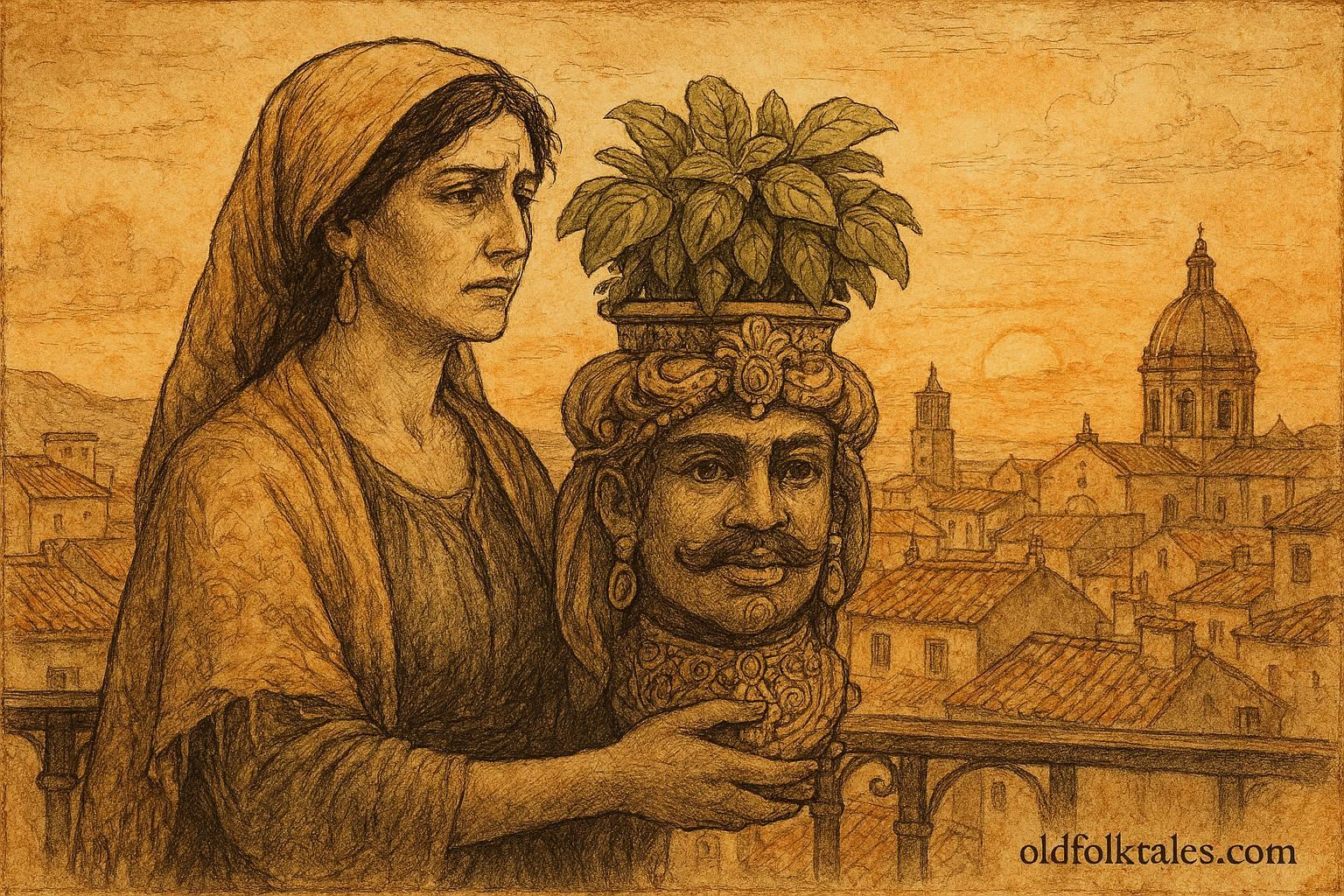
Refusing to let his deceit vanish into obscurity, she severed his head and fashioned it into a vessel. She hollowed it carefully and filled it with soil. Within it, she planted basil, sweet, fragrant basil that flourished under the Sicilian sun.
Each day, she watered it with devotion.
The basil grew lush and vibrant, its leaves thick and green, spilling over the edges of the vessel. Neighbors noticed its extraordinary beauty. They admired the unusual planter, crafted in the shape of a Moor’s head. Some whispered of its origin; others simply marveled at its artistry.
Over time, the image of the Moor’s head became more than a personal relic. It became a symbol.
In Caltagirone, famed for its ceramics, artisans began crafting ornate vases shaped like Moorish heads, adorned with crowns, intricate patterns, and vibrant glazes. In Palermo, balconies were decorated with similar figures, watching over streets and homes. These ceramic Teste di Moro stood as reminders, not merely of love and betrayal, but of memory preserved in art.
The woman’s act, though born of sorrow, transformed into cultural emblem.
The Moor’s head came to represent vigilance, pride, and the refusal to allow betrayal to pass unmarked. It symbolized a fierce sense of honor deeply rooted in Sicilian identity,, a reminder that passion and consequence are forever entwined.
Centuries passed. The story softened at its edges, retold in marketplaces and homes, embroidered with details yet always anchored in its core: a woman deceived, a lover unmasked, a symbol born from betrayal.
Travelers to Sicily today still see the ceramic Moor’s heads gazing from balconies and doorways. Some are crowned as kings and queens, paired together as decorative companions. Their expressions are regal, enigmatic. They have become art, beautiful, intricate, almost playful.
Yet beneath the glaze and ornament lies the memory of a legend.
A story of love that crossed cultural boundaries.
A story of deception unveiled.
A story of honor fiercely defended.
In the warm light of Sicily, where history lingers in stone and tile, the Moor’s head remains not only a decorative motif but a narrative carved into clay—a reminder that art can preserve the passions and lessons of the past.
And so the legend endures, passed from generation to generation, whispered among the very balconies where it is displayed.
Moral Lesson
This Sicilian folktale teaches that betrayal carries consequences and that honor, once wounded, seeks restoration. It also reveals how memory can be transformed into art, preserving lessons of love, pride, and retribution across generations.
Knowledge Check
-
What is the central conflict in The Moor’s Head legend?
A Sicilian woman discovers her foreign lover intends to abandon her for his wife back home. -
What action does the woman take after learning of the betrayal?
She kills him and transforms his head into a basil planter. -
What does the basil symbolize in the story?
Memory, transformation, and enduring consequence. -
How did the legend influence Sicilian art?
It inspired the creation of ceramic Moor’s head vases, especially in Caltagirone and Palermo. -
What themes are central to this Sicilian folktale?
Honor, betrayal, pride, justice, and symbolic transformation. -
When and where was this legend recorded?
In 19th-century Sicilian folklore collections, including those documented in the 1870s.
Source: Sicilian oral tradition documented in 19th-century folklore collections, including works by Giuseppe Pitrè (1870s).
Cultural Origin: Sicily (Caltagirone and Palermo traditions).