In the rolling hills and dense forests of Flanders, Belgium, animals lived with a mix of harmony and rivalry. Among them, the fox was renowned far and wide for its cunning and cleverness, a creature whose sharp mind often saved it from danger. One day, as the sun glittered on the morning dew, the fox gathered the woodland creatures. With a sly grin, he made a bold proclamation.
“You all believe yourselves cunning,” the fox said, “but there is one being far cleverer than any of us, the man-animal, the human. No bear, no wolf, nor even the wisest owl can match the wit of a human.”
The forest fell silent. The animals, proud of their own strengths, were unwilling to accept this claim without proof. Among them, the bear, a hulking figure of brute strength and courage, stepped forward. “Then I shall see for myself,” he rumbled. “If this human is as cunning as you say, I will witness it with my own eyes.”
The fox, his tail flicking with amusement, agreed. “Go then,” he said, “but remember, the mind often triumphs over might.”
The bear lumbered out of the forest, his heavy paws sinking into the soft earth, his breath misting in the crisp morning air. He wandered through fields and along winding streams, searching for the man whose craftiness had been spoken of in whispers. Hours passed, and at last, he came upon a small village where a human was tending his farm.
The bear approached boldly, intending to test his strength and perhaps intimidate the man. But the human, quick of mind and steady of hand, noticed the looming shadow and devised a plan. First, he pretended not to see the bear, then he spoke in a calm, commanding voice as though addressing a friend. “Ah, you must be weary from your long journey. Come, share some water with me, and we shall rest together.”
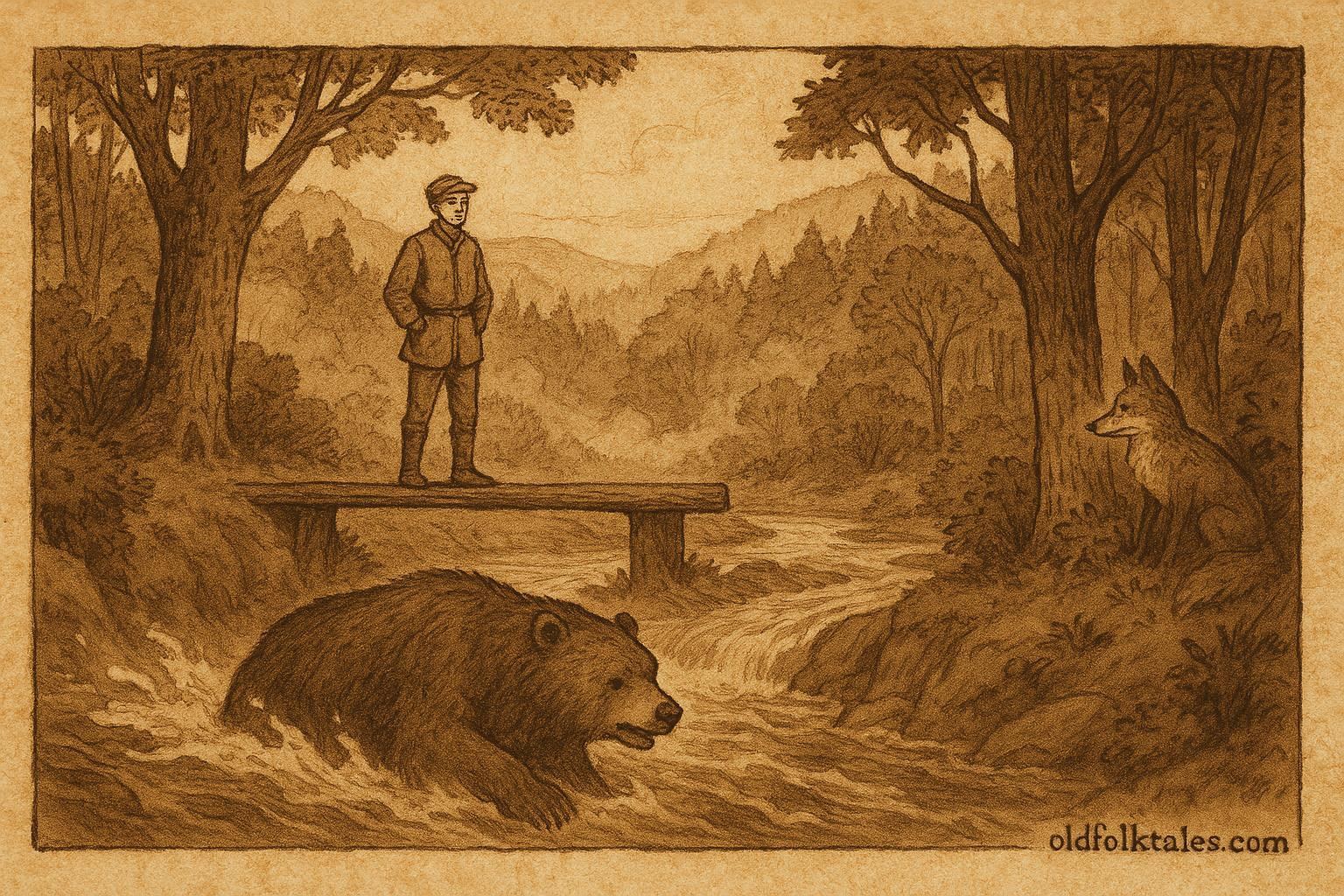
The bear, unaccustomed to such diplomacy, paused. Curiosity mingled with caution, and he stepped closer. The man led him to a narrow bridge over a rushing river. “Be careful on the bridge,” the human said, feigning concern. “It cannot hold the weight of a bear!”
Trusting the words, the bear stepped onto the bridge. As he did, the man’s clever construction—a bridge that could only bear the weight of a human—bent and groaned. With a startled roar, the bear slipped, plunging into the river below. The human, calm as ever, pulled a rope to steady him and guided the soaked, humbled bear to shore.
So astonished was the bear at being outwitted that he could not hide his amazement. “Indeed,” he admitted with a reluctant bow of his massive head, “this human is cunning beyond measure. The fox spoke true.”
The bear returned to the forest, dripping and humbled, and recounted his encounter. The animals listened, wide-eyed, as he described the human’s cleverness, his calm mind, and the ingenious bridge. The fox, of course, watched with barely concealed amusement, knowing that wit could always triumph over sheer strength.
From that day forward, the fox’s reputation as a truth-teller grew even greater, and the animals learned to respect the cunning of humans. Though they remained proud of their own abilities, they never again doubted the cleverness of the man-animal.
Moral Lesson
“The Most Cunning Animal” teaches that intellect and cleverness can outmatch even the strongest or fiercest. True wisdom lies not in raw power, but in strategy, foresight, and the ability to think beyond immediate strength.
Knowledge Check
- Who claims that humans are the most cunning?
The fox, known for its cleverness, asserts that the human is far more cunning than any animal. - Which animal sets out to test the fox’s claim?
The bear, confident in his strength, decides to witness the human’s cleverness firsthand. - How does the human outsmart the bear?
By luring the bear onto a fragile bridge and guiding him carefully, the human uses strategy to humble the stronger animal. - What does the bear’s reaction reveal about the story’s message?
The bear’s amazement and admission show that wisdom and cunning can surpass brute force. - What symbolic role does the fox play in the tale?
The fox represents intelligence, foresight, and the ability to understand the value of wit over physical power. - How does this folktale reflect Belgian storytelling traditions?
It showcases clever animals, moral lessons about intellect versus strength, and a naturalistic forest setting, common in Flemish folklore.
Cultural Origin: Belgian folktale, Belgium
Source: Adapted from Jean de Bosschère’s collection Folk Tales Collected in Flanders, mythcloud.eu