Long ago, in a Romanian land of wooded hills and wide valleys, there lived an old man whose life had been shaped by years of honest labor and quiet endurance. His cottage stood at the edge of a village where time passed slowly, marked by the rhythm of seasons and the tolling of church bells. Though age had bent his back and silvered his hair, his eyes remained clear, and his spirit steady. He spoke little, listened much, and treated every creature he met, human or otherwise, with courtesy.
One year, troubling news spread across the kingdom. The king’s orchards had begun to fail. Trees bore little fruit, rivers ran thin, and the people feared that famine might follow. It was then that an old legend resurfaced, spoken in whispers and half-remembered songs: deep beyond the dark forests stood a tree that bore golden apples, fruits said to restore balance and prosperity wherever they were planted.
Explore the wit and wisdom of Western Europe, where humor and virtue often go hand in hand
The king issued a decree throughout the land. Whoever could bring him a golden apple would be rewarded with riches and honor. Many young men set out, armed with swords and bold words, yet none returned. Some vanished into the forest; others came back shaken, unwilling to speak of what they had seen.
The old man listened quietly to these tales. He did not desire wealth, nor did he trust reckless ambition. Yet he understood the suffering of the land and felt a sense of duty stir within him. Without ceremony or announcement, he prepared for the journey. Taking only a walking staff, a loaf of bread, and a flask of water, he set out at dawn.
Through the Enchanted Forest
The forest was older than memory. Its trees stood tall and close together, their branches weaving a canopy that dimmed the daylight. Strange sounds echoed through the undergrowth, and the air carried the scent of damp earth and moss. Each step forward felt like crossing a boundary between the ordinary world and another governed by older laws.
The old man walked carefully, greeting the forest aloud, as tradition dictated. He stepped gently, avoided breaking branches, and thanked the land for safe passage.
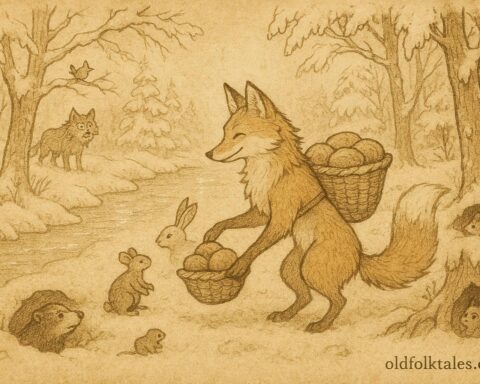
Before long, he came upon a fox trapped beneath a fallen log, its leg injured and trembling. The animal growled weakly but did not bite. The old man knelt, lifted the log with effort, and bound the wound with cloth torn from his own sleeve.
To his surprise, the fox spoke.
“Kind old one,” it said, “your kindness will not go unpaid. Remember me when you are in need.”
The fox vanished into the trees.
Later, the old man crossed a narrow stream where a raven lay shivering, its wing caught in ice. He freed the bird with care, warming it until it could fly.
The raven circled above him and croaked, “Those who respect life are never alone.”
As night fell, the old man shared his bread with a hungry wolf. Instead of attacking, the wolf bowed its head and disappeared into the darkness.
The Keeper of Ancient Knowledge
On the third evening, the old man reached a clearing where a crooked hut stood upon uneven ground. An ancient woman lived there, her face lined like bark, her eyes sharp and knowing. She seemed to expect him.
“You seek the golden apples,” she said.
“I do,” replied the old man. “Not for myself, but for the land.”
She nodded slowly and tested him with questions about his journey, his treatment of the forest, and his reasons for coming. Satisfied, she presented him with three objects:
-
A cloak that would conceal him from danger, but only if worn humbly
-
A wooden whistle that could summon aid if used without greed
-
A small sack that would hold only what was rightfully taken
“These will fail you,” she warned, “if pride enters your heart.”
The Giant and the Golden Tree
At last, the old man reached a hidden valley where the golden apple tree stood, its branches heavy with shining fruit. Beside it slept a giant of immense size, his breath shaking the earth. The ground bore marks of failed attempts, broken weapons, trampled grass, and silence.
The old man put on the cloak and moved quietly, whispering apologies to the land as he passed. Reaching the tree, he touched it gently and spoke words of respect before taking a single apple. The sack accepted only one.
As he turned to leave, the giant stirred. The earth trembled.
The old man raised the whistle and blew a clear note. From the forest came the fox, darting between the giant’s legs; the raven, striking at his eyes; and the wolf, howling from the shadows. Confused and enraged, the giant chased the sounds away from the tree.
The old man escaped unseen.
Return and Resolution
When the old man presented the golden apple to the king, the court stood in awe. The king offered land, gold, and honors.
But the old man bowed and said, “Plant it. Let the land heal.”
The apple was planted, and from it grew orchards that never failed. Rivers flowed strong again, and the people prospered. The old man returned home as he had left, poor in possessions, rich in wisdom.
Moral Lesson
Wisdom, humility, and respect for nature bring greater rewards than strength or ambition. True virtue is recognized by the unseen world.
Knowledge Check
1. Who is the main hero of the story?
The hero is an old man whose wisdom and humility guide his journey.
2. What do the golden apples symbolize?
They represent balance, restoration, and rewards earned through virtue.
3. Why do the animals help the old man?
Because he treated them with kindness and respect.
4. What role does the giant play in the story?
The giant guards the apples and represents brute force without wisdom.
5. What lesson does the story teach about ambition?
Ambition without humility leads to failure.
6. From which culture does this folktale originate?
Romanian peasant folklore.
Source: Collected by I. C. Fundescu, Basme și povestiri, 1875
Cultural Origin: Romanian peasant folklore, 19th century