Long ago, in the misty highlands of the Czech lands, there lived a poor boy who had nothing but his courage and a steady heart. His parents were gone, and with no one left to care for him, he decided one morning to seek his fortune beyond the village fields. The road wound through forests and valleys, past farms and rivers, until the sun dipped behind the hills. Just as night fell, he saw a faint light flickering in the distance.
Curious and weary, he followed it and came upon a crooked hut standing deep in the forest. Smoke curled from its chimney, and the air smelled faintly of herbs and ash. At the door stood an old woman wrapped in a black shawl. Her back was bent, her nose long and sharp, and her eyes glittered strangely in the lamplight.
“Good evening, grandmother,” the boy said politely. “May I rest here tonight?”
The old woman smiled, a thin, cold smile. “Rest, yes,” she croaked. “And perhaps work, too. I can make a fine servant out of a strong lad like you. Serve me faithfully for a year and a day, and I shall make you rich.”
The boy, thinking himself lucky, agreed. He had no home, and the promise of gold tempted him. That night, he slept on straw by the fire, unaware that the old woman was no grandmother at all but a wicked witch who devoured her servants one by one.
At dawn, she clattered a wooden spoon against the hearth. “Up, lazy bones!” she shrieked. “Your first task is to clean my hut until it shines like silver. Miss a speck of dust, and I’ll eat you for breakfast!”
The boy worked quickly, scrubbing the floors and washing the walls. As he swept the ashes from the fireplace, he noticed a small bird perched on the windowsill, a tiny, bright-feathered creature with clever eyes. The bird chirped softly, “Be brave, young man. Do what she asks but watch closely and use your wits.”
By evening, the hut gleamed, and the witch grudgingly nodded. “You’ve done well enough, for today.”
The next morning, she gave him a harder task. “Go into the forest,” she commanded, “and chop a pile of wood taller than the house before sunset. If you fail, I’ll roast you like a pig!”
The boy took the axe and trudged into the forest. The trees loomed tall and endless, and his arms soon ached. Then the little bird fluttered down beside him and whispered, “Strike only once on each tree, and say, ‘In the witch’s name, be done!’”
The boy did as told, and with each swing, whole logs fell neatly cut and stacked, as if by unseen hands. By nightfall, the pile reached the witch’s roof. She narrowed her eyes when she saw it but said nothing.
On the third morning, she gave him her cruelest order yet. “Fetch water from the mountain spring,” she hissed, “and mind you bring it in this sieve.” She thrust a leaky wooden sieve into his hands. “But beware, the spring is guarded by a dragon that eats all who come near.”
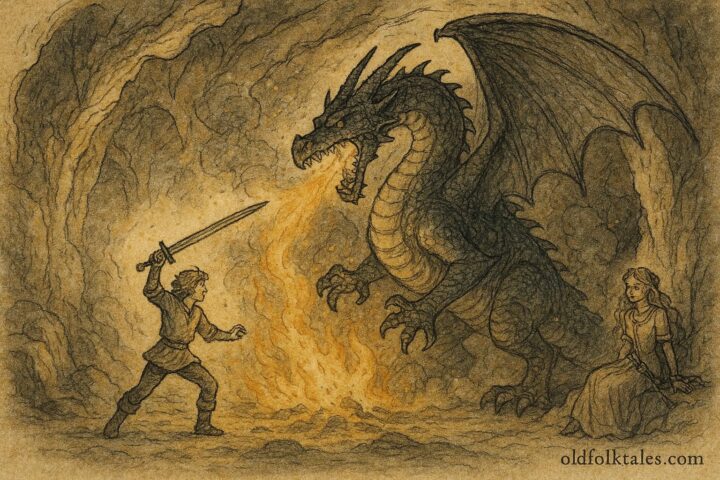
The boy’s heart sank. How could he carry water in a sieve, or face a dragon? Still, he set out, the bird flying at his side. When they reached the spring, its surface shimmered like silver glass, and the dragon’s tail coiled around the rocks. Smoke rose from its nostrils.
“Dip the sieve in clay,” whispered the bird, “so no water can escape. As for the dragon, throw three pebbles into the spring and say, ‘Sleep, guardian of evil!’”
The boy obeyed, and at once the dragon yawned, its eyes closing in slumber. He filled the sieve and carried the water home without spilling a drop.
The witch stared in disbelief. “You’ve done what none have done before,” she muttered. “Perhaps you are cleverer than I thought.”
That night, she decided to rid herself of him once and for all. “Tomorrow,” she said sweetly, “you shall go to my iron castle beyond the black hills. Bring me the golden casket that lies within.”
When morning came, the bird whispered urgently, “This is her trap. Inside that castle lie cages filled with souls she has stolen. You must free them.”
Following the bird’s lead, the boy crossed dark valleys and rivers of mist until the iron castle rose before him, its towers blackened and its gates bound by chains. Inside, he saw rows upon rows of cages, each holding a faint, flickering light.
The bird guided him to a shelf where a great book lay open, its pages covered in strange runes. “This is her spellbook,” it said. “Burn it, and her power will end.”
The boy tore the pages free and set them alight. As the fire spread, the cages burst open one by one, and shining spirits soared into the air, singing with joy. The golden casket shattered, scattering jewels across the floor.
Just then, a scream echoed through the forest—the witch’s shriek as her magic crumbled. The hut where she waited collapsed into dust, and the ground swallowed her whole.
When the boy returned, the bird sang triumphantly, “You have broken her curse! The souls are free, and evil is no more.”
The boy thanked the bird and walked home, richer not in gold but in courage and honor. Wherever he went, people told the tale of the clever youth who outwitted the old witch and freed the innocent.
Moral Lesson
Courage and cleverness can defeat even the darkest evil. Those who keep faith, use their wits, and act with kindness will always triumph over deceit and cruelty.
Knowledge Check
1. What was the boy’s first task in the witch’s service?
To clean her hut completely, or risk being eaten for failing.
2. How did the boy complete his impossible chores?
With the help of a magical bird who guided him and taught him wise tricks.
3. What guarded the mountain spring, and how did the boy overcome it?
A dragon guarded the spring; the boy used pebbles and a spell to make it sleep.
4. What did the boy find inside the iron castle?
Cages of enchanted souls and the witch’s powerful spellbook.
5. How did he destroy the witch’s power?
He burned her spellbook, freeing the souls and ending her magic forever.
6. What is the main moral of The Old Witch?
That courage and cleverness can free the innocent and conquer evil.
Source: Adapted from Czechoslovak Fairy Tales by Parker Fillmore (1919); also found in Karel Jaromír Erben’s Czech Folktales.
Cultural Origin: Czech Republic