In a kingdom set among the rolling valleys and steep mountains of Norway, there stood a hill unlike any other.
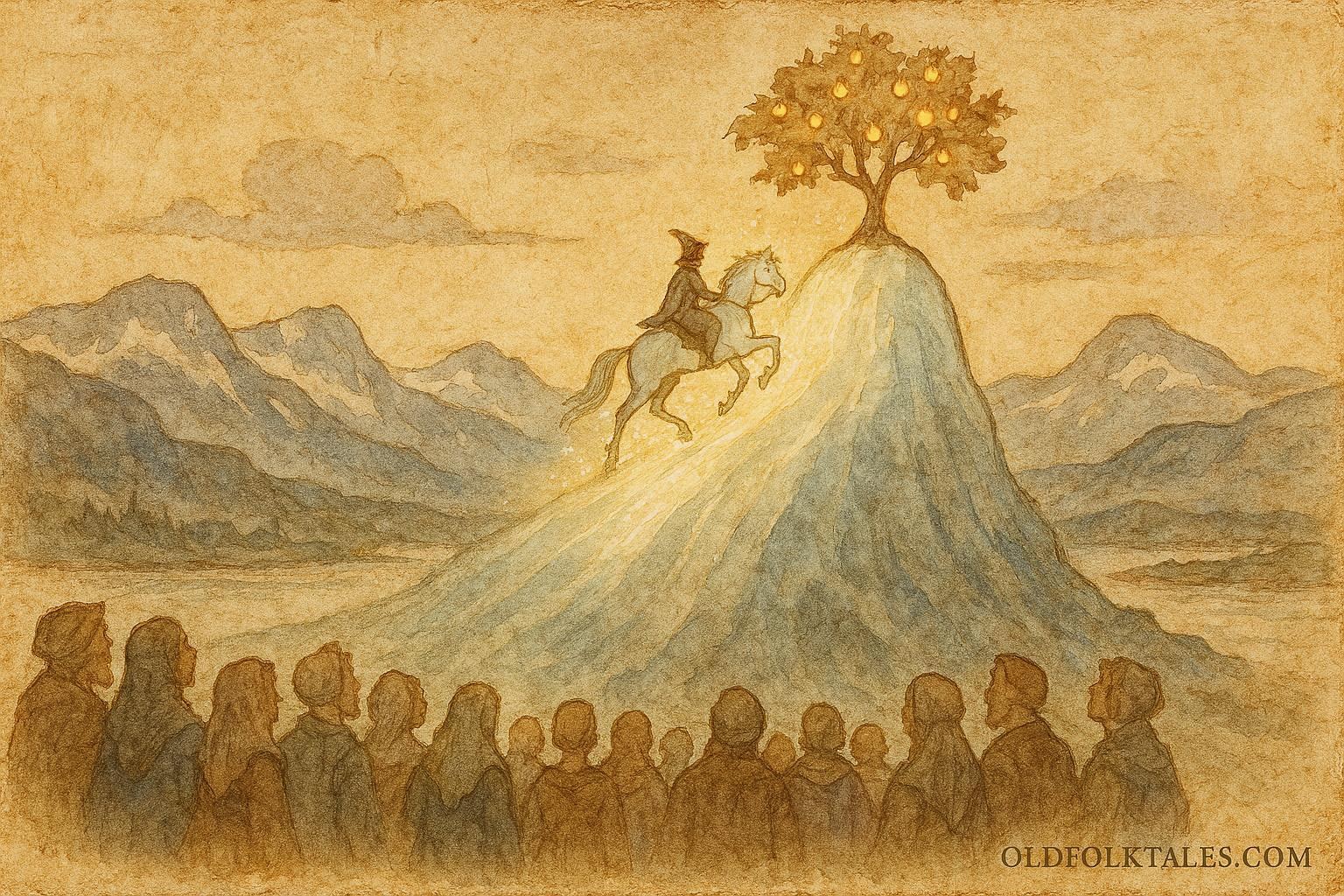
It rose sharply from the earth, smooth and shining as though carved from glass. Its surface reflected the sky, catching light in a way that made it seem almost unreal, beautiful, but impossible to climb.
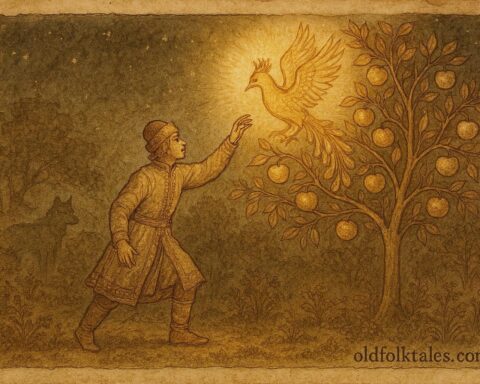
At the top of this hill grew a tree.
And upon that tree hung golden apples, bright and gleaming, said to hold great value, not only for their beauty, but for what they represented.
The king, who ruled the land, had made a proclamation.
His daughter, the princess, would marry the man who could ride to the top of the glass hill and bring back the golden apples.
It was a challenge that drew many.
From distant lands and nearby villages, men came, strong men, proud men, men certain of their own ability. They brought their finest horses, polished saddles, and bold confidence.
One by one, they tried.
They urged their horses forward, charging toward the hill with determination.
But the moment the horses reached the slope, their hooves slipped.
No matter how strong or swift they were, they could not gain footing.
They slid back down, their efforts undone.
The crowd watched, murmuring.
Some laughed.
Others shook their heads.
“It cannot be done,” many said.
Yet still, they came.
Among those who lived near the kingdom were three brothers.
The two elder brothers were much like the men who had already tried, confident, eager, and certain that they would succeed where others had failed.
The youngest brother, however, was different.
He was often overlooked.
His clothes were simple, his manner quiet, and he was rarely taken seriously by those around him. While his brothers spoke loudly of their plans, he listened.
When word of the challenge reached them, the elder brothers prepared at once.
“We will go,” they said. “We will win the princess and bring honor to our name.”
They dressed well, chose their strongest horses, and set out with pride.
The youngest asked to go as well.
His brothers laughed.
“What will you do there?” they asked. “Watch as others succeed?”
But he did not argue.
“I will go,” he said simply.
Reluctantly, they allowed him to follow.
When they arrived, the scene was as it had been for many before them. Riders attempted the climb, only to fail and slide back down.
The elder brothers stepped forward confidently.
They urged their horses forward, determined to succeed.
But like the others, they failed.
The hill did not yield to strength or speed.
They returned to the base, their confidence shaken.
The youngest brother stood apart, watching.
He did not rush forward.
Instead, he turned away from the crowd and walked quietly toward the edge of the forest.
There, hidden from view, he found what he had hoped for.
A horse.
But not like the others.
Its coat shimmered faintly, its presence calm yet powerful. It did not move restlessly, nor did it show fear.
The boy approached it slowly.
The horse did not resist.
When he mounted, it stood steady, as though it had been waiting.
He guided it back toward the hill.
The crowd barely noticed him at first.
He was not dressed like the others.
He did not draw attention.
But when he began his ascent, something changed.
The horse moved differently.
Its hooves found grip where others had slipped.
Step by step, it climbed.
The crowd grew quiet.
Higher and higher he went, until at last, he reached the top.
There, he took a golden apple.
Then, without pause, he turned and descended.
By the time he reached the bottom, the crowd had begun to stir.
“Who was that?” they asked.
But the boy did not stay.
He returned the horse to where he had found it and rejoined his brothers as though nothing had happened.
The next day, the challenge continued.
Again, many tried.
Again, many failed.
The elder brothers, unwilling to give up, attempted once more.
But the result was the same.
The youngest brother slipped away again.
This time, he found another horse, stronger, more radiant than the first.
He mounted it and returned.
Again, he climbed.
Again, he succeeded.
And again, he left without revealing himself.
By now, the mystery had grown.
The king watched closely.
“Who is this rider?” he asked.
But no one could answer.
On the third day, the final chance was given.
The hill stood as it always had, silent, shining, unyielding.
The brothers stood among the crowd.
The elder ones no longer spoke with the same certainty.
The youngest once again walked quietly away.
In the forest, he found the third horse.
It was the most remarkable of all, its presence strong, its form almost luminous.
When he mounted it, there was no hesitation.
He rode to the hill.
And this time, as he climbed, all eyes were upon him.
The horse moved with perfect balance.
The boy reached the top.
He gathered the golden apples.
And as he turned to descend, something caught the light.
The princess, watching from below, saw him clearly for the first time.
There was no mistaking it.
This was the one.
When he reached the bottom, he did not disappear.
Instead, he remained.
The crowd parted.
The king stepped forward.
“Who are you?” he asked.
The boy dismounted.
“I am as you see,” he said.
There was no boast in his voice.
No pride.
Only truth.
The elder brothers stared, unable to reconcile what they saw with what they had believed.
The princess stepped forward.
She had watched each attempt.
She had seen each failure.
And she had seen him succeed.
Not once, but three times.
“You have done what no one else could,” she said.
The boy bowed his head slightly.
“I did what I was able,” he replied.
And so, the promise was fulfilled.
The boy who had been overlooked, who had been dismissed as insignificant, stood as the one who had succeeded.
Not through strength alone.
Not through pride.
But through patience, humility, and the quiet courage to try when others had failed.
And in time, the story spread, not only of the glass hill and the golden apples, but of the one who climbed it.
A reminder that true worth is not always seen at first glance.
But it reveals itself, when the moment calls for it.
Moral Lesson
True merit lies in humility, persistence, and quiet courage. Those who are underestimated often possess the strength and determination needed to achieve the impossible.
Knowledge Check
1. What challenge was set for the princess’s hand in marriage?
A man had to ride up a glass hill and retrieve golden apples.
2. Why did many suitors fail?
Their horses could not gain footing on the smooth, slippery hill.
3. What made the youngest brother different?
He was humble, patient, and underestimated by others.
4. How did he succeed in climbing the hill?
He used magical horses that could grip the glass surface.
5. Why did he hide his identity at first?
He did not seek attention or recognition, acting quietly instead.
6. What is the main theme of the story?
Merit and perseverance matter more than status or appearance.
Source: Norske Folkeeventyr (1840s)
Cultural Origin: Norwegian countryside folklore