In a northern land shaped by long winters, deep forests, and wooden halls warmed by firelight, there lived a miller whose tongue was quicker than his wisdom. One evening, while boasting before the local king, the miller claimed that his daughter possessed a gift beyond all others: she could spin ordinary straw into shining gold. The words were spoken lightly, but they carried great weight, for kings do not ignore such claims.
The king, whose heart prized wealth as much as power, summoned the miller’s daughter to his hall at once. She was young, clever, and dutiful, but she had no such gift. Still, she stood silently as the king’s eyes fixed upon her, measuring her worth not as a person, but as a promise.
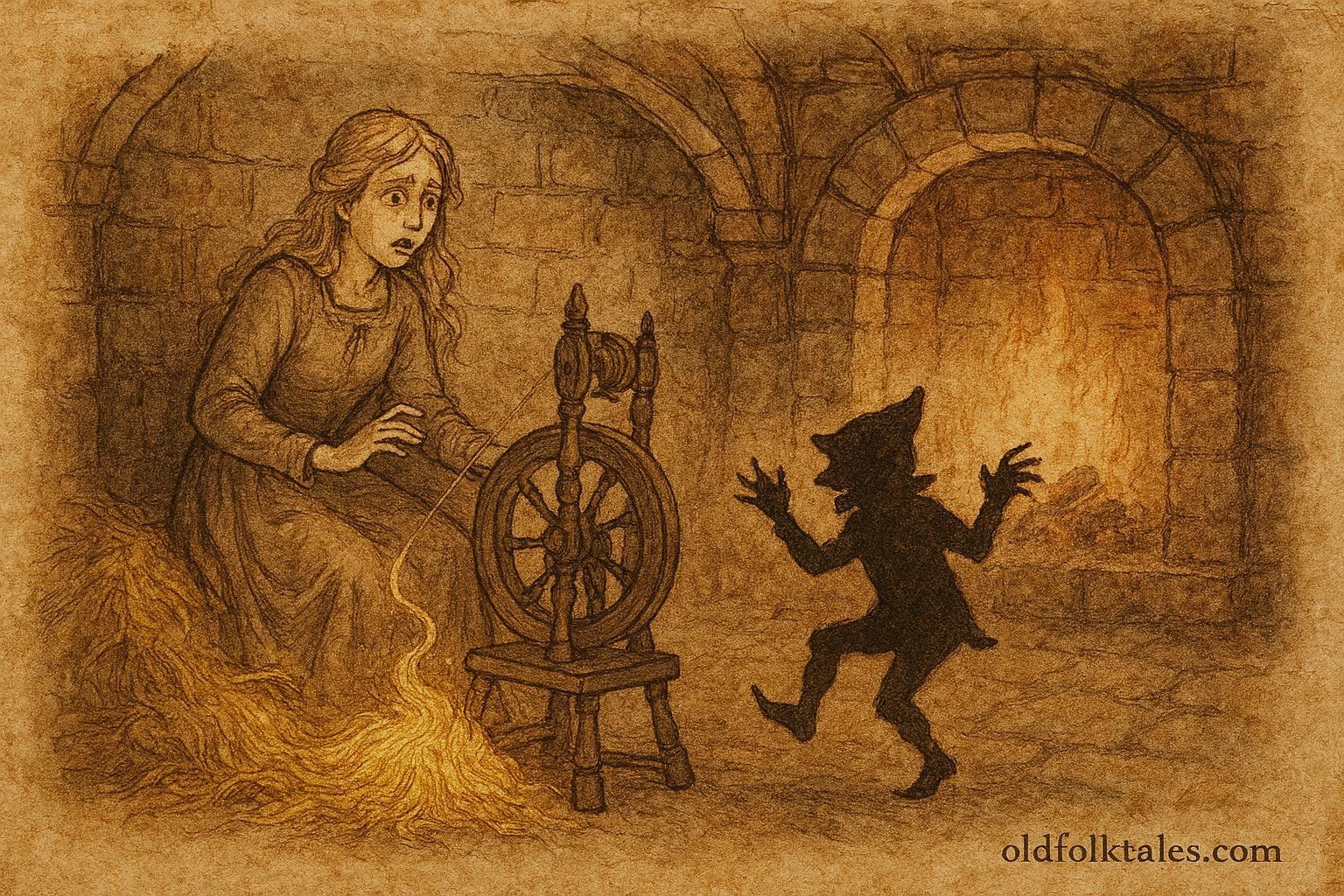
That very night, she was led to a stone chamber filled from floor to ceiling with dry straw. A spinning wheel stood in the corner, cold and unmoving. The king’s voice echoed against the walls.
“Spin this straw into gold by morning,” he said, “or you shall pay for your father’s lie.”
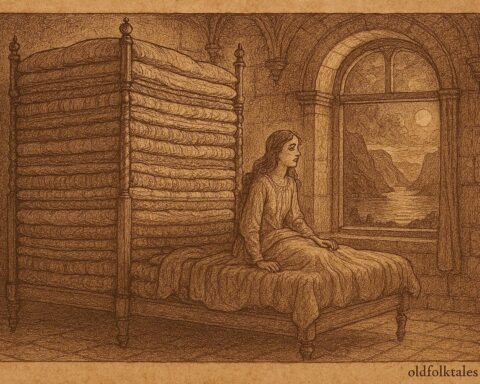
When the door closed and the lock turned, the girl sank to the floor in despair. She knew spinning well enough, but straw was straw, and gold was gold. No skill of human hands could change one into the other. Tears fell freely as the night deepened and the moon crept higher above the frost-rimmed window.
It was then that she heard a soft tapping at the door.
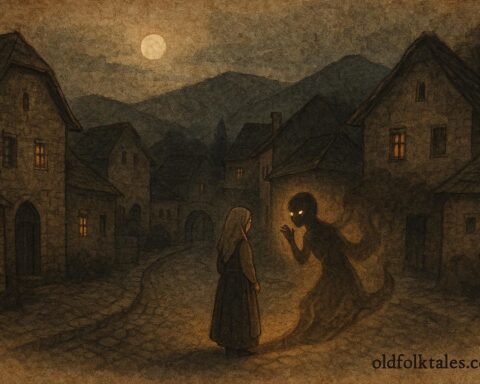
From the shadows stepped a small, strange man, no taller than a child, with bright eyes and a voice sharp as frost. He looked at the straw, the wheel, and the girl’s tear-stained face.
“Why do you weep so bitterly?” he asked.
She told him of the king’s demand and her certain doom. The little man smiled, not kindly, but knowingly.
“I can help you,” he said. “I can spin straw into gold. But nothing is given freely in this world.”
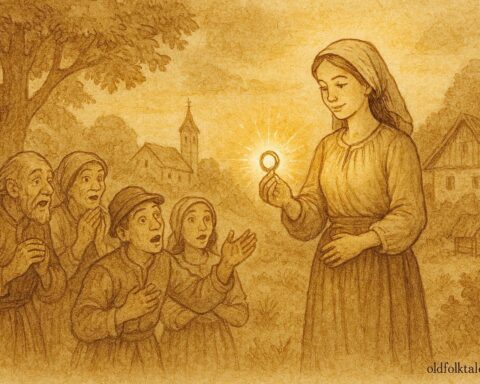
Desperate, the girl agreed to bargain. She gave him her necklace, a simple keepsake from her mother. The little man sat at the wheel, and as his feet danced and the wheel hummed, the straw shimmered and transformed into gleaming golden thread. By dawn, the room overflowed with gold.
The king was astonished. Instead of freeing the girl, he moved her to an even larger chamber filled with straw.
“Spin this as well,” he commanded. “Then we shall see your true worth.”
Again, the girl wept. Again, the little man appeared. This time, she gave him her ring. Once more, the straw turned to gold before morning light.
On the third night, the king led her to the largest chamber of all. Straw piled high like snowdrifts, and the king’s voice was cold with expectation.
“If you succeed tonight,” he said, “you shall become my queen.”
Alone once more, the girl knew she had nothing left to give. When the little man appeared for the third time, she told him so.
“Then you must promise me your firstborn child,” he said softly.
Horrified, she hesitated. But fear clouded her judgment, and with no other choice before her, she agreed.
The straw became gold, and the king kept his word. The miller’s daughter became queen, and in time, she bore a child she loved more than life itself.
When the little man returned to claim his due, the queen begged him to take anything else, gold, jewels, even her crown. He refused.
But he granted her mercy of a sort.
“If you can discover my name within three days,” he said, “you may keep the child. If not, the bargain stands.”
The queen sent messengers across the land. They listened in forests, villages, and mountain paths, gathering every strange name they could find. Each day, she spoke the names aloud, and each day the little man laughed and shook his head.
On the third day, a messenger returned from the deep woods, breathless with news. He had seen a small man dancing alone by a fire, singing a strange song and boasting of a secret name known only to himself.
When the little man came again that night, the queen named him calmly.
At the sound of his true name, his face twisted with rage and disbelief. The power of naming broke the enchantment. Bound by his own words, he vanished, never to return.
The queen held her child close, wiser now than before. She had learned that words have power, bargains carry weight, and truth, once spoken, cannot be undone.
Moral Lesson
Cleverness, patience, and truth can overcome even the most binding bargains. Power lies not only in wealth or magic, but in understanding names, promises, and the weight of one’s words.
Knowledge Check
-
Why is the miller’s daughter brought before the king?
Because her father falsely claims she can spin straw into gold. -
Who helps her complete the impossible task?
A mysterious little man who offers magical help in exchange for payment. -
What price does the little man demand in the end?
The queen’s firstborn child. -
How is the bargain ultimately broken?
By discovering and speaking the little man’s true name. -
What role does naming play in the story?
Naming holds magical power and reveals truth and control. -
What tradition does this tale belong to?
Scandinavian folktales related to the Rumpelstiltskin cycle.
Source: Variant attested in Scandinavian folktale collections related to the Rumpelstiltskin cycle. Oral roots; recorded in folklore collections during the 1800s.
Cultural Origin: Scandinavia (especially Norway and Denmark).