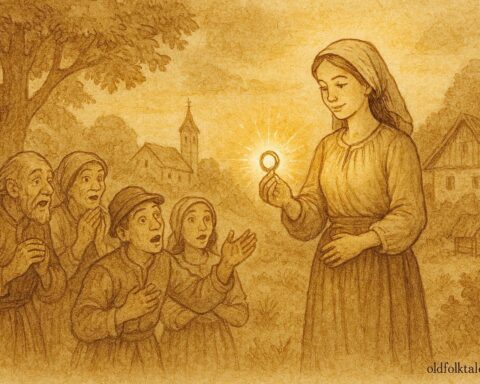
It was a cold autumn night in a small Andalusian village, the kind of night when the air itself seems to whisper prayers. The townsfolk, huddled in their homes, knew better than to wander after midnight, especially on the eve of All Souls’ Day, when the boundary between the living and the dead thins to a breath.
In a humble stone cottage on the edge of the village lived Martina, a widow known for her piety and solitude. Each evening, she lit a candle for the departed and prayed for their peace. Her neighbors often said that she could feel what others could not, the chill of unseen presences, the weight of the souls still seeking rest.
That night, the wind carried a strange murmur through the olive groves. It was not the sound of the breeze, nor the hoot of an owl, but a rhythmic whisper, like the sighing of many voices joined in prayer. Martina rose from her chair and went to the window. The moon, veiled by clouds, cast a dim silver light across the road that wound up toward the chapel on the hill.
From afar came a faint glow, as though a line of flickering candles were advancing slowly along the path. Martina pressed her face to the glass. Shapes began to form, figures in white robes, their heads bowed, their hands clasped over their chests. Their procession moved silently, their footsteps making no sound upon the earth.
A chill ran through Martina’s spine. She crossed herself, whispering, “Las ánimas…”, the souls of the departed.
The procession of the dead was said to appear only to those whose prayers or deeds had bound them, in some mysterious way, to the other world. The living were forbidden to join or even to watch too closely, for the souls were on a solemn journey, retracing the paths of their earthly sins and seeking intercession for their release.
Martina trembled. Yet her curiosity and compassion overcame her fear. She stepped outside, clutching her rosary, the candle from her table still burning in her hand.
The night was utterly still. Even the crickets were silent. As she neared the roadside, the glow intensified. The spectral line of souls passed before her, hundreds, perhaps thousands, moving in mournful silence. Some carried crosses; others held faintly shining lamps. Their faces were pale and sorrowful, yet serene, as though freed from pain but not from remembrance.
At the head of the procession walked a tall figure in a tattered robe, holding a great wooden cross. Martina recognized him at once, it was Don Álvaro, the former landowner of the village who had died years before, infamous for his greed and cruelty. Now his ghost bore the cross of penance, his eyes cast downward in eternal remorse.
Martina fell to her knees. “God have mercy on them,” she whispered. “And on me, a poor sinner.”
The souls passed by her, one by one. When the last spirit, an old woman clutching a rosary, turned her head toward Martina, her voice, faint as a breath of wind, reached her:
“Pray for us, sister, that we may rest.”
Then, in a single instant, the entire vision dissolved. The glow faded; the road lay empty once more. Martina’s candle, which had burned so steadily, went out with a soft hiss.
She remained kneeling in the darkness, trembling yet calm, filled with a strange peace. The next morning, when the church bells rang for All Souls’ Day, she went to Mass and offered prayers for every departed soul she could remember, friends, neighbors, even strangers whose graves she had tended.
Word of her vision spread through the village. Some doubted; others shuddered. But many followed her example, visiting the cemetery with candles and prayers. From that year onward, no All Souls’ night passed without the villagers lighting their lamps and whispering petitions for those unseen travelers who still walked among them.
Martina lived many more years, always faithful in her devotion. And on the night she herself passed away, the villagers swore that a soft light was seen moving from her home toward the chapel, merging with a silent, glowing procession that vanished beyond the hill.
Moral of the Story
The legend of Las Ánimas reminds us that compassion and prayer connect the living and the dead. By remembering those who came before us, we help to ease the burdens of their spirits, and, in turn, bring peace to our own souls.
Knowledge Check: Spanish Ghost Legend of Las Ánimas
- What is the main theme of the legend of Las Ánimas?
The story explores the connection between the living and the dead, emphasizing prayer, remembrance, and spiritual redemption. - Who is the main character in the story?
Martina, a devout widow who witnesses the spectral procession of departed souls. - What event does the legend take place around?
The night before All Souls’ Day, when it is believed that the dead return to seek prayers from the living. - What is the significance of the candle Martina carries?
The candle symbolizes faith, light in darkness, and the offering of prayer for the departed. - What lesson does Martina’s experience teach the villagers?
It inspires them to pray for the dead, showing that acts of faith and compassion can bring peace to both worlds. - What region of Spain is this folktale associated with?
The story comes from Andalusia and other regions of Spain, collected in 19th-century Spanish oral traditions by Fernán Caballero.
Cultural Origin: Spanish folktale, Spain
Source: Adapted from Las ánimas (“The Souls”), recorded by Fernán Caballero. Biblioteca Virtual Miguel de Cervantes.