Once upon a time in a quiet Romanian village, there lived an old man and an old woman. The old woman owned a plump, lively hen, while the old man had only a thin, scraggly rooster. Each morning, the hen laid two fine eggs, which the old woman cooked and ate greedily, never sharing even one with her husband.
At last, the old man could bear it no longer. “Listen, old crony,” he said, “you live as if you were a queen, eating all those eggs. Give me at least two, so I can have a taste of them.”
But the old woman was miserly and hard-hearted. “No indeed!” she snapped. “If you want eggs, beat your rooster till it lays some. I flogged my hen, and now look how well she lays!”
The old man, as foolish as he was greedy, took her advice to heart. In anger, he seized the poor rooster, beat it soundly, and shouted, “There! Lay some eggs for me, or out you go! I’ll not feed you for nothing any longer!”
Bruised and frightened, the rooster escaped from his hands and ran down the road. As it went, it spied something glinting in the dust, a small purse containing two half-pennies. Taking it carefully in its beak, the rooster began its journey back home.
But along the road came a fine carriage carrying a gentleman and several ladies. The gentleman noticed the rooster and said to his coachman, “Go see what that bird carries in its beak.” The driver leapt down, snatched the purse, and handed it to his master, who pocketed it with a smirk.
The rooster, indignant, chased after the carriage, crowing in fury:
“Kikeriki, sir! Kikerikak!
To me the little purse give back!”
The gentleman laughed in annoyance. “Impudent creature! Toss it into the well!” he ordered.
The driver obeyed, hurling the rooster down a deep well. But the clever bird, rather than drowning, began to drink and drink until it had swallowed all the water in the well. Then, shaking itself, it flew back out and continued its pursuit, crying:
“Kikeriki, sir! Kikerikak!
To me the little purse give back!”
The gentleman turned red with rage. “This creature must be a demon!” he cried. “Throw it on the burning coals!”
The cook grabbed the rooster and did as she was told, shoving it into the hearth and blocking the chimney with a great stone. But the rooster, clever as ever, began to spit out all the water it had swallowed. It poured and poured until the fire was drowned, the hearth cooled, and the entire kitchen flooded. The cook fainted in fury as the rooster pushed away the stone, stepped out unharmed, and flew to the window, tapping the glass with its beak.
“Kikeriki, sir! Kikerikak!
To me the little purse give back!”
The gentleman was beside himself. “This wretched bird will be the death of me!” he groaned. “Driver, throw it among the herds! Let a bull pierce it through with his horns.”
The rooster was thrown among the oxen and cows, but instead of being gored, it opened its beak and swallowed them all: bulls, calves, and cows alike, until its belly grew as round as a hill. Then, it flapped its wings, darkening the gentleman’s room, and cried again:
“Kikeriki, sir! Kikerikak!
To me the little purse give back!”
The gentleman trembled with fury. “I’ll lock this devil in my treasure-chamber!” he cried. “Let it choke on my gold!”
So he cast the rooster into a room filled with chests of ducats. The rooster wasted no time, it swallowed every coin, every last gleaming piece, until the room was bare. Then it broke through the door, strutted to the window once more, and called:
“Kikeriki, sir! Kikerikak!
To me the little purse give back!”
Finally defeated, the gentleman threw the purse out of the window. The rooster caught it neatly in its beak and proudly made its way home. All the village poultry followed behind it, as if in a grand wedding procession. The gentleman, pale with rage, muttered, “Let them all go! There’s witchcraft in that rooster!”
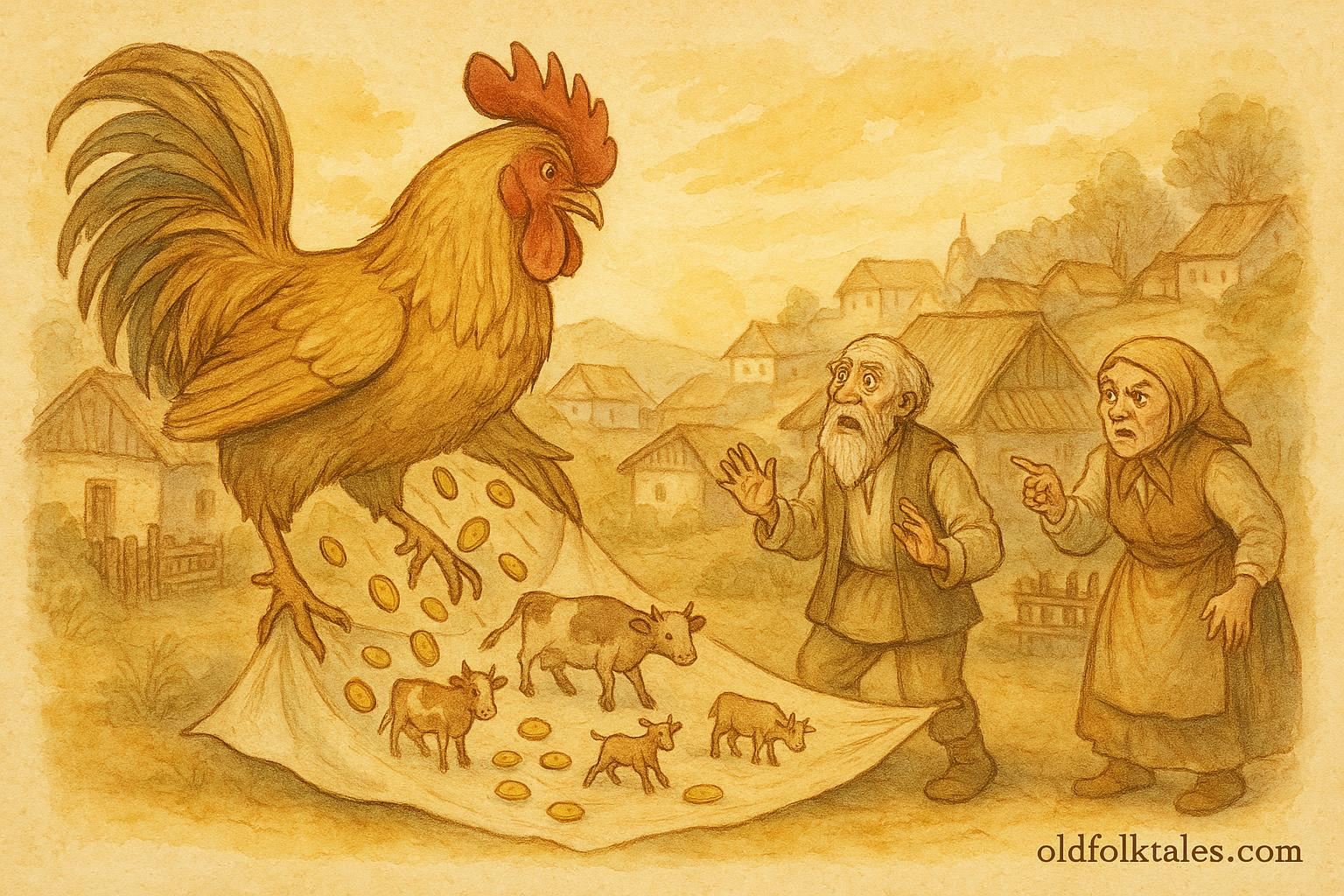
When the old man saw his rooster returning, he could hardly believe his eyes. The bird was enormous, towering like a mountain, with flocks of bright birds behind it. “Master,” said the rooster, “spread a sheet in the yard.”
The old man hurried to obey. The rooster stood upon the sheet, flapped its wings, and shook out herds of cattle, flocks of birds, and a glittering heap of ducats that shone like sunlight. The old man wept for joy, kissing his faithful rooster.
Just then, the greedy old woman arrived. Her eyes bulged at the sight of the treasure. “Dear friend,” she said sweetly, “give me a few ducats.”
The old man laughed. “No, old miser. When I asked you for eggs, what did you tell me? Now beat your hen and see if it will fetch you gold. I beat my rooster, and you see what it has brought me.”
So the old woman beat her poor hen mercilessly and sent it down the road. The hen found a shiny glass bead, swallowed it, and ran home, cackling proudly. But when it laid its “egg,” the old woman found nothing but the same glass bead. Enraged, she beat the poor creature to death — and from that day forward, she lived in misery and hunger, while the old man prospered.
The kind old man grew rich, built fine houses, and dressed his rooster in gold collars and shining spurs. The rooster became a symbol of cleverness and perseverance, the bird that turned a beating into a blessing.
Moral Lesson
Greed brings ruin, but gratitude and perseverance lead to reward. The rooster’s loyalty and courage turned injustice into fortune, while the old woman’s selfishness brought her to ruin.
Knowledge Check
1. Who are the main characters in “The Rooster and the Little Purse”?
The story features an old man, an old woman, a clever rooster, and a greedy gentleman.
2. What lesson does the folktale teach?
It warns against greed and selfishness while praising perseverance and fairness.
3. What does the purse with two half-pennies symbolize?
It represents opportunity and reward earned through resilience.
4. How does the rooster outsmart its enemies?
By using cleverness, swallowing water, escaping danger, and never giving up until justice is done.
5. What happens to the old woman at the end?
Her greed leads her to beat her hen to death, leaving her poor and alone.
6. What is the cultural origin of this folktale?
It is a traditional Romanian folktale.
Source: Adapted from the Romanian folktale “The Little Purse with Two Half-Pennies,” collected by Mite Kremnitz in Roumanian Fairy Tales (1889), Leipzig: Wilhelm Friedrich.
Cultural Origin: Romania (European folklore)