In the days when the roads of Europe were worn smooth by pilgrims’ feet and faith was carried as surely as bread or water, a young man set out from his home with little more than a staff, a satchel, and a heart full of devotion. He was a pilgrim, bound for the shrine of Saint James in Santiago de Compostela, as countless others had been for generations. His journey led him through the northern lands of Portugal, where rivers ran clear through green valleys and stone villages rested quietly beneath church bells.
The pilgrim walked alone, rising before dawn and resting only when night fell. Each village he passed offered the same rhythm of life: farmers tending their fields, women drawing water from wells, bells marking the hours of prayer. Though poor, he lacked nothing essential, for he trusted that God would guide his steps and provide what he needed.
Discover the spiritual depth and wisdom hidden in the ancient folklore of Eastern and Balkan Europe
After many days on the road, he reached the region of Barcelos. The land there was fertile and well-kept, and the town itself was known for its markets, its craftsmen, and its strong sense of order. Law and judgment were taken seriously, for peace depended upon them. The pilgrim entered the town near sunset, weary and hungry, and sought lodging for the night.
He was directed to an inn near the town square, a sturdy stone building where travelers often stayed. The innkeeper, a man of means and pride, agreed to give him shelter. The pilgrim ate little, spoke politely, and retired early, knowing he must continue his journey at first light.
But that night, while the town slept, a misfortune occurred.
A silver goblet, valuable and finely worked, disappeared from the innkeeper’s household. When morning came and the loss was discovered, anger and fear spread quickly. Theft was not only a crime but a stain upon honor, and the innkeeper demanded justice.
Suspicion turned swiftly toward the pilgrim.
He was a stranger, unknown to the town, with no family to speak on his behalf. Though he protested his innocence, his words were met with doubt. In a time when travelers were often viewed with caution, his presence alone seemed proof enough to some.
He was seized by the town guards and brought before the magistrate. The court gathered quickly, curious and eager to see justice done. The pilgrim stood calmly, though his hands were bound and his clothes dusty from the road. When questioned, he spoke plainly and without anger.
“I have taken nothing,” he said. “I am guilty of no crime. I ask only that God bear witness to the truth.”
But reason mattered little against fear and assumption. The missing goblet was never found, and no other suspect was considered. The magistrate, charged with maintaining order, declared the pilgrim guilty. The sentence was death by hanging, to be carried out before sunset.
The crowd murmured approval. Justice, they believed, had been served.
Yet as the guards prepared to lead him away, the pilgrim requested permission to speak once more. His voice did not tremble, and his gaze was steady.
“My lord,” he said to the magistrate, “I am innocent. And as proof, I say this: when I am hanged, the roasted rooster prepared for your meal will stand and crow.”
At that moment, a servant was bringing dishes into the hall for the magistrate’s midday feast. Among them was a rooster, already roasted and laid upon a platter, its flesh browned and its eyes lifeless.
Laughter broke out. Some mocked the pilgrim openly. Others shook their heads at what they believed to be desperate madness. The magistrate himself smiled faintly, amused by the absurdity of the claim.
“Very well,” he said. “Let the rooster remain untouched. We shall see what truth it speaks.”
The sentence stood.
The pilgrim was led through the streets toward the gallows, set upon a hill outside the town. Bells tolled slowly, and the crowd followed, drawn by habit more than cruelty. The pilgrim walked without resistance, praying quietly as he went.
When the rope was placed around his neck, he did not cry out. Instead, he whispered a final prayer, not for his life, but for justice to be revealed.
At that very moment, back in the magistrate’s hall, silence fell.
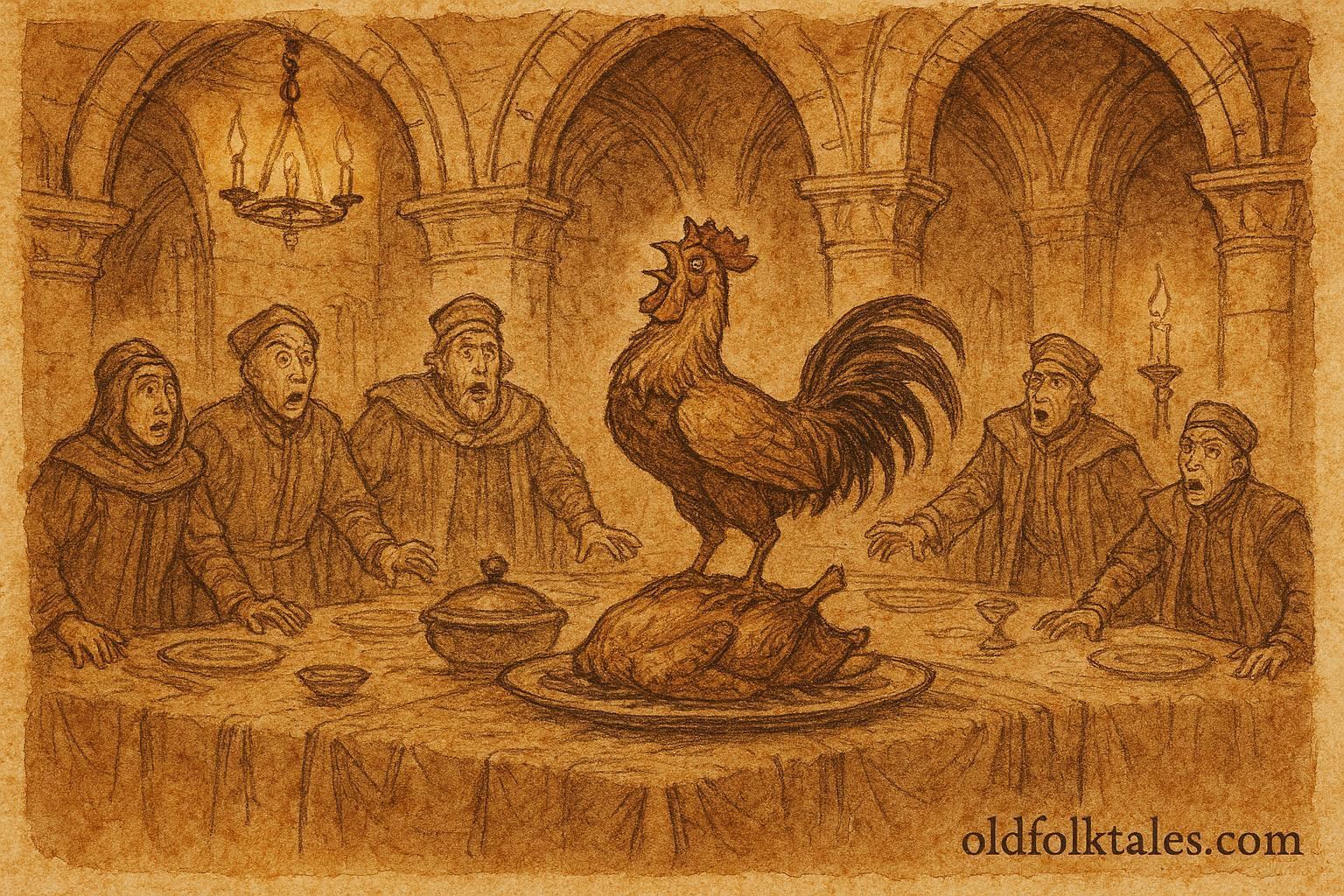
The roasted rooster stirred.
Before the eyes of those gathered, it rose upon the platter. Its feathers regained their color, its neck stretched upward, and it let out a loud, clear crow that echoed against the stone walls.
Shock froze the room. Plates fell. Servants gasped. The magistrate’s face drained of blood as realization struck him like thunder.
Without hesitation, he ordered his horse and rode at full speed to the hill. When he arrived, he found the pilgrim still alive, the knot in the rope had loosened, and the executioner had been unable to complete the task.
The pilgrim was freed at once. The magistrate fell to his knees, begging forgiveness for his blindness and haste. Before all who had gathered, the pilgrim’s innocence was declared.
The man resumed his journey in gratitude, completing his pilgrimage in faith renewed rather than broken.
Years later, he returned to Barcelos and carved a stone monument to honor the miracle, not for himself, but as a reminder that justice must be guided by humility and truth.
From that day forward, the rooster became a symbol across Portugal: painted brightly, carved in wood and stone, standing for faith rewarded and innocence defended.
And so the Rooster of Barcelos continues to crow, not with sound, but with meaning, warning against rash judgment and reminding all that truth, though tested, will always find a voice.
Moral Lesson
Faith rooted in truth cannot be silenced by injustice. When human judgment fails, divine justice speaks in ways that cannot be denied.
Knowledge Check
1. Why was the pilgrim accused of theft?
Because he was a stranger and an easy target when a goblet went missing.
2. What miracle proves the pilgrim’s innocence?
A roasted rooster comes back to life and crows.
3. What role does the magistrate play in the story?
He represents flawed human judgment corrected by divine intervention.
4. Why is the rooster an important symbol in Portugal?
It symbolizes faith, justice, truth, and hope.
5. How does the story reflect medieval pilgrimage culture?
It shows the vulnerability of travelers and the central role of faith.
6. Where did the Rooster of Barcelos legend originate?
In northern Portugal, specifically the Barcelos region.
Source: Portuguese oral folklore, recorded in literary folklore collections (late 19th century)
Cultural Origin: Barcelos region, Northern Portugal