In the deep green heart of Bulgaria’s mountain forests, where the pines climb skyward and mist curls low among ancient roots, there lived a young woodcutter whose life was shaped by the rhythm of the axe and the patience of the trees. He was neither rich nor poor, neither celebrated nor forgotten. Each dawn found him walking narrow forest paths, his boots damp with dew, his breath visible in the cool mountain air. The forest was his livelihood, but also his quiet companion, a place of whispered warnings and unseen watchers.
From childhood, he had been taught that the forest was not empty. His grandmother, bent with years and wisdom, used to say that not all who dwell among the trees walk on human feet. She spoke of Samodivi, forest maidens of great beauty and peril, who danced by moonlight in hidden clearings, whose voices could charm or destroy, and whose veils held their power. To meet one was rare. To cross one was fatal.
Explore the warmth and wit of Mediterranean storytelling, where love and wisdom intertwine
The young man listened, but as years passed and no spirits crossed his path, the stories softened into half-belief. Still, he greeted old trees before cutting them and never mocked the old tales aloud. Respect, even when uncertain, had been sewn into him early.
One evening, as the sun lowered itself behind the mountains and gold light spilled between the trunks, the woodcutter strayed deeper than usual. His arms ached, and the forest seemed unusually still, as though holding its breath. Then he heard it, a sound like wind moving through silver bells. It was laughter, light and distant, yet close enough to stir the hairs on his neck.
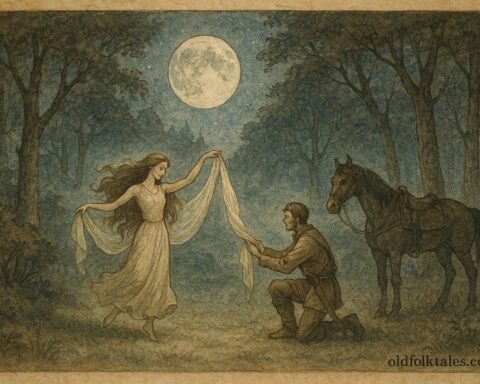
He followed the sound carefully, pushing past fern and thorn until the trees opened into a small clearing. There, beneath the fading sky, danced a woman unlike any he had ever seen.
She moved as though the earth itself bent to her steps. Her hair flowed loose like dark water, her eyes shone with an unearthly clarity, and her skin glimmered faintly, as though touched by moonlight even before night had fallen. Draped over a nearby branch was a delicate veil, woven so finely it seemed spun from mist.
The woodcutter froze. He knew at once what stood before him.
A Samodiva.
Fear rooted him to the ground yet wonder held him fast. The Samodiva danced alone, unaware of his presence, her bare feet brushing the grass without sound. The veil caught his eye again. He remembered the old warnings: A Samodiva without her veil is bound. The thought unsettled him. This was no moment for cunning or theft.
But fate, like the forest itself, does not always wait for permission.
A sudden breeze rose, sharper than the others, snapping the veil from its branch and carrying it across the clearing. It tumbled at the woodcutter’s feet. He looked from the veil to the dancer, whose movements slowed, then stopped entirely. Her eyes met his, and the joy drained from her face, replaced by something colder and more dangerous.
She approached him, each step measured.
“Human,” she said, her voice neither loud nor soft, but weighted with command. “You hold what is mine.”
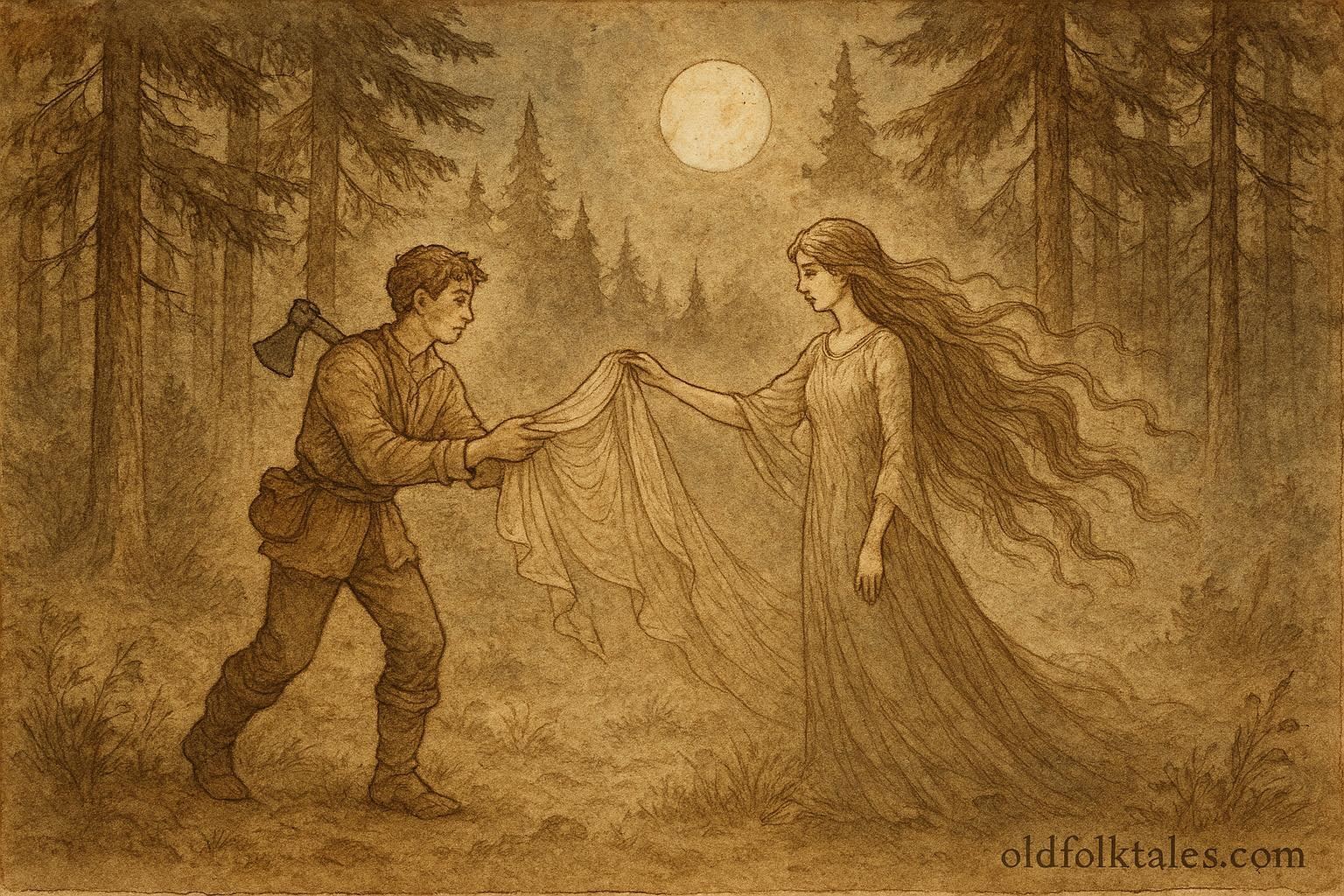
The woodcutter’s hands trembled as he lifted the veil. He could have run. He could have hidden it. But he remembered his grandmother’s voice and bowed his head.
“I meant no harm,” he said. “Take it. I do not wish to keep what does not belong to me.”
He offered the veil with both hands.
For a long moment, the Samodiva studied him. Then, slowly, she took the veil and draped it over her shoulders. The air shifted. The forest exhaled.
“You have shown respect,” she said at last. “Few do.”
She circled him once, her gaze sharp and searching. “For this, I grant you a gift.”
Before he could speak, she raised a hand. “But heed this warning. Never speak of it. Never boast of what you receive. The unseen world listens more closely than you know.”
With that, she touched his forehead. A warmth spread through him, steady and strong, like roots anchoring deep into the earth.
When he opened his eyes, the clearing was empty.
The woodcutter returned home in silence, unsure whether the encounter had been dream or truth. Yet in the days that followed, he noticed a change. His hands grew surer. His axe struck true. Trees fell cleanly, and his work brought him greater reward than before. Wood sold easily. His household never lacked bread or warmth.
He remembered the warning and kept his peace.
Seasons passed. Prosperity followed him quietly, like a shadow that lengthened but never spoke. Yet humans are not made for silence forever.
One evening, after sharing drink with other villagers, someone remarked on his fortune. Laughter filled the room. Pride, slow and subtle, rose within him. Words slipped before he could catch them.
“I have had… help,” he said.
The moment the words left his mouth, the room seemed to dim. The fire crackled sharply. A cold draft brushed his neck.
That night, the forest reclaimed what it had given.
From that day on, his axe slipped. Trees splintered unpredictably. Buyers turned away. The ease he once knew vanished like mist under sun. He returned often to the clearing, but the Samodiva never appeared again.
The forest remained. The lesson endured.
Moral Lesson
This tale teaches that respect for the unseen world demands humility and restraint. Gifts granted by forces beyond human understanding are sustained not by pride, but by silence, gratitude, and wisdom. To boast is to invite loss.
Knowledge Check
1. Who is the central supernatural figure in the story?
The Samodiva, a forest spirit from Bulgarian folklore.
2. What object symbolizes the Samodiva’s power?
Her veil, which binds her strength and freedom.
3. What warning does the Samodiva give the woodcutter?
Never to boast or speak of the gift she grants him.
4. What causes the woodcutter’s downfall?
His moment of pride and broken silence.
5. What cultural belief does the story reflect?
Respect for nature spirits and the unseen world.
6. What is the central lesson of the folktale?
Humility preserves blessings; pride destroys them.
Source: Bulgarian oral folklore traditions documented by Ivan Shishmanov, 1890s.
Cultural Origin: Bulgarian woodland and mountain regions (Bulgarian folklore)