In the days when songs shaped the world and the northern winds carried the voices of spirits, the land of Kalevala was a place of both wonder and peril. Across its vast lakes and deep pine forests lived people guided by wisdom, magic, and music. Among them stood Väinämöinen, the sage whose songs could calm seas and summon life itself, and Ilmarinen, the divine smith, whose hammer and forge could fashion marvels beyond mortal craft.
Far to the north lay Pohjola, a cold, shadowed land ruled by the powerful mistress Louhi, a woman feared for her cunning and command of sorcery. It was said that wealth and good fortune dwelt in her realm, hidden within a miraculous object known as the Sampo, a mill that ground endless grain, salt, and gold for its keeper. Whoever possessed the Sampo held the power to bring abundance to their people.
The Forging of the Sampo
The tale began when Louhi, desiring to increase her wealth, promised her daughter’s hand in marriage to whoever could forge the Sampo. Väinämöinen, wise and ambitious, sought to claim that honor, but he lacked the skill to create such a wonder. He turned instead to his companion Ilmarinen, the master smith. Persuaded by Väinämöinen’s plea, and Louhi’s tempting offer, Ilmarinen journeyed north to Pohjola to undertake the impossible task.
In the frozen halls of Louhi’s stronghold, Ilmarinen built his forge of copper and iron and began his work. For days and nights, sparks flew as he chanted the ancient words of creation. On the first day, from the flames leapt a bow, but it thirsted for blood. On the second, a ship emerged, but it sought to sail without a captain. On the third, a heifer appeared, but it devoured the fields. And on the fourth, a plough arose, but it ploughed up men and homes alike.
Finally, on the fifth day, Ilmarinen threw his strength into one final effort. He worked until the forge glowed white and the air trembled with power. From the fire came forth the Sampo, a wondrous, shining mill with a many-colored lid that glowed like the northern lights. It ground flour, salt, and gold without end, blessing whoever owned it with fortune and prosperity.
Louhi, overjoyed, hid the Sampo deep within the mountains of Pohjola, locking it behind iron gates. She kept her promise to Ilmarinen in part, but her heart was shrouded in greed, and the smith returned home without the happiness he had hoped for.
The Longing for the Sampo
In Kalevala, news of the Sampo spread quickly. Väinämöinen longed for its gifts, for the fields of his homeland were not always kind, and the winters were long and cruel. He spoke to Ilmarinen and Lemminkäinen, the bold adventurer, urging them to sail north and bring back the Sampo to bless their people.
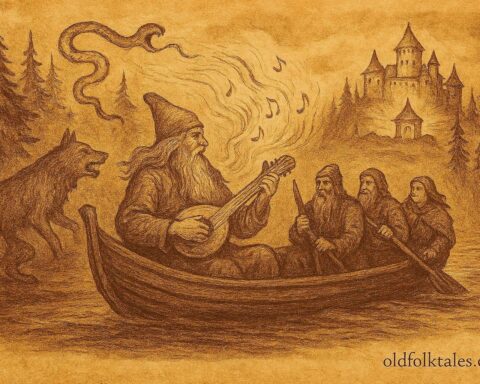
Together, the three heroes set out upon their great journey. They built a mighty ship, singing it into being with Väinämöinen’s enchantments. When it was ready, they launched it upon the sea and sailed toward the far northern shores, where Louhi’s fortress stood.
The voyage was perilous. The winds howled, and the waves rose high, but Väinämöinen’s songs calmed the storm, and Ilmarinen’s craft guided them true. After many trials, they reached Pohjola and demanded the return of the Sampo. Louhi refused, knowing the power it brought her land. A fierce struggle ensued, magic against magic, will against will.
The Theft and the Breaking
Through cunning and bravery, the heroes managed to seize the Sampo from its hidden chamber. They loaded it aboard their ship and fled southward across the dark waters. Louhi, discovering the theft, transformed herself into a great eagle of shadow and storm. She summoned the winds to her aid, and the sea boiled with fury as she swooped down upon the heroes’ ship.
The battle between Väinämöinen’s light and Louhi’s darkness raged above the waves. The ship tossed and creaked, its mast splintered, and the Sampo trembled in its hold. Louhi struck again and again, and at last, in the chaos, the precious mill was shattered. Its fragments scattered into the sea, some sinking to the ocean’s floor, some washing ashore upon Kalevala’s coast.
Though the Sampo was broken, its magic was not lost. Wherever its pieces fell, the land grew fertile, and the waters rich with fish. The people of Kalevala mourned what might have been, but they rejoiced in what remained, a world blessed with new prosperity, born from courage and struggle.
The Enduring Song
Väinämöinen sang once more, not of loss but of gratitude. His melodies filled the air, carrying the memory of the Sampo across the ages. He reminded his people that abundance, though sought in treasures and tools, truly lived in the harmony of wisdom, work, and unity. The Sampo’s fragments became symbols of this truth, a reminder that even when great gifts are broken, their blessings endure through those who strive to do good.
Moral Lesson
The Tale of the Sampo teaches that greed and envy can destroy even the most wondrous gifts, while cooperation and courage can restore what was lost. The broken Sampo reminds us that abundance comes not from hoarded wealth but from shared labor, harmony, and gratitude for the gifts of the earth.
Knowledge Check
- What is the Sampo in Finnish mythology?
The Sampo is a magical mill-like object that endlessly produces grain, salt, and gold, symbolizing prosperity and abundance. - Who forged the Sampo and for whom?
Ilmarinen, the divine smith, forged the Sampo for Louhi, the Mistress of Pohjola, in exchange for her daughter’s hand. - Why did Väinämöinen and his companions steal the Sampo?
They sought to bring its blessings and wealth to the people of Kalevala, whose lands were often barren and harsh. - How did the Sampo break?
It shattered during a sea battle when Louhi attacked the heroes’ ship in the form of a great eagle. - What happened after the Sampo broke?
Its fragments scattered across land and sea, bringing fertility and fortune wherever they landed. - What moral does this Finnish folktale convey?
True prosperity comes not from possession or greed, but from unity, effort, and appreciation of nature’s gifts.
Source: Adapted from The Kalevala, compiled by Elias Lönnrot (1835; revised 1849), based on Finnish and Karelian oral rune traditions. English translation available via Project Gutenberg.
Cultural Origin: Finland (Finnish and Karelian folklore)