In a quiet Belarusian village, where wooden cottages stood close together and narrow paths wound between fields and forest, there lived a man whose name was spoken with unease. He was known not for kindness or generosity, but for his sharp tongue, his harsh dealings, and the coldness with which he treated others.
He lived alone at the edge of the village, where the shadows of the forest stretched long across his yard each evening. People avoided him when they could, stepping aside when they saw him approach, lowering their voices when he passed. Though no one openly challenged him, all knew his nature.
He was a man who took more than he gave, who spoke without care, and who showed little regard for the feelings or well-being of others.
And yet, for all his faults, there was one thing about him that seemed entirely ordinary.
His shadow.
Each day, as the sun rose and moved across the sky, his shadow followed him faithfully. It stretched when the sun was low, shortened at midday, and disappeared in darkness, just as all shadows do.
At least, it did at first.
It began so subtly that the man barely noticed.
One morning, as he stepped outside into the pale light of dawn, he paused. Something felt… unusual. He glanced down and saw his shadow lying at his feet, but it did not align quite as it should. It seemed slower, as though reluctant to move when he did.
He frowned, shifting his stance.
The shadow followed, but not immediately.
He dismissed it.
“It is nothing,” he muttered, brushing the thought aside as he went about his day.
But the strangeness did not end there.
As the days passed, the shadow grew increasingly out of step. When the man walked, it lagged behind. When he stopped, it seemed to take an extra moment to settle. At times, it appeared almost unwilling to mirror him.
The man began to notice.
One afternoon, as he argued loudly with a neighbor over a small piece of land, his voice rising in anger, something peculiar occurred. As he gestured sharply, pointing and accusing, his shadow did not match the motion.
Instead, it remained still.
The neighbor saw it too.
Their argument faltered, replaced by a shared silence.
The man glanced down, his brow tightening. He moved his arm again, more forcefully this time.
Only then did the shadow follow, but slowly, reluctantly, as though compelled against its will.
A faint unease settled within him, though he refused to acknowledge it.
In the days that followed, the village began to take notice.
Whispers spread quietly at first.
“Have you seen it?” one asked.
“His shadow… it does not behave as it should,” another replied.
People began to watch him more closely, not just the man, but the dark shape that trailed behind him.
And what they saw unsettled them.
When the man spoke harshly, his shadow sometimes turned away. When he acted with cruelty, it seemed to shrink or hesitate. At times, it appeared to resist him entirely, as though it wished to separate but could not yet do so.
The man grew irritated.
“Why do you stare?” he snapped at those who lingered too long.
But the more he tried to ignore it, the more obvious it became.
One evening, as the sun dipped low and cast long, golden light across the village, the man stood alone near his home. He looked down, and froze.
His shadow was no longer directly beneath him.
It stood slightly apart.
Not far, but enough to be unmistakable.
The man took a step forward.
The shadow did not move.
A chill ran through him.
He stepped again, more quickly this time.
Still, the shadow remained where it was.
For the first time, fear touched him, not of others, not of the unknown forest, but of something far closer.
“Come,” he muttered under his breath, as though calling to it.
The shadow did not respond.
Night fell, and with it, darkness swallowed the ground. The shadow disappeared as it always did, leaving the man alone with his thoughts.
But the unease did not fade.
The next day, the separation grew clearer.
In the bright light of morning, the shadow reappeared, but not at his feet. It lingered a short distance away, moving only when it chose to, and not always in perfect imitation.
Villagers stopped in their tracks to watch.
Children pointed.
The man felt their eyes upon him, and anger rose within him.
“Look away!” he shouted.
But even as he spoke, his shadow turned its back to him.
A murmur rippled through those gathered.
The man clenched his fists.
From that day on, the distance between him and his shadow increased.
At times, it followed at a reluctant pace. At others, it remained still while he moved, as though refusing to be part of him.
And then, one day, it stopped following him altogether.
The man walked through the village, his steps quick, his expression hard, but behind him, there was nothing.
No dark outline. No silent companion.
Only empty ground.
The villagers watched in stunned silence.
For a moment, the man pretended not to notice. He kept walking, his chin lifted, his gaze fixed ahead.
But the absence was undeniable.
He turned suddenly, searching the ground behind him.
There it was.
His shadow stood apart, several paces away.
It did not move toward him.
It did not mimic him.
It simply stood, still, separate, and unmistakably independent.
A deep silence fell over the village.
In that moment, something shifted.
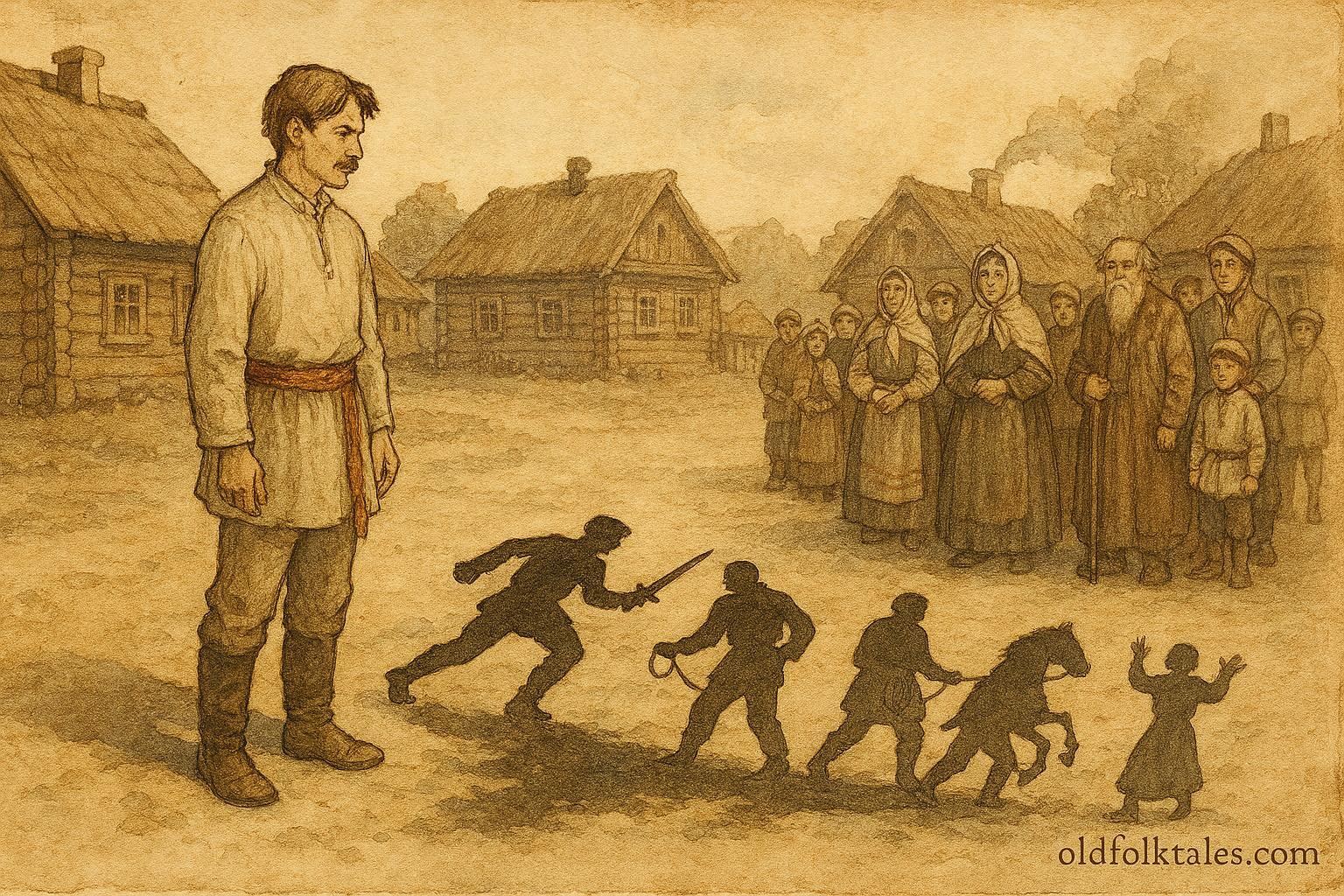
The shadow began to move, not toward the man, but among the people.
As it passed near them, its shape seemed to change. It stretched and twisted, forming images, echoes of the man’s actions.
There, in the shifting darkness, the villagers saw what had long been hidden in plain sight.
They saw him taking more than his share.
They saw him speaking harshly, driving others away.
They saw moments of unkindness, of selfishness, of disregard.
Each motion of the shadow revealed another truth.
The man stood frozen.
“No,” he said, his voice unsteady. “That is not,”
But the shadow did not stop.
It moved through the village, showing what words alone had never fully revealed.
The villagers, once silent in their discomfort, now understood clearly.
The man’s true nature had been laid bare.
When the shadow finally came to rest, it remained apart from him, still and distant.
The man stood alone.
For the first time, there was no anger in him, only the weight of what had been shown.
Days passed.
The villagers kept their distance, not out of fear this time, but out of clarity. They had seen enough to know who he was.
The man returned to his home, but it no longer felt the same. The silence there was heavier, the emptiness more pronounced.
And always, when the light returned, the shadow remained separate.
At first, the man resisted.
“It is not my fault,” he muttered to himself.
“They misunderstand.”
But the shadow did not move.
It did not follow.
It did not return.
Gradually, something within him began to shift.
He thought of the moments the shadow had shown, the words he had spoken, the choices he had made. He could no longer dismiss them. They stood before him, as clear as the shadow itself.
One morning, he stepped outside and paused.
He looked at the shadow, standing apart as it had for days.
“I see it now,” he said quietly.
There was no response—but something in the air felt different.
That day, the man did something he had not done before.
He went into the village, not to demand, not to argue, but to listen.
He spoke to those he had wronged, his voice softer than it had ever been. He offered help where he once would have refused. He gave where he once would have taken.
At first, the villagers were wary.
But as the days turned into weeks, they began to notice the change.
The man’s actions, once harsh and self-serving, grew measured and considerate. He did not seek praise, nor did he demand forgiveness. He simply continued, quietly, steadily.
And all the while, the shadow remained just beyond him.
Until one evening, as the sun lowered and cast long light across the earth, something changed.
The man stood still, watching the horizon.
Slowly, almost imperceptibly, the shadow moved.
It shifted closer.
The man did not move.
He waited.
The shadow drew nearer, its edges aligning more closely with his own. Step by step, it returned, not as it had been before, but as something restored.
At last, it settled at his feet.
Whole once more.
The man looked down, not with pride, but with understanding.
From that day on, the villagers spoke of him differently. Not as the man he had been, but as one who had changed.
And though his shadow followed him again, it was never taken for granted.
For both he and the village had learned that a shadow is not merely a shape cast by light, it is a reflection of what lies within.
Moral Lesson
A person’s true nature cannot remain hidden forever. When conscience is ignored, it may reveal itself in ways that cannot be denied—but through genuine repentance, redemption is always possible.
Knowledge Check
1. What unusual event happens to the man in the folktale?
His shadow begins to act independently and eventually separates from him completely.
2. What does the shadow represent in the story?
The shadow symbolizes the man’s conscience and the truth of his inner character.
3. How do the villagers react to the shadow’s behavior?
They become aware of his true nature as the shadow reveals his past actions.
4. What causes the shadow to fully separate from the man?
His continued cruelty and lack of accountability cause the shadow to reject him.
5. How does the man begin to change?
He reflects on his actions, shows remorse, and begins treating others with kindness and fairness.
6. When does the shadow return to him?
It returns gradually after he demonstrates genuine repentance and consistent change.
Source: Documented by Mikhail Federowski, Folk Beliefs of the Belarusian People (1901)
Cultural Origin: Belarusian moral folklore with symbolic storytelling elements