Long ago, when the forests of Västergötland were deeper and the lakes shimmered like glass under the northern sun, there stood the mighty hill of Skalunda Mountain. It rose above the surrounding land like a sleeping beast, covered in moss and birch, and crowned with great stones said to be the work of giants.
Discover the moral heart and wild spirit of the north through timeless Nordic storytelling
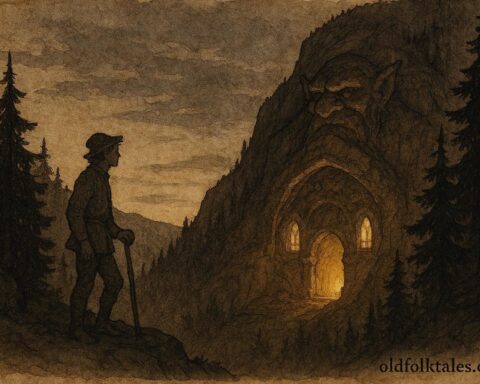
In those early days, before the land was tamed by plough and prayer, a giant lived within the mountain. He was called the Skalunda Giant, a creature of immense strength and size, with hair like tangled roots and eyes that glowed like embers. Though he lived apart from men, he watched them with curiosity and disdain, for they were small and noisy, yet daring enough to build villages on land that once belonged to his kind.
The giant lived in peace until the day the people of Skalunda built a church near the mountain’s base. Its white walls gleamed in the sunlight, and its tall spire reached toward the heavens. But what disturbed the giant most were the church bells, their clear, ringing sound echoed through the valley and up into his stony dwelling.
Each Sunday morning, when the bells began to toll, their pure tones filled the air, driving away the silence he so cherished. The sound struck the giant’s ears like iron on rock. He would groan, clutch his head, and roar so loud that the echoes shook the forest.
At last, unable to bear the bells any longer, the giant thundered down from the mountain, his heavy steps cracking the earth beneath him. Standing before the church, he bellowed so that even the steeple trembled:
“Who dares fill my valley with this clamor? Let these bells be silenced, or I shall crush them beneath my hand!”
But the villagers, trembling though they were, did not remove the bells. They told the giant that the ringing was holy, a sound of faith, calling people to worship and peace.
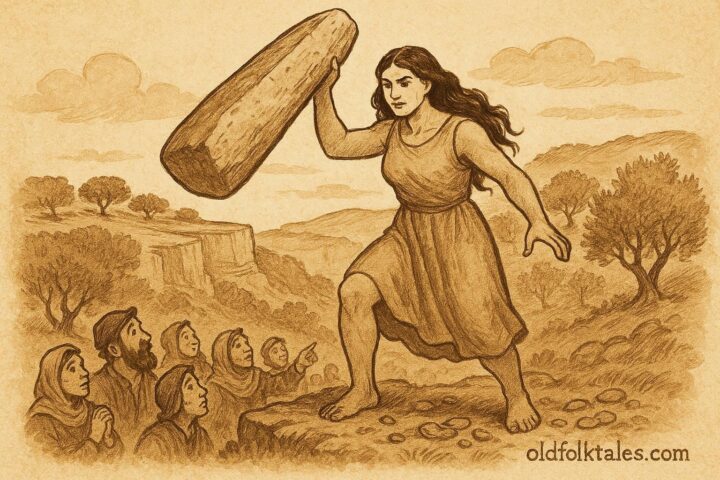
The giant’s anger burned like fire. He seized a massive boulder and hurled it toward the church, intending to smash it to dust. Yet the stone fell short, landing in the field below. Some say the hand of God guided it; others say the weight of his wrath was too heavy. The rock still lies there today, called Jättestenen, “the Giant’s Stone.”
Unable to silence the bells, the giant gathered his belongings and left Skalunda Mountain forever. With great strides, he crossed forests, rivers, and valleys until he reached a distant shore, far from the sound of men and their faith. There he built a new home in solitude, surrounded only by wind and sea.
Years passed. The village prospered, and the story of the Skalunda Giant became a legend told by fireside on long winter nights. But the giant himself lived on, for such beings do not age as men do.
One stormy night, many years later, a shipwrecked sailor was washed ashore near the very rocks where the giant now dwelt. Exhausted and freezing, he stumbled into a great cave seeking shelter. To his terror, the darkness stirred, and two burning eyes opened before him.
“Who comes here?” the giant growled, his voice rumbling like distant thunder.
The sailor, trembling but polite, answered, “I am but a poor man, shipwrecked by the storm. I seek no harm.”
The giant studied him for a moment, then grunted. “You are a brave one to stand before me and speak so. If you would warm yourself, take this iron bar and heat it in the fire.”
The sailor obeyed. As he worked, he glanced around the cave and saw heaps of broken stone, old weapons, and chains thick as tree trunks. When the iron bar glowed red, the giant said, “Now, hand it to me.”
The sailor hesitated, for the heat was fierce, but the giant insisted. Carefully, he passed the glowing bar to the massive creature. The giant took it in his hand and smiled grimly.
“So the iron still burns as bright as the church bells,” he murmured. “Even now, I cannot escape their echo.”
Then, with a hiss and a roar, the giant drove the red-hot iron into his own heart. Flames leapt from his chest, and the cave shook as his great form collapsed. When the fire died, nothing was left of him but a pile of ashes and a faint scent of smoke.
The sailor fled at dawn, and when he told the villagers what he had seen, they said the giant’s spirit had finally found peace, that even his stone heart had been softened by time, by memory, and perhaps by the sound of those distant bells.
Discover the moral heart and wild spirit of the north through timeless Nordic storytelling
Moral Lesson
The tale of the Skalunda Giant reminds us that pride and anger cannot withstand the quiet strength of faith and perseverance. Even the hardest heart, when faced with truth and time, may find peace at last.
Knowledge Check
- Where did the Skalunda Giant live?
He lived inside Skalunda Mountain in Västergötland, Sweden, near the site where a church was later built. - Why did the giant leave his home?
He could not bear the sound of the church bells that echoed through his mountain and disturbed his peace. - What did the giant do before leaving Skalunda?
In anger, he threw a massive stone toward the church, but it fell short, the boulder still lies in the field and is known as the Giant’s Stone. - Who met the giant years later?
A shipwrecked sailor who sought shelter in the giant’s seaside cave. - What was the symbolic meaning of the red-hot iron bar?
It represented the burning torment of the giant’s pride, when he pierced his heart with it, he freed himself from his inner pain. - What is the main moral of this Swedish folktale?
That peace and humility conquer even the greatest anger, and that no one can escape the echoes of their own conscience.
Source: Adapted from “The Skalunda Giant” (Svenska Folksagner, Hofberg, 1882, p.98).
Cultural Origin: Sweden (Skalunda region, Västergötland).