Beneath the sun-baked hills and winding streets of Toledo, in the heart of Castile, La Mancha, there lies a secret older than the stone walls of the city itself. Ancient caves and hidden chambers, long forgotten by ordinary citizens, conceal a slumbering king and his faithful warriors. This is the legend of the Sleeping King of Toledo, a tale whispered across generations, preserved in the verses of Gustavo Adolfo Bécquer, and recounted by those who still wander the city’s twilight streets with awe and caution.
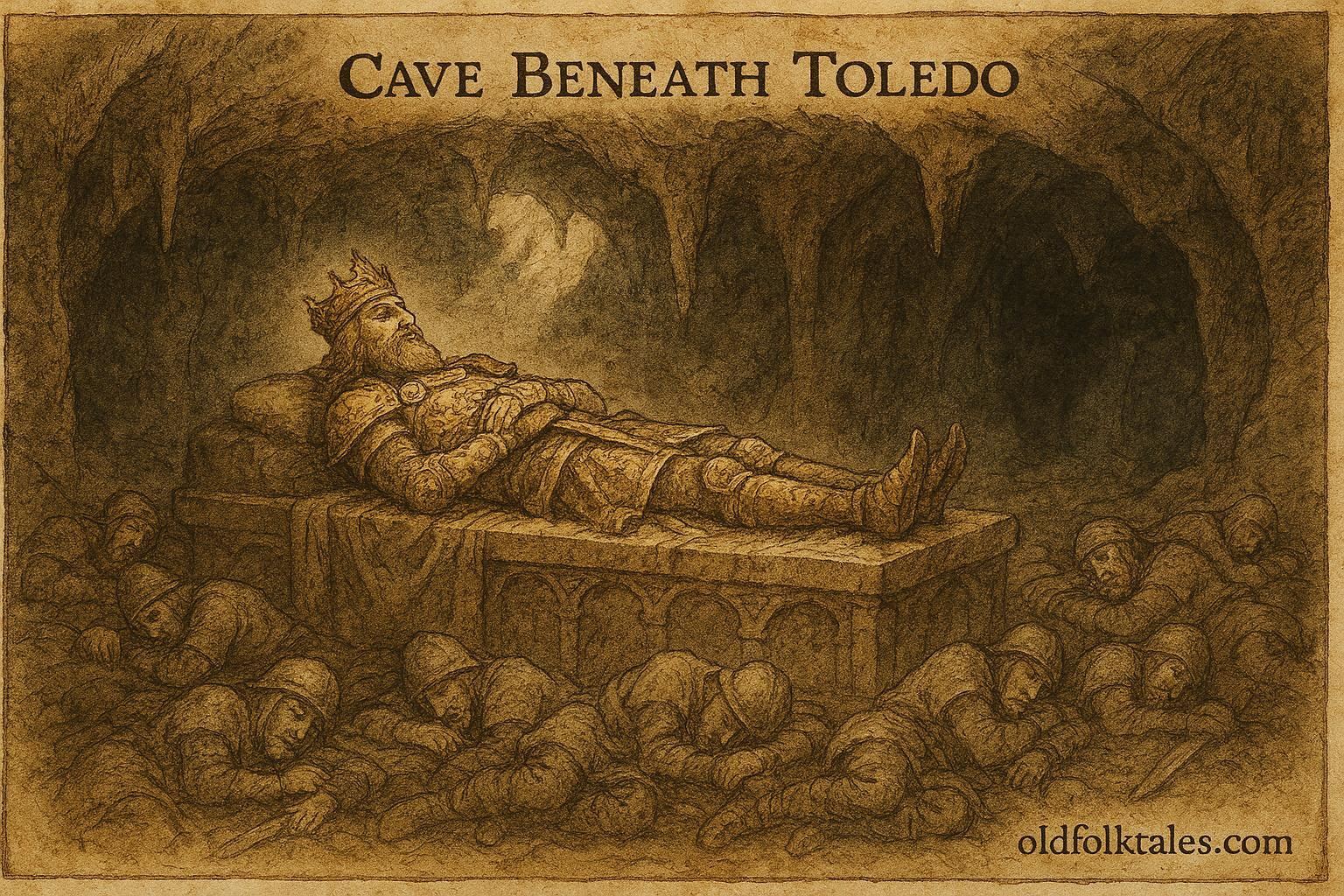
The king, a Visigothic monarch of great renown, is said to rest upon a golden bier, his hands folded over a breastplate etched with sacred symbols. Around him lie his warriors, arranged as if in eternal vigilance, their spears and shields forming a silent circle. The story says that the king sleeps not as mortals do, but in a suspended calm, protected by enchantments woven through the ages. Only when Spain faces its gravest danger will he awaken, his warriors rising from stone and shadow to defend the land.
Long ago, in the age of Visigoths, Toledo was a city of power and influence. The king ruled justly, leading armies with courage and wisdom, uniting disparate peoples beneath a single banner. Yet, as the years passed, enemies gathered along Spain’s borders, and whispers of doom reached the king’s ears. A prophecy emerged from seers and wise men: the kingdom would endure if, in its darkest hour, the king and his warriors could rise once more to defend it.
As time wore on, the king, seeing the inevitability of decline, chose to place himself in an enchanted sleep. He entrusted his faithful captains to remain ever vigilant in their resting state, bound by magic to rise only when the realm required them most. Sealed within hidden caverns beneath Toledo, they were protected from decay and oblivion, waiting through centuries of peace and peril alike.
Legends recount strange phenomena near the areas above the hidden king’s chambers. On certain nights, travelers report faint glimmers of golden light dancing along the cliffs and rocky outcroppings that guard the city. Echoes of distant horns and the clash of swords drift faintly on the wind, though no army marches above ground. The locals tell children to beware wandering too far near old ruins after sunset, for the king and his warriors are restless even in their enchanted sleep, sensing disturbances in the world above.
Stories tell of shepherds in the hills who once stumbled upon a cave glowing with a pale, unearthly light. Inside, they glimpsed armored figures, their faces calm yet vigilant, and the king lying in majestic repose. Fearful yet awed, the shepherds retreated, carrying with them tales of silent watchfulness and a destiny intertwined with the fate of Spain.
Over centuries, Toledo itself grew, overlaying roads and neighborhoods atop the hidden passages. Yet the legend persisted, surviving in whispers and manuscripts. During times of foreign invasion, the people said the king stirred, and sometimes, inexplicable phenomena seemed to confirm it. Lamps would sway in empty chambers; faint sounds of footsteps echoed through abandoned streets; shadows seemed to gather in patterns reminiscent of soldiers’ formations. These subtle signs reminded the people that the kingdom’s protector lay waiting beneath, patient and eternal.
The story of the Sleeping King serves not only as an account of prophecy but as a meditation on vigilance, duty, and the cycles of history. Spain, like the king, is bound by destiny and resilience. The tale teaches that even in apparent calm, guardianship endures, and that hope persists as long as memory remembers the deeds of the past.
Some versions of the legend expand upon the king’s virtues and fears. It is said that he dreamed of his people, imagining the fields of Toledo and the Tagus River gleaming in sunlight, the bustling marketplaces, and the harmony of churches and mosques standing side by side. Yet in his slumber, he foresaw threats: invasions, famine, and internal strife. The enchantment ensured he would awaken only at the precise moment when Spain’s survival depended upon his wisdom and courage.
Generations of villagers, scholars, and wanderers have claimed encounters with the king’s presence, though none have entered the deepest chambers. They recount visions: golden banners hovering in moonlight, the soft glint of armor under rocks, and the distant, echoing sound of a horn as though summoning the people to vigilance. These are interpreted as subtle warnings, a reminder that even hidden defenders maintain a connection with the mortal world.
In modern times, the legend endures as Toledo’s secret heartbeat. Guided tours of the city, while mostly focused on visible architecture and history, occasionally recount tales of the hidden king. Writers and poets are inspired by the idea that beneath their feet, a noble Visigothic protector lies in eternal patience. The story invites reflection on the passage of time, the continuity of cultural memory, and the moral duty to safeguard what has been entrusted to us.
Though the Sleeping King lies unseen, his tale resonates with every generation. He embodies the hope that even in periods of decline or threat, guardianship, courage, and destiny persist. The echoes of his slumbering court remind all that history is alive, and that the deeds of the past inform the protection of the future. Those who walk Toledo’s streets in quiet contemplation may still hear, in the rustling of leaves or the whisper of the Tagus, the distant warning of a king waiting for his hour.
Moral Lesson
The tale of the Sleeping King beneath Toledo teaches patience, vigilance, and hope. True guardianship endures unseen, and history, memory, and duty are intertwined with the survival of communities and nations.
Knowledge Check
1. Who is the Sleeping King of Toledo?
A Visigothic king who sleeps beneath Toledo with his warriors, destined to awaken in Spain’s greatest peril.
2. What magical arrangement protects the king and his warriors?
An enchantment keeps them in suspended slumber, ensuring they awaken only when the kingdom is threatened.
3. What phenomena are said to occur near the king’s hidden chambers?
Strange lights, echoes of horns, and shadowy formations appear, signaling the king’s vigilance even in slumber.
4. Where is Toledo located?
Toledo is in Castile, La Mancha, central Spain, along the Tagus River.
5. What themes are emphasized in this folktale?
National destiny, patience, hope, vigilance, and cycles of history.
6. Who documented the legend in written form?
The story was recorded by Gustavo Adolfo Bécquer in Leyendas (1871).
Source: Gustavo Adolfo Bécquer, Leyendas, 1871
Cultural Origin: Toledo, Castile–La Mancha, Spain