Among the highest ranges of southern Poland, where the Tatra Mountains rise like stone sentinels above the valleys of Podhale, the land holds secrets older than memory. These mountains are not merely peaks of rock and ice. To the Górale people who have lived beneath them for generations, the Tatras are living witnesses, keepers of promises made in times of sorrow and faith.
The wind that rushes through their passes carries more than cold. It carries stories.
Long before the present age, when the fate of Poland trembled beneath the weight of invasion, division, and hardship, there lived a brotherhood of knights sworn to defend the land. They were not conquerors seeking glory, nor mercenaries bound by coin. They were guardians, men who believed that the soil beneath their boots, the forests, rivers, and villages, were worth more than their own lives.
They fought where they were called, standing between danger and the helpless. Yet even courage has its limits, and there came a time when the strength of the knights alone was not enough to shield the country from suffering.
It was then that the mountains called to them.
The Journey into the Tatras
As the tale is told, the knights gathered beneath darkening skies and turned their faces southward, toward the Tatras. Snow already crowned the highest peaks, though the valleys below still breathed with late summer warmth. Shepherds who saw them pass later swore that the earth itself seemed to fall silent as the warriors climbed higher, as if the land recognized its defenders.
The knights did not march in despair. They moved with purpose, guided by an understanding that cannot be spoken aloud. Their leader, a man of great wisdom and unshaken resolve, carried a sword said to have been forged not merely of steel, but of loyalty itself. He did not raise it in anger as they ascended but held it as one would carry a sacred object.
At a hidden place known only to the mountains, the knights halted. The rock face before them appeared solid and unyielding, until it was not. With a sound like deep thunder muffled by earth, the mountain opened, revealing a cavern vast enough to swallow the light of day.
Without fear, the knights entered.
The Cavern of Waiting
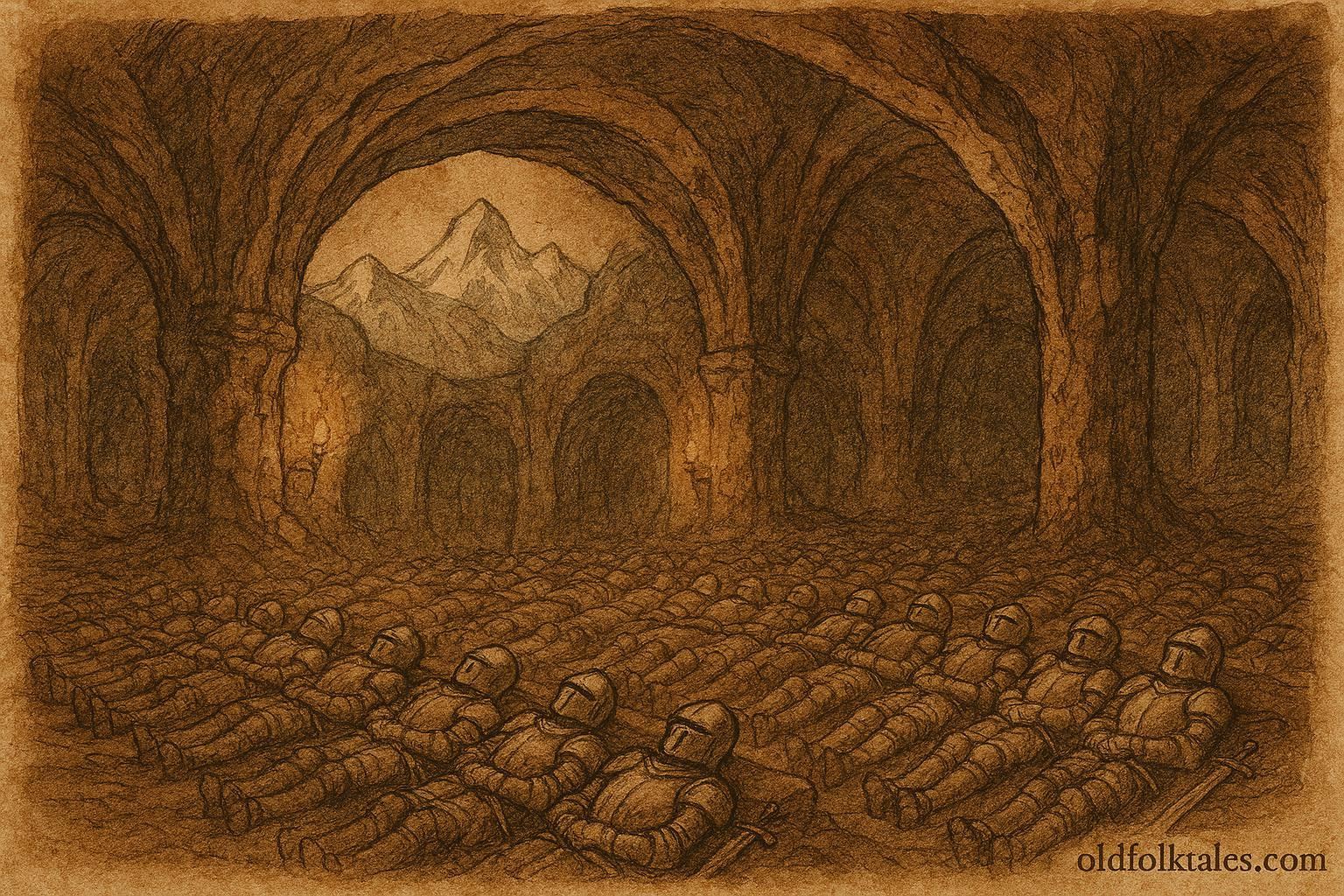
Inside the mountain lay a hall unlike any crafted by human hands. Pillars of stone rose naturally from the ground, smooth and towering, supporting a ceiling lost in shadow. The air was cool, still, and timeless. Along the walls burned torches whose flames did not flicker, casting a steady golden glow that revealed rows of stone benches and long tables carved directly from the rock.
Here, the knights laid down their burdens.
One by one, they removed their helmets and placed their swords beside them. Their armor, dulled by battle, bore marks of sacrifice rather than defeat. At the center of the hall stood a great stone table, and upon it the leader placed his sword before sitting down for the last time.
It is said that when all had taken their places, the mountain closed behind them, sealing the hall from the world above.
Then the knights slept.
Not Death, but Enchantment
The Górale are careful in how they tell this part of the story. The knights did not die beneath the mountains. Death belongs to endings, and this legend is not about an ending.
Instead, the knights were placed into an enchanted sleep, a state between waking and dreaming. Their bodies did not age. Their wounds did not fester. Their swords did not rust. Time itself seemed to slow within the mountain, as if the Tatras had chosen to preserve what mattered most.
Their leader, resting at the center of the cavern, is said to breathe steadily, his beard growing slowly over the stone table like roots seeking earth. His hand remains wrapped around the hilt of his sword, ready to rise when the moment demands it.
The knights wait, not idly, but attentively.
The Mountains as Guardians
Above the hidden hall, life in Podhale continued. Seasons turned. Empires rose and fell. Borders shifted, and generations passed. Through it all, the Tatras stood unchanged, their peaks catching the first light of dawn and the last glow of dusk.
To the Highlanders, this constancy is no accident.
They believe the mountains themselves are guardians, entrusted with sheltering the knights until the appointed hour. The Tatras are not silent out of emptiness, but out of restraint. They speak only when necessary.
When storms gather suddenly, roaring through the passes without warning, elders say the knights have stirred. When the ground trembles faintly beneath shepherds’ feet, they whisper that armor has shifted in the depths. And when thick fog rolls down the slopes, obscuring the valleys below, some claim it is the mountain’s way of shielding its secret from unworthy eyes.
Signs of Awakening
The legend holds that the knights will not rise for ordinary sorrow. Hunger, hardship, and even injustice are trials the people must endure themselves. The sleeping army is reserved for a time when the very spirit of the nation is threatened, when the land itself cries out for defense.
Only then will the mountains open once more.
When that hour comes, the Tatras will shake, and the stone doors will part. The knights will awaken, rise from their benches, and reclaim their swords. They will march down from the peaks not as conquerors, but as protectors, restoring balance where it has been broken.
Until that day, they remain hidden.
Faith Passed Through Generations
The Górale do not seek the sleeping knights. They do not climb the peaks in search of the cavern, nor do they attempt to disturb the mountains’ rest. To do so would be an act of disrespect, not only to the knights, but to the land itself.
Instead, they honor the legend through quiet faith.
Children are taught to greet the mountains with humility. Shepherds remove their hats when sudden storms rise. Travelers speak softly in high passes, mindful that they walk above something sacred.
The legend is not told to inspire fear, but reassurance.
No matter how dark the times become, Poland is not alone.
The Meaning of Waiting
In this tale, waiting is not weakness. It is endurance.
The sleeping knights represent the idea that justice may be delayed but never erased. Strength does not always appear in the moment it is desired, but when it is most needed. The land remembers those who have sworn themselves to it, and it does not abandon them, or those they protect.
As long as the Tatras stand, the promise endures.
Moral Lesson
The legend teaches that a nation’s spirit cannot be destroyed, only tested. True protection lies not only in immediate action, but in patience, faith, and the enduring bond between people and land. Even in silence, hope remains watchful.
Knowledge Check
-
Where are the knights said to be sleeping?
Beneath the Tatra Mountains in a hidden cavern. -
Who preserves this legend?
The Górale (Highlander) communities of Podhale. -
Why do the knights sleep instead of fighting?
They are preserved for Poland’s greatest hour of need. -
What role do the mountains play in the story?
They act as guardians and keepers of the knights. -
What signs suggest the knights may be stirring?
Sudden storms, trembling earth, and mountain silence. -
What is the central message of the legend?
Endurance, hope, and faith in eventual justice.
Source: Highlander (Górale) oral tradition. Recorded by Oskar Kolberg, mid-19th century (c. 1850s)
Cultural Origin: Podhale, Tatra Mountains, Poland