In the vast, snow-covered land of Russia, there once lived a weary soldier who had served faithfully in the Tsar’s army for twenty-five long years. Through countless battles and bitter winters, he had fought bravely for his homeland. But when the day of his discharge came, there was no gold, no homecoming feast, only a slip of paper declaring his freedom.
Poor and hungry, the soldier trudged along a lonely road, his thoughts heavy with disappointment. He had given his youth to service, and now, with nothing but his tattered uniform, he faced the world alone. As twilight deepened and the cold wind whispered through the birch trees, he saw a beggar sitting by the roadside.
The old man’s beard was white as frost, and his eyes glimmered with strange wisdom. “Good evening, soldier,” said the beggar kindly. “You look tired and empty-handed. What have you gained from your many years of service?”
“Nothing,” the soldier replied bitterly. “No coin, no home, no peace.”
The beggar smiled and drew from his cloak a rough, old sack. “Take this,” he said. “It will serve you better than all the Tsar’s gold. Whatever you command to enter this sack will obey. But use it with care.”
The soldier thanked the old man, slung the sack over his shoulder, and went on his way, curious to see if the gift held any power.
That evening, he stopped at a village inn, hoping for warmth and bread. But the innkeeper, a greedy man with cold eyes, refused him food. “No pay, no meal!” he barked. “Get out, old soldier!”
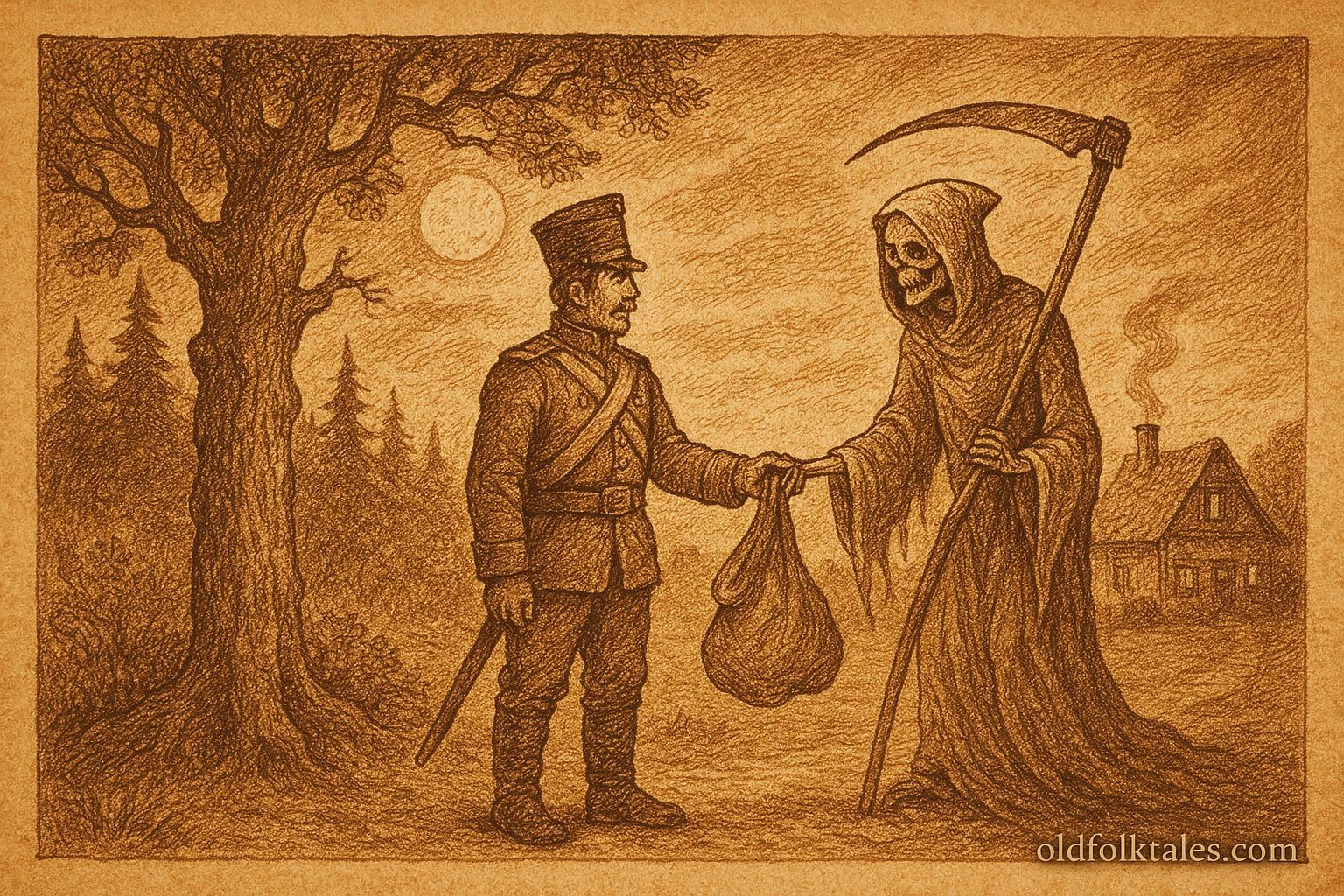
The soldier was about to leave when a sudden chill swept through the room. The candles flickered, and a tall shadow entered, the figure of Death himself, cloaked in darkness, carrying his scythe. Death walked straight to the miserly innkeeper and said in a hollow voice, “Your time has come.”
The soldier stood up and shouted, “Stop, Death! Into my sack, at once!”
To his astonishment, Death obeyed. The soldier quickly tied the mouth of the sack tight and hung it high upon an oak tree outside. Then he returned to the inn, where the fire burned brighter and the air felt suddenly lighter.
From that moment, no one died. Days turned to months, months into years, and still the world went on without the touch of Death. Soldiers wounded in battle never perished. The sick lingered endlessly. The old grew older still, groaning under the burden of their years. Even beasts and birds lived on, weary and frail, yet unable to find rest.
The world became overcrowded and sorrowful. The young despaired of inheritance, and the old prayed for peace that never came. Finally, the people cried out, “Release Death! Let life and nature follow their rightful course!”
Moved by their suffering, the soldier took his sack down from the oak and opened it. Out sprang Death, pale and trembling, yet relieved to be free. “You have bound me long enough,” Death said grimly. “But I will not forget your cunning. Still, I will spare you until your years are spent. When your time truly comes, I shall come for you as a friend.”
The soldier bowed in thanks, content that he would live long and die only when ready.
Years passed, and the soldier, now old and stooped, felt the gentle hand of Death upon his shoulder one morning. “It is time,” said Death softly.
The soldier smiled, for he had lived a full life. He followed Death willingly, and soon they reached the gates of Heaven. But the angels barred the door.
“You played tricks with Death,” they said. “There is no place for deceit here.”
So Death led him down to the fiery gates of Hell. But the devils too refused him. “We have no use for a soldier who trapped Death itself!” they cried.
And so, rejected by both Heaven and Hell, the old soldier wandered back to the Crossroads, the meeting place of the living and the dead. There he sat beneath a signpost, his faithful sack slung across his shoulder, singing a simple tune.
And it is said that sometimes, when the night is still and the stars are bright, travelers hear his voice drifting through the air, a reminder that no man, however brave or clever, can escape his destiny forever.
Moral Lesson
This Russian folktale teaches that even the cleverest tricks cannot defeat fate. Life and death are two parts of the same circle, and wisdom lies not in avoiding Death but in living honourably and accepting the balance of nature.
Knowledge Check
1. Who gave the soldier the magical sack?
A mysterious beggar who rewarded him for his service.
2. What power did the sack possess?
Whatever the soldier commanded to enter it would obey.
3. How did the soldier use the sack against Death?
He ordered Death into the sack and tied it to a tree, stopping death across the world.
4. Why did the world beg the soldier to release Death?
Because no one could die, and endless life brought suffering and weariness.
5. What happened when the soldier finally died?
He was refused entry to both Heaven and Hell for having tricked Death.
6. What is the central moral of “The Soldier and Death”?
That no one can outsmart destiny; all must accept life’s natural end.
Source: Adapted from “The Soldier and Death” in Russian Fairy Tales by W. R. S. Ralston (1873), based on Alexander Afanasyev’s collection.
Cultural Origin: Russia (Slavic oral tradition)