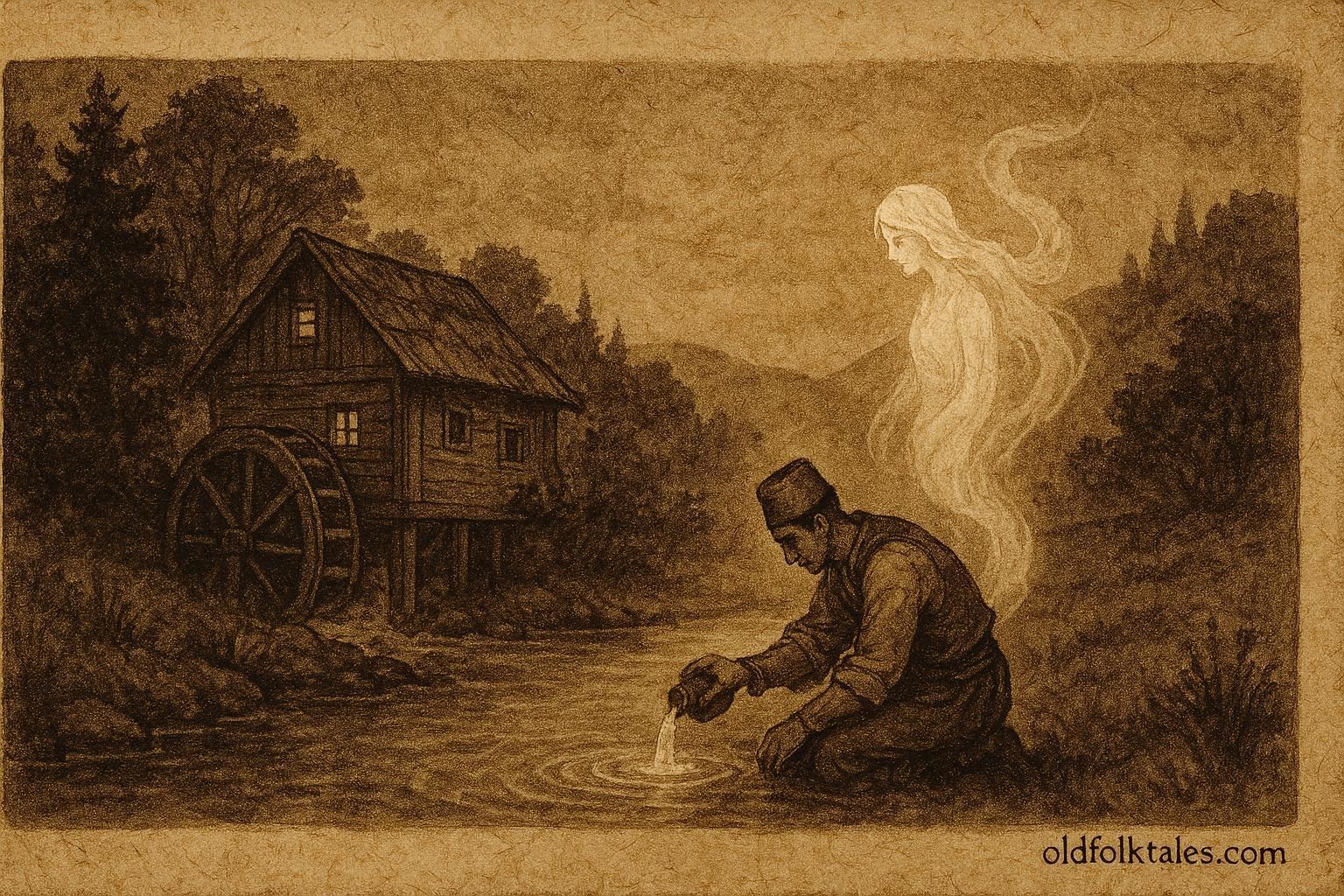
In a quiet Bosnian valley, near the edge of a birch forest, an old watermill stood by the murmuring river. The villagers called it the cursed mill, for strange things were said to happen there after dusk. The wheel creaked though no wind stirred, shadows flickered in the water, and sometimes, when the moon was full, people swore they heard a low sigh rising from inside the walls, as though the building itself breathed.
No one dared grind their grain there at night, except a poor miller named Hasan. He had inherited the mill from his late father, who had always warned him, “Never stay after sunset. The spirit wakes when the stars rise.” But Hasan, worn by hardship and eager to earn more, often lingered after dark, convincing himself that ghosts were nothing but tales for children.
The Whispering Night
One autumn evening, after a long day of work, Hasan decided to grind one last sack of corn before going home. The sun dipped behind the hills, turning the water gold, then grey. Crickets sang. The air grew heavy with mist. As the mill wheel turned slower, Hasan heard a faint whisper, a voice that seemed to rise from the churning water.
“Hasan… the toll… the toll…”
Startled, he looked around. No one was there. He tried to laugh it off, muttering that fatigue must be playing tricks on him. Yet when he turned back to his work, the sack of grain had shifted by itself. The door creaked open though he had bolted it. Cold air swept in, carrying a smell of damp earth and candle wax.
Hasan froze. The whisper came again, this time from directly behind him:
“Pay the toll, Hasan, as your father did…”
He spun around. There stood a pale, shapeless figure, a man’s outline made of mist and moonlight, eyes hollow like two dark wells. It was the Spirit of the Mill, the duh iz mlina that villagers had whispered about for generations.
The Bargain
“Who are you?” Hasan gasped, clutching a wooden spoon like a weapon.
The spirit’s voice was soft but deep, echoing like water under stone.
“I am the keeper of this place. For every grain ground after dusk, a toll is owed. Your father knew this. You have forgotten.”
Hasan trembled. “What toll do you want?”
The spirit drifted closer. “Three drops of oil and a prayer before the wheel turns at night. Nothing more. That is the old pact.”
Shame washed over Hasan. He had heard of such customs, that mills, bridges, and wells must be blessed before use, lest the spirits guarding them grow restless. He fell to his knees and whispered the prayer his father had taught him as a boy. Then he poured oil from his lamp into the water channel, murmuring words of apology.
The spirit watched in silence. As the last drop touched the stream, the figure bowed its head, fading slowly into the mist.
“Keep the pact, miller’s son,” it said. “Forget again, and the wheel will grind more than grain.”
When the dawn came, Hasan found the mill silent and still. The wheel was spotless, as though someone had washed it during the night. From that day on, he never worked past sunset, and every week, he left three drops of oil and a whispered prayer at the stream.
The Warning Ignored
Years passed. Hasan prospered modestly, and the tales of the mill spirit became a local legend. But one winter, a greedy merchant came from another village and mocked Hasan’s ritual.
“Spirits? Old superstitions,” he scoffed. “I will grind at midnight and take your customers.”
Despite Hasan’s warnings, the merchant entered the mill one cold, moonless night. The next morning, the villagers found the wheel broken, the floor soaked as if from a storm, and the merchant’s belongings scattered by the riverbank. His body was never found.
From then on, no one questioned the unseen presence guarding the mill. People left their oil and their prayers, not from fear, but from respect.
The Moral
The Spirit of the Mill reminds listeners that ancient customs often hide wisdom, respect for nature, humility before unseen forces, and the duty to honor what sustains us. Greed and disbelief, as the tale warns, can turn prosperity into peril.
Knowledge Check
1. Who is the main character in “The Spirit of the Mill”?
Hasan, a humble miller who inherits a haunted mill from his father.
2. What supernatural being appears in the story?
The Duh iz mlina, a spirit who guards the watermill and demands a ritual toll.
3. What toll does the spirit require from Hasan?
Three drops of oil and a prayer before grinding grain after dusk.
4. What happens when the merchant ignores the warning?
He disappears mysteriously, and the mill shows signs of supernatural disturbance.
5. What is the main moral of the tale?
Respect traditions and unseen powers; greed and arrogance invite misfortune.
6. What cultural elements are reflected in this folktale?
Bosnian Islamic-influenced beliefs about jinn, household spirits (prepasti), and respect for sacred customs tied to work and nature.
Cultural Origin: Bosnian folktale, Bosnia and Herzegovina.
Source: Adapted from regional oral traditions collected in 19th–20th-century Bosnian folklore anthologies.