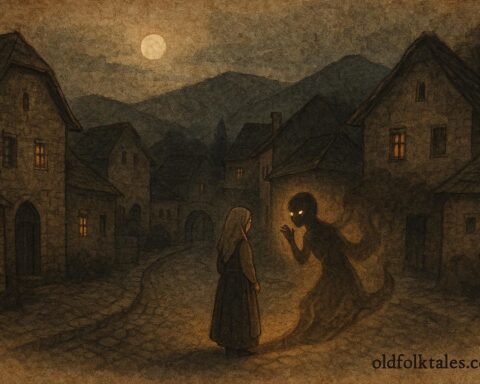
Along the northern edge of Lake Como, where mountains descend sharply into dark, still waters, the people have long believed that stone remembers what men forget. In villages clinging to the slopes and in noble houses built of cold marble, stories passed quietly from mouth to mouth, warnings shaped like legends.
Among the most feared was the tale of the Stone Guest, known in Lombardy as L’Ospite di Pietra.
This was not a story told lightly, nor to children at play. It was spoken in low voices beside hearth fires and after funerals, when bells still echoed in the hills. It concerned a nobleman of Como whose pride rose higher than the mountains themselves, and whose downfall was as final as stone.
The Arrogant Nobleman
The nobleman lived in a grand house overlooking the lake, its balconies carved from pale stone and its halls lined with statues brought from distant cities. He was wealthy, educated, and powerful, accustomed to obedience and flattery. Servants feared him, priests rebuked him gently, and neighbors avoided crossing his path.
He laughed at sermons and mocked funerary rites, calling them tools of fear meant for peasants. He boasted that death held no authority over him, and that stone was nothing more than decoration.
When an elderly noble, once his equal, died and was laid to rest in the cathedral near the lake, the arrogant man attended not out of respect, but curiosity. The tomb was newly finished, marked by a finely carved statue of the deceased, hands folded, eyes lifted in eternal prayer.
Standing before it, the nobleman laughed aloud.
“Stone cannot hear,” he said. “Stone cannot judge.”
And in a moment of reckless mockery, he struck the statue’s foot with his cane and spoke words that would seal his fate.
“If you are anything more than carved rock,” he sneered, “come dine with me tomorrow.”
Those nearby crossed themselves. No one laughed with him.
The Invitation Accepted
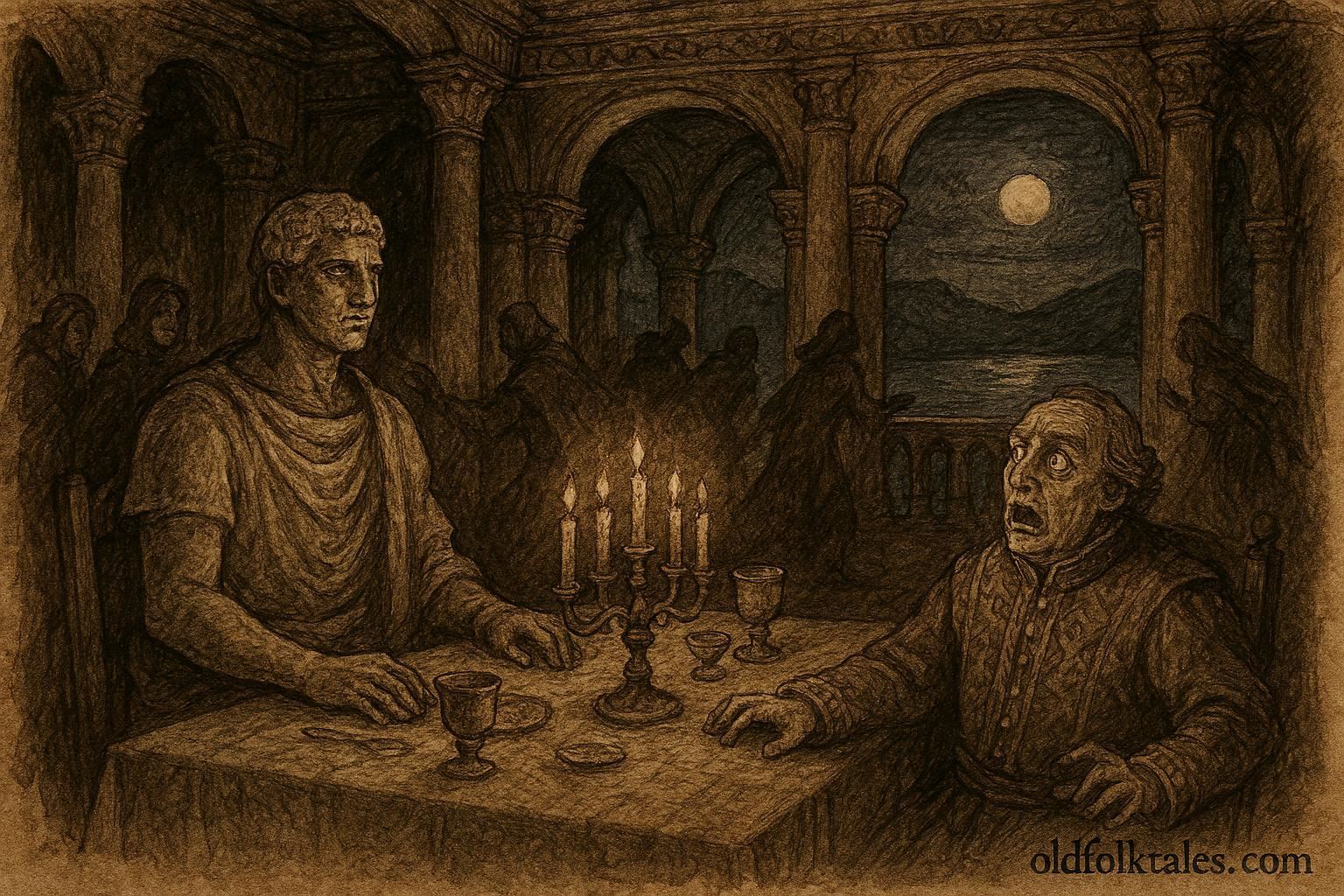
The following evening, the nobleman hosted a lavish banquet. Candles burned low in silver holders, and meats and wine filled the table. Music echoed through the hall as guests dined nervously, uneasy with the memory of the invitation made in jest.
Then, as the final course was served, a sound echoed through the house.
Heavy. Slow. Unmistakable.
Footsteps.
The doors opened without a touch, and cold air swept into the hall. There stood the statue, no longer bound to the tomb, but upright, gray, and lifeless in color, yet moving with dreadful purpose.
Its stone eyes turned toward the nobleman.
“You invited me,” the Stone Guest said, its voice grinding like rock against rock. “I have come.”
Guests fled in terror. Candles guttered. The nobleman alone remained, pale but defiant.
The Reckoning
The statue sat at the table, untouched by food or drink. Its presence chilled the room, and the nobleman’s bravado faltered for the first time. The Stone Guest spoke, not in anger, but in judgment.
It named the nobleman’s sins: his cruelty to servants, his scorn for the dead, his mockery of the sacred, his pride in believing himself beyond consequence.
“You laughed at what you did not understand,” the statue said. “You mistook silence for weakness.”
The nobleman tried to speak, to deny, to command, but his voice failed him. The Stone Guest rose and extended a stone hand.
“Now,” it said, “you will answer.”
When the nobleman touched the hand, a cold unlike any earthly chill seized him. By morning, he was found lifeless, his face frozen in terror. No wound marked him. No illness explained him.
The statue was gone.
Aftermath and Warning
The nobleman’s house stood empty for years. Some claimed to hear footsteps echoing in its halls. Others swore that on certain nights, a stone figure could be seen reflected in the lake’s black surface.
The people of Como learned what the priests had long taught: the dead are not powerless, and arrogance invites judgment.
From that day forward, no one mocked a tomb or spoke lightly of stone. The story of L’Ospite di Pietra endured, not as a threat, but as a warning carved into memory.
Moral Lesson
The Stone Guest of Como teaches that arrogance toward the sacred and the dead leads to ruin. Pride blinds judgment, but respect preserves life and honor.
Knowledge Check
1. Who is the Stone Guest in the folktale?
A stone statue of a deceased noble that returns to confront a proud man with his sins.
2. Why does the nobleman invite the statue?
Out of arrogance and mockery, believing the dead powerless.
3. What themes does the story emphasize?
Moral reckoning, respect for the dead, and consequences of pride.
4. How does the statue judge the nobleman?
By confronting him with his actions and sealing his fate through supernatural judgment.
5. What cultural tradition does this tale belong to?
Northern Italian variants of the Don Juan and Stone Guest legend.
6. Where is this version set?
Lake Como, Lombardy, Northern Italy.
Source: Northern Italian variants of the Don Juan legend, regional folklore collections, Early 17th century (circulating c. 1620s)
Cultural Origin: Lake Como, Lombardy, Italy