In the rolling plains and rugged hills of Thessaly, where golden fields stretch toward distant mountains and the wind carries the scent of thyme and wild grasses, there lay a small, remote village. Life here was simple but hard, shaped by the rhythm of the seasons and the toil of farmers tending their flocks and fields.
For generations, the villagers had known little trouble beyond the ordinary struggles of harvests, storms, and winter cold. That peace, however, would be broken in a most extraordinary way.
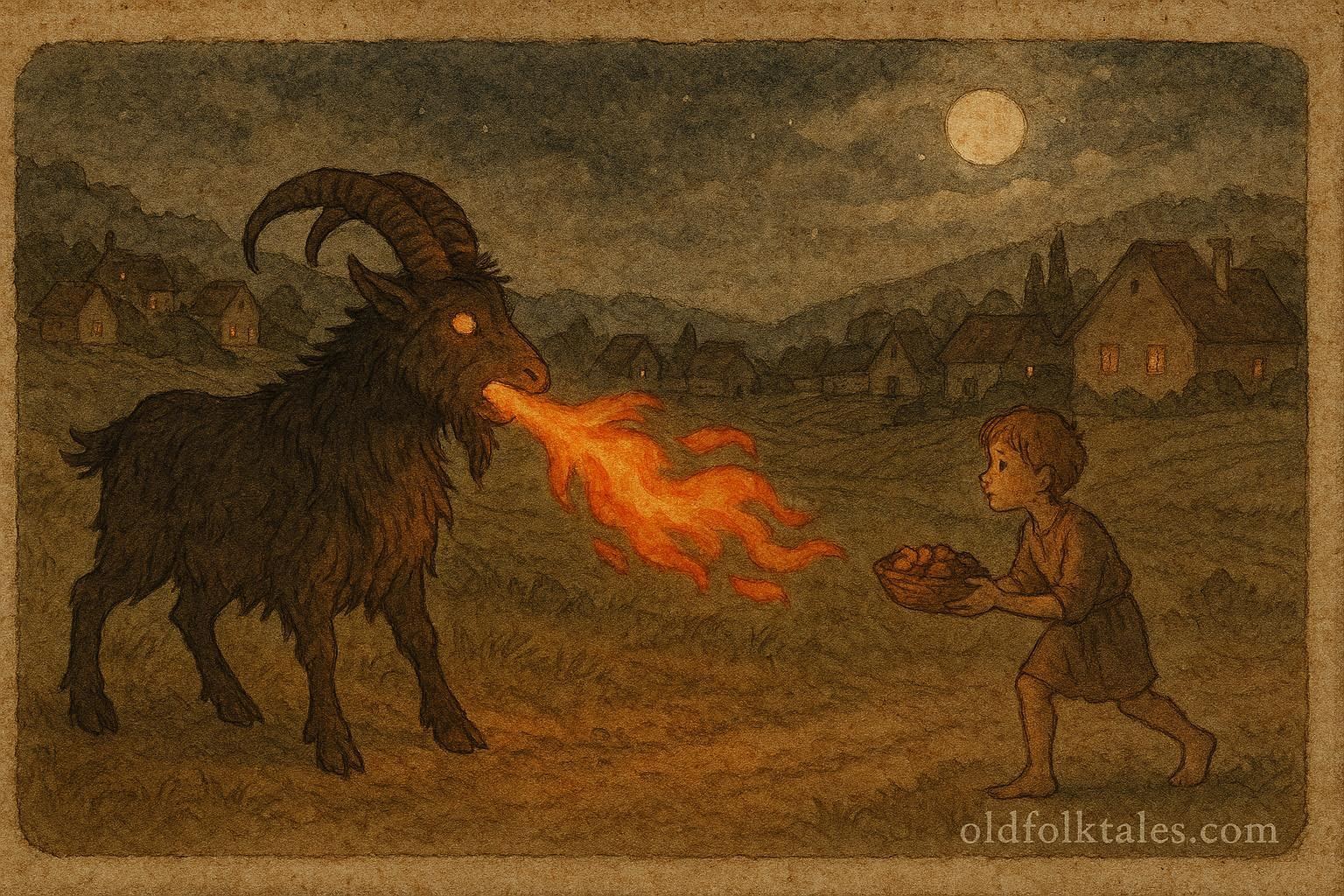
One morning, as the sun crested the hills and painted the sky with soft pinks and golds, farmers in Thessaly ran toward the village square in terror. Their crops, ripening barley, wheat, and vegetables, had been scorched overnight. The cause of this destruction was no ordinary pest. For standing among the burned fields was a goat unlike any they had seen. Its eyes glowed with an unnatural light, and smoke curled from its nostrils. When it opened its mouth, flames shot forth, leaving scorched earth wherever it trod.
The villagers could do nothing. Hoses and torches, stones and nets, none could stop the goat. Its fire seemed unstoppable, and panic spread through the village. Some whispered that the creature had been sent by angry gods; others feared the work of a powerful witch.
Among the villagers was a young man named Petros, clever and brave, though often underestimated for his youth. Unlike the others, he did not flee in fear. Instead, he studied the goat quietly, observing its behavior and noting the moments when it seemed less aggressive.
He noticed that the goat often lingered near an old, abandoned cottage on the edge of the village. Its gaze seemed drawn to the crumbling stones, and its fire, though terrifying, was not always aimed with purpose, only when the goat became startled or agitated.
Petros suspected there was more to the creature than sheer malice. Guided by both courage and curiosity, he approached the goat slowly one morning, carrying a bundle of fresh hay and a small jug of water. He spoke softly, calling its name as if he knew it, even though he did not. To his astonishment, the goat allowed him near, sniffing the offerings without flame.
Petros understood then that the goat’s fury was not natural. Someone, or something, had cursed it.
Word came from an elder that long ago, a witch had been angered by the village. Though she had left decades before, rumors held that her magic lingered, affecting the land and its creatures. Petros realized that the fire-breathing goat was a victim of this lingering spell, forced to destroy what it could not enjoy.
If he could break the curse, the village would be saved, and the goat spared.
For three nights, Petros watched and studied. He brought herbs, fresh water, and tokens of kindness, learning the goat’s routines and understanding its fears. He spoke to it as if it could hear his intentions, reassuring it and guiding it away from the villagers’ homes. Slowly, the goat’s flames became less frequent, its movements calmer, and its eyes, once wild, softened with trust.
On the fourth night, Petros took a final step. He placed an offering of bread, olive oil, and flowers at the foot of the old cottage, the place the goat seemed most drawn to. Then he spoke aloud, invoking goodwill:
“Spirit of the land, protector of the creatures, let this curse be lifted. Let the fire vanish, and let this goat be free, as it was meant to be.”
A gentle wind rustled through the trees, carrying the scent of wildflowers and smoke. The goat stirred, then exhaled softly, no fire, only a wisp of harmless smoke. The flames that had terrorized the village were gone, replaced by calm warmth, and the curse was broken.
The villagers awoke to find their fields unharmed and the goat grazing peacefully at the edge of the village. Petros explained what he had done, though he never boasted of his courage. Instead, he reminded everyone that it was the combination of bravery, cleverness, and kindness that had saved them all.
From that day onward, the goat lived among the villagers as a gentle creature, a guardian rather than a threat. And Petros, once underestimated, became respected for his wisdom, courage, and compassion.
Even now, Thessalian storytellers recount the tale. They speak of how courage, intelligence, and kindness, rather than brute strength, can overcome even the most dangerous magic. The Fire-Breathing Goat serves as a reminder that appearances can be deceiving and that wisdom often lies in understanding and compassion rather than fear and force.
Moral Lesson
The Tale of the Fire-Breathing Goat of Thessaly teaches that courage, intelligence, and compassion can break curses and resolve conflict. True heroism comes from understanding and kindness, not brute strength or fear.
Knowledge Check
1. What creature terrorizes the village in the folktale?
A magical, fire-breathing goat cursed by a witch.
2. Who discovers the secret behind the goat’s fire?
Petros, a brave and clever young villager.
3. How does Petros lift the curse?
Through observation, kindness, offerings, and invoking goodwill, he calms the goat and removes the spell.
4. What does the goat symbolize in this story?
It represents the consequences of magic and the importance of compassion to resolve conflict.
5. What central themes are explored in the folktale?
Courage, resourcefulness, the impact of magic, and community protection.
6. Where does this folktale originate?
From Thessaly in central Greece, documented by Georgios A. Megas around 1953.
Source: Greek Folk Tales by Georgios A. Megas, c. 1953 CE
Cultural Origin: Greece (Thessaly)