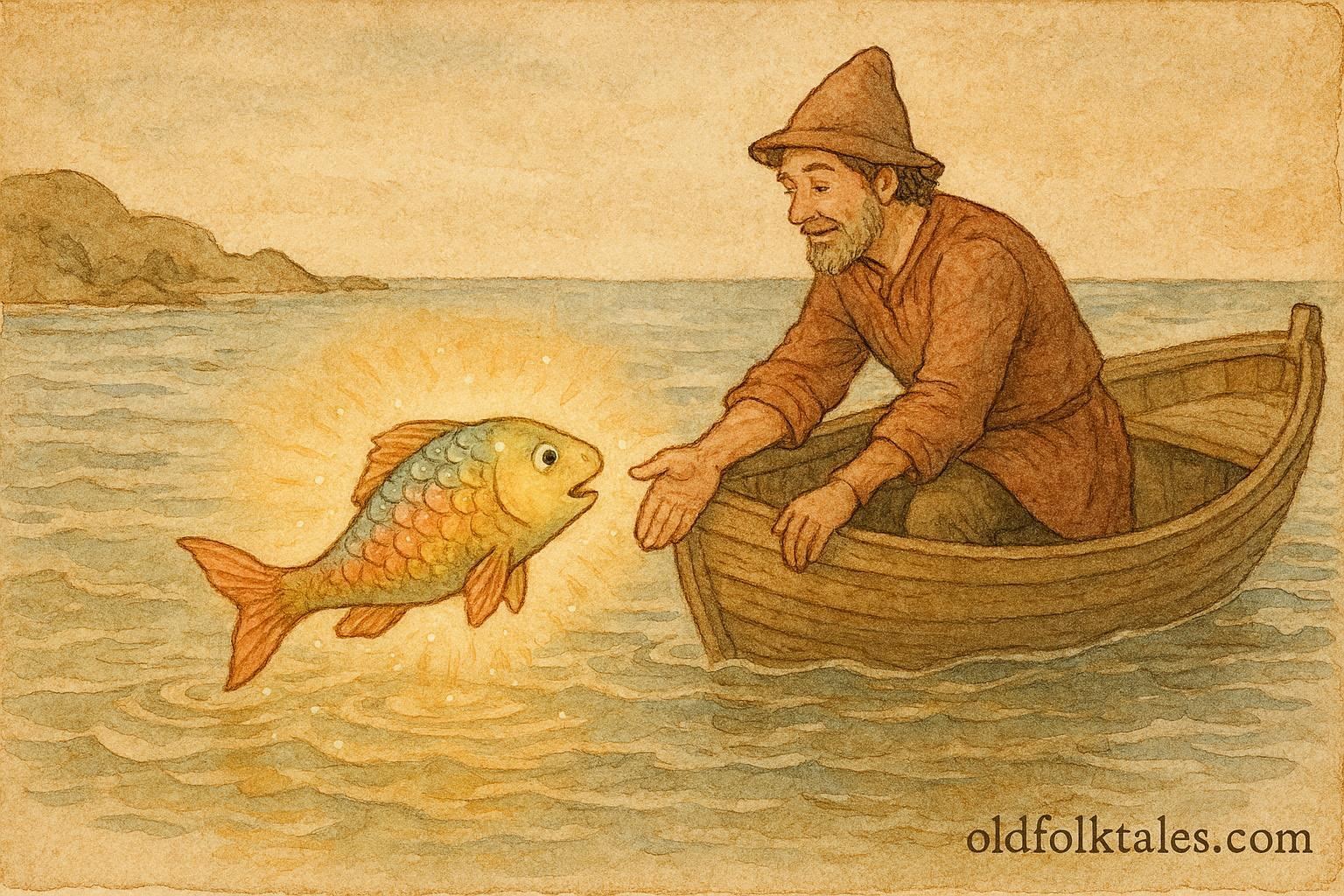
Along the rocky, sun-baked shores of Albania’s Adriatic coast, there lived a fisherman named Dritan. His life was humble and simple: each morning he rowed his small wooden boat into the deep blue waters, casting his nets in hopes of a catch sufficient for his family. Though poor, Dritan was hardworking, patient, and respectful of the sea that sustained him.
One morning, as the sun began to gild the waves with streaks of gold, Dritan cast his nets into a quiet cove where the waters shimmered like liquid glass. Pulling the net with effort, he was astonished to find not the usual flounder or mackerel, but a fish unlike any he had ever seen. Its scales sparkled in rainbow hues, and its eyes glimmered with an uncanny intelligence.
Discover Polish, Russian, Ukrainian, and Belarusian folktales where magic and morality meet
Before Dritan could examine it further, the fish spoke:
“Fisherman, release me, and I shall grant you wealth, happiness, and prosperity beyond your dreams. But heed this: the gifts come only if you act with humility and gratitude.”
Dritan blinked, unsure whether he was dreaming. Yet the voice was firm, kind, and insistent. Remembering the hardships he and his family endured, he carefully lifted the fish from the net and set it free into the deep. Immediately, the waters seemed to sparkle more brightly, and a gentle warmth flowed through him, as if the sea itself were blessing his act of mercy.
Returning to his village, Dritan was greeted by neighbors curious about his catch. He told them of the talking fish and its promise, though he kept his wealth modest, mindful of the fish’s warning about humility.
Days passed, and Dritan’s fortune seemed to blossom. His nets were always full, the fish abundant, and small favors and luck followed him wherever he went. His family’s home, once cramped and damp, grew sturdier, and his neighbors marveled at the miraculous turn of events. Yet even as he prospered, whispers of doubt and desire crept into Dritan’s mind.
“What if I asked for more?” he thought. “Surely the fish could grant greater wealth, finer clothes, even lands beyond our village.”
Temptation tugged at him, and though he recalled the fish’s warning, greed clouded his reason. One evening, under the pale light of a crescent moon, Dritan set out in his boat once more, hoping to find the magical fish again. He rowed to the same cove where the encounter had first occurred, calling out into the waves:
“Fish of rainbow scales, I have come to ask more! Grant me wealth greater than the richest man in the land!”
The waters stirred, and the fish emerged, its scales shimmering like molten jewels. Its voice, though calm, carried a note of disappointment:
“Fisherman, you have asked not for need but for excess. Remember the gifts of humility and respect. I warned you: greed cannot bring happiness.”
Yet Dritan, blinded by desire, ignored the warning. “I deserve more than mere fortune,” he insisted. “I want treasures, lands, and the admiration of all.”
With a sorrowful glance, the fish flicked its tail, and a shimmering mist rose from the water, enveloping Dritan. Instantly, the abundance that had blessed him vanished: his nets were empty, his home seemed smaller, and the fields surrounding his village yielded nothing. Even his neighbors, once friendly, now seemed distant, for the fish’s magic had retreated, leaving only the natural world’s impartial rhythm.
Dritan returned home, bewildered and sorrowful. The villagers whispered that he had angered the sea and the spirits within it. Alone that night, he pondered the fish’s words and realized the gravity of his folly. He had taken what was freely given, but sought to exceed the bounds of gratitude. Humility, he now understood, was not weakness, it was the path to lasting prosperity and respect.
Determined to restore balance, Dritan spent the following days mending his nets, tending his modest catch with care, and offering thanks for the simplest blessings. He no longer sought wealth beyond need, and he shared what little he had with neighbors and travelers. Though his fortune did not return in extravagant form, he discovered something more valuable: contentment, respect from his community, and a sense of harmony with the sea.
One morning, as he cast his nets into the waters he now revered, a familiar shimmer caught his eye. The rainbow-scaled fish appeared once more, hovering just beneath the surface. Its voice was gentle, approving:
“Fisherman, you have learned the lesson of humility and respect. Fortune is not only measured by gold, but by gratitude and care for the world around you. I leave you with this gift: continue your life with wisdom, and the sea will always favor you.”
With that, the fish vanished into the deep, leaving Dritan with a renewed heart. Though he never grew rich by human standards, he lived in harmony with the sea, his family safe and cared for, and his reputation as a man of wisdom and integrity spread far beyond the coastal villages.
From that day onward, the tale of Dritan and the talking fish was told along the shores and marketplaces of Albania. It reminded all who heard it that the gifts of the magical and natural world are to be cherished, respected, and never taken for granted. Humility, patience, and gratitude were not mere virtues, they were the keys to lasting happiness.
Moral Lesson
Greed leads to loss, while humility and respect for the natural and supernatural world bring lasting rewards. True prosperity lies in wisdom, gratitude, and harmony with the world.
Knowledge Check
1. Who was the protagonist of the story?
Dritan, a humble fisherman living along Albania’s coast.
2. What magical creature does he encounter?
A talking fish with rainbow-colored scales.
3. What promise does the fish make?
To grant wealth and happiness if Dritan releases it and remains humble.
4. How does Dritan initially respond to temptation?
He succumbs to greed, asking for excessive wealth, and loses the blessings he had gained.
5. What lesson does Dritan ultimately learn?
Humility, gratitude, and respect for nature bring lasting prosperity, while greed destroys blessings.
6. What is the cultural origin of the story?
Albanian coastal communities, blending everyday life with magical folklore.
Source: Gjergj Fishta, Histori e Pasqyruar në Legjenda (1913)
Cultural Origin: Albanian coastal folklore, combining maritime life with magical realism