In the heart of the Serbian mountains, where ancient forests whisper old secrets and rivers run clear as glass, there once lived three brothers. They were the sons of a poor farmer but possessed hearts filled with restless ambition. Tales had spread throughout the land that a mighty dragon had stolen the king’s only daughter, a princess of rare beauty and grace. The creature had taken her to its fiery lair deep within the mountains, and no warrior or prince had yet returned from the rescue attempts.
The king, in despair, proclaimed across the kingdom that whoever slew the dragon and freed his daughter would win her hand in marriage and half the realm besides. This promise stirred the hearts of many, including the three brothers. Each vowed to attempt the quest, though their reasons differed.
The eldest, proud and boastful, sought glory and riches. The middle brother desired the princess’s beauty and the crown that came with her hand. The youngest, quiet and kind-hearted, longed only to serve his king and do what was right. The others laughed at him.
“You?” scoffed the eldest. “You can barely wield a sword!”
“Stay home,” added the middle one. “You’ll only shame us.”
But the youngest merely smiled. “The road will judge us all,” he said.
So the three brothers set forth, armed with swords and courage, toward the dark mountains where the dragon’s shadow was said to blot out the sun.
Their path was not easy. The first trial was a river of fire, whose molten waves burned anything that touched them. The eldest brother, eager to prove his strength, charged forward but was driven back by the scorching heat. The second tried to leap from stone to stone but slipped and singed his boots. The youngest observed carefully, cut a great tree, and laid it across the river, forming a bridge. Quietly and with patience, he led his brothers across.
“Beginner’s luck,” grumbled the eldest.
Next, they entered a valley haunted by enchanted wolves, their eyes glowing red as embers. The beasts pounced from the shadows. The eldest swung wildly, his sword clanging uselessly. The middle brother fled behind a boulder. But the youngest faced them calmly. He remembered his mother’s wisdom, that even wild things respect courage, and struck his blade upon a rock three times. The sound rang pure through the air, and the wolves, subdued by his bravery, lowered their heads and vanished into the forest mist.
Still, his brothers offered no thanks.
Finally, the three reached the mouth of a cave so vast and black that it seemed to swallow the light. The dragon’s lair reeked of smoke and iron, and deep within, they heard the faint cry of the imprisoned princess. The brothers trembled.
The eldest whispered, “Let us draw lots for who enters first.”
But before the lot was cast, the youngest stepped forward. “No need,” he said quietly. “I came to fight, not to hide.”
And so he entered the darkness alone.
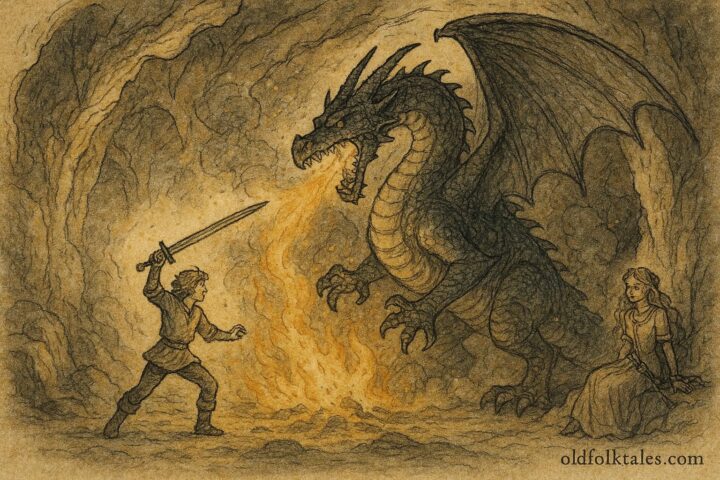
For three days and three nights, he battled the dragon. The earth shook beneath their struggle. Fire lit up the cave as if a new sun had been born underground. The dragon’s scales were like armor, its breath like a storm, yet the youth fought on, unyielding. At last, with one mighty strike of his sword, he drove the blade into the beast’s heart. The creature roared once, and then all was still.
Exhausted, the young hero found the princess chained to a stone pillar. With trembling hands, he freed her and gave her water from his flask. She gazed at him with gratitude.
“You are the bravest man in the world,” she whispered.
He smiled faintly. “The world will not know that if I die of sleep.” And before he could say more, fatigue overcame him, and he fell into a deep slumber beside the dragon’s corpse.
When his brothers, who had been hiding near the cave entrance, heard silence, they crept inside. There they found the princess safe and the dragon slain. Seeing their brother asleep, they exchanged wicked glances.
“Why should he have all the glory?” muttered the eldest.
“He is young and weak,” said the other. “The king will never know.”
And so they carried the princess away, leaving the hero lying among the dragon’s ashes.
But before leaving, the princess, wise and kind-hearted, slipped her golden ring upon the youngest brother’s finger while he slept. “This,” she whispered, “will tell the truth when words cannot.”
When the young man awoke, the cave was empty. His heart sank, but he followed their trail through forests and hills until he reached the king’s palace. There, he saw his brothers standing proudly beside the princess, claiming to be her rescuers.
Yet when the king asked his daughter to speak, she bowed low and said, “My lord, only one man fought the dragon. He bears my ring upon his hand.”
The hall fell silent. The youngest brother stepped forward and showed the ring. His brothers’ faces turned pale. The truth was revealed, and justice followed swiftly. The king ordered the traitors to be punished and embraced the true hero.
“You are worthy not only of my daughter,” he said, “but of my crown.”
And so the humble brother married the princess, while his brothers were cast out. The land rejoiced, and peace reigned again under the wisdom of a ruler who had proven his courage not through pride, but through heart.
Moral Lesson
This Serbian folktale teaches that true bravery lies not in boasting or strength, but in purity of heart and selfless courage. Deceit may win for a moment, but truth endures forever.
Knowledge Check
-
Who were the main characters in “The Three Brothers and the Dragon”?
Three brothers, a kidnapped princess, and the dragon guarding her. -
What challenges did the brothers face before meeting the dragon?
They crossed a river of fire, fought enchanted wolves, and entered a dark cave. -
How did the youngest brother defeat the dragon?
He fought bravely for three days and nights and struck the beast through the heart. -
What symbol proved the true hero’s identity?
The princess’s golden ring placed on his hand. -
What was the fate of the two older brothers?
They were punished for their deceit and lost their honour. -
What is the main moral of this Serbian folktale?
That humility, courage, and honesty bring lasting reward, while greed leads to downfall.
Source: Adapted from the Serbian folktale “The Three Brothers and the Dragon” in Serbian Folk-Tales, collected by Vuk Stefanović Karadžić; trans. Elodie Lawton Mijatovich (1915), London: George Allen & Unwin.
Cultural Origin: Serbia (Dragon-slayer motif, Eastern Serbian oral tradition).