In the heart of the Ukrainian countryside, where rolling fields met deep forests and rivers carved their paths through the land, there lived an old man with his three sons. Their home stood at the edge of a village, simple yet sturdy, and though their lives were modest, they were bound together by shared labor and quiet endurance.
The two elder brothers were strong and proud. They carried themselves with confidence, believing that strength and boldness were enough to shape their futures. They spoke loudly, acted quickly, and sought recognition wherever they went.
The youngest brother was different.
He spoke less, observed more, and acted with care. Where his brothers saw only obstacles to overcome, he often saw something worth understanding.
Because of this, he was often overlooked.
“You think too much,” his brothers would say. “The world favors those who act.”
But the youngest did not argue. He simply listened.
One day, news spread through the land of a great opportunity. A distant ruler had set forth a challenge, those who could complete a series of difficult tasks would earn honor and reward beyond measure.
The three brothers, eager to prove themselves, decided to set out together.
Their father, though old, stood at the door as they prepared to leave.
“Remember,” he said, “it is not only strength that carries a man forward.”
The elder brothers nodded, though they paid little attention.
The youngest listened carefully.
And so, they began their journey.
They traveled across fields and through forests, their path long and uncertain. At first, they moved together, their steps steady, their spirits high.
But as time passed, their differences became clear.
The elder brothers pushed ahead, eager to reach their destination quickly. They dismissed delays, avoided anything that might slow them down, and paid little attention to the world around them.
The youngest, however, moved with patience.
One evening, as the sun lowered and shadows stretched across the forest floor, the brothers came upon something unusual.
In a clearing stood a figure unlike any they had seen.
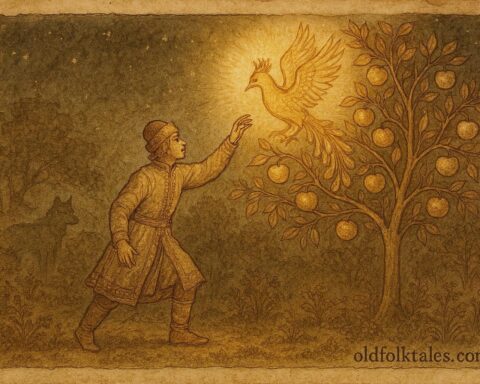
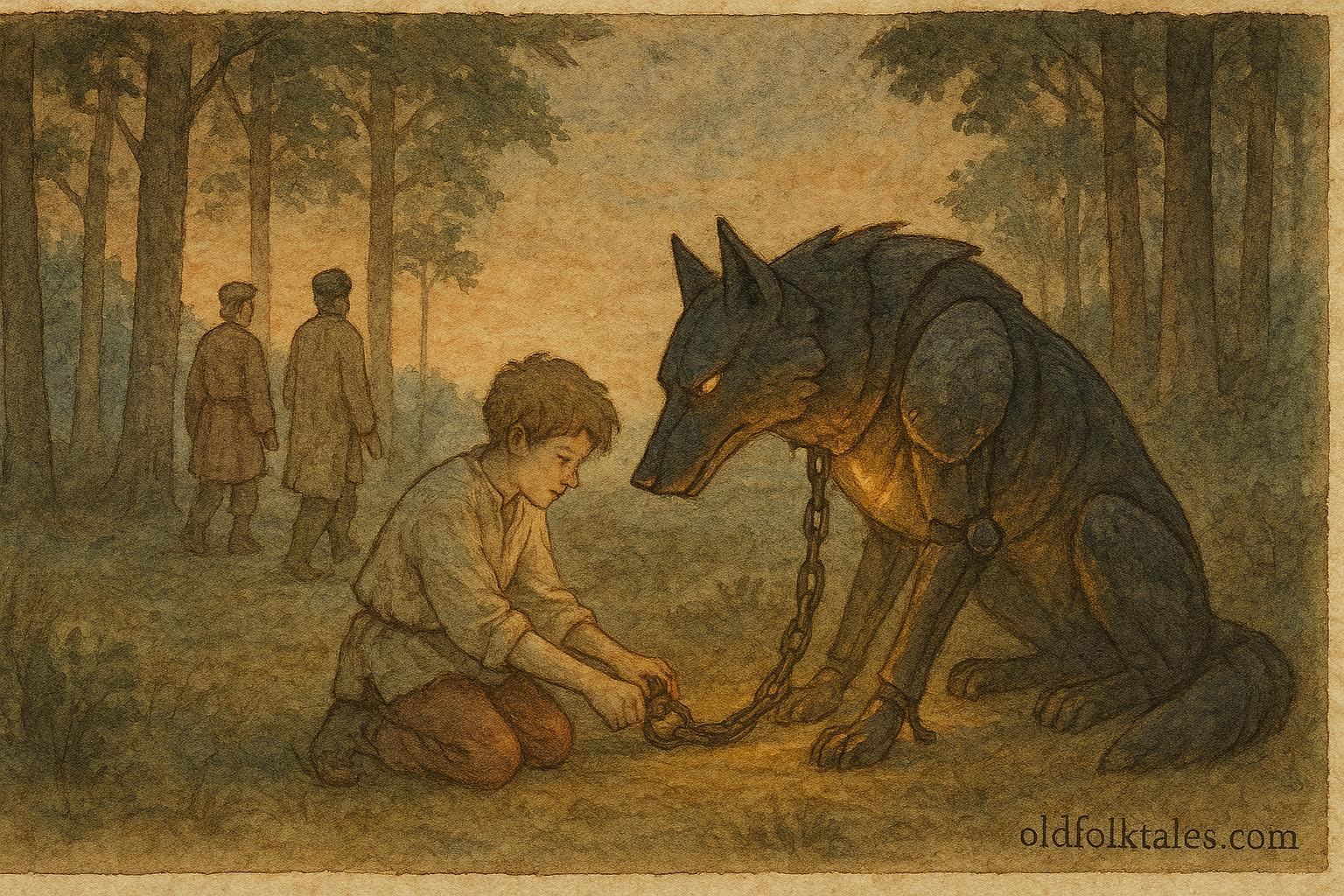
It was a wolf.
But not a creature of flesh and fur.
Its body gleamed faintly in the fading light, as though forged from iron. Its form was strong, its presence commanding, and its eyes held a quiet awareness that seemed almost human.
The elder brothers recoiled.
“A cursed thing,” one said.
“Leave it,” said the other. “It is not our concern.”
They moved on without hesitation.
But the youngest remained.
He stepped closer, though cautiously.
The wolf did not move.
It simply watched him.
The boy noticed something then, a subtle stiffness in the creature’s stance, as though it were bound by something unseen.
“You are not free,” the youngest said softly.
The wolf’s eyes seemed to sharpen.
The boy looked around and saw what the others had not, a heavy iron chain, partially hidden, holding the creature in place.
Without speaking further, he approached and carefully loosened the chain.
The metal resisted at first, but with patience and effort, he freed it.
When the last link fell away, the wolf stepped forward.
For a moment, it stood still.
Then, it spoke.
“You have shown kindness where others showed only fear,” it said.
The youngest did not step back.
“I saw that you were bound,” he replied.
“And you chose to act,” the wolf said. “For this, I will not forget.”
The boy nodded.
“Then go freely,” he said.
The wolf turned, its form catching the last light of the day.
“I will find you again,” it said.
And then it was gone.
The youngest hurried to catch up with his brothers.
When he told them what had happened, they laughed.
“You waste time on strange things,” they said. “That will not win you honor.”
The youngest said nothing.
In time, they reached the place of challenge.
Before them stood the ruler’s domain, vast and imposing. Many had gathered there, each hoping to succeed where others had failed.
The tasks were announced.
They were not simple.
Each required not only strength, but thought, precision, and endurance.
The elder brothers stepped forward confidently.
But one by one, they failed.
They acted quickly, without understanding the nature of the tasks, and found themselves unable to complete what was required.
The youngest waited.
He observed.
He listened.
When his turn came, he stepped forward, not with certainty, but with readiness.
It was then that the iron wolf returned.
It appeared beside him as if it had always been there, its presence steady and unwavering.
“I have come,” it said quietly, unheard by others.
The youngest felt a sense of calm.
“You remember,” he said.
“I remember,” the wolf replied.
The first task was set before him, one that seemed impossible at first glance. But the wolf guided him, offering quiet direction, helping him see what others had missed.
Together, they succeeded.
The second task followed, more difficult than the first.
Again, the wolf stood beside him, not acting in his place, but guiding him, showing him where to step, when to wait, and how to act.
Once more, he succeeded.
The elder brothers watched in disbelief.
“How is this possible?” they whispered.
But the youngest did not boast.
He simply continued.
The final task was the most difficult of all, a challenge that tested not only ability, but courage.
For a moment, even the youngest hesitated.
But the wolf remained beside him.
“Trust what you have learned,” it said.
The boy nodded.
And with that, he stepped forward and completed the task.
When it was done, silence filled the space.
Then, slowly, it gave way to recognition.
The ruler acknowledged him, not for strength alone, but for the wisdom and balance he had shown.
The elder brothers stood apart, their confidence shaken.
The youngest, once overlooked, had achieved what they could not.
When the time came to return home, the iron wolf stood once more beside him.
“You have done well,” it said.
“I could not have done it alone,” the boy replied.
The wolf inclined its head.
“Kindness is never lost,” it said. “It returns when it is needed most.”
Then, as quietly as it had come, it disappeared.
The youngest returned home, not with pride, but with understanding.
His brothers, though slower to accept it, began to see what they had missed, that strength alone is not enough, and that the smallest act of kindness can shape the greatest outcome.
And in time, the story of the iron wolf and the youngest brother was told across the land, not as a tale of victory alone, but as a reminder.
That those who are overlooked may carry the greatest strength of all.
Moral Lesson
Kindness and patience often lead to rewards that strength alone cannot achieve. Those who act with compassion may find help in the most unexpected forms.
Knowledge Check
1. What made the youngest brother different from his siblings?
He was thoughtful, patient, and kind, unlike his proud and impulsive brothers.
2. What was unusual about the wolf they encountered?
It was an iron wolf, a magical creature bound by a chain.
3. How did the youngest brother help the wolf?
He freed it from its chain instead of ignoring or fearing it.
4. How did the wolf repay the boy’s kindness?
It guided him through difficult tasks and helped him succeed.
5. Why did the older brothers fail the challenges?
They relied only on strength and did not think carefully about the tasks.
6. What is the main lesson of the story?
Kindness and wisdom can lead to success where strength alone fails.
Source: Collected in Ukrainian folktale compilations (≈1895)
Cultural Origin: Central Ukrainian heroic folklore with mythological animal symbolism