In the days when the Kingdom of Naples lay under a blazing southern sun and the hills rang with shepherd songs and church bells, there lived a young prince whose heart was restless and unfulfilled. Though he lacked nothing in wealth or comfort, a strange melancholy followed him like a shadow. No laughter pleased him for long, no feast satisfied his spirit. His parents, the king and queen, watched with growing concern as their son wandered the palace halls in silence, gazing beyond the city walls as if searching for something the world had hidden from him.
One day, as fate would have it, the prince passed beneath an old balcony where an elderly woman sat spinning flax. Her fingers moved swiftly, yet the thread snapped suddenly, falling useless to the ground. The old woman cursed aloud, and the prince, startled from his thoughts, burst into unexpected laughter. It was the first true laughter he had given in many months.
The old woman looked down at him sharply. “You laugh,” she said, “but do you know what would truly satisfy your heart?”
The prince, amused, answered lightly that he did not.
“You will find no peace,” she declared, “until you possess the Three Citrons.”
At her words, laughter vanished from the prince’s face. He felt as though an unseen hand had tightened around his chest. Before he could ask more, the woman vanished from the balcony as though she had never been there.
From that moment on, the prince could think of nothing else. The Three Citrons haunted his thoughts by day and troubled his dreams by night. He asked scholars, courtiers, and travelers what they knew of these citrons, but none could give him clear answers. Some laughed, others warned him that such objects were bound to danger. Yet the more obstacles placed before him, the stronger his resolve grew.
Against his parents’ wishes, the prince prepared for a journey. He dressed not in royal finery but as a traveler, taking only a sword, a purse of coins, and a heart filled with longing. Leaving Naples behind, he crossed scorched plains, rocky hills, and lonely roads where the wind carried whispers of ancient magic.
After many hardships, the prince encountered a powerful fairy who guarded the path to the citrons. She tested him not with strength, but with patience and humility. Only when he answered her riddles honestly and treated her with respect did she reveal the truth: the Three Citrons were hidden beyond great dangers, guarded by fierce forces that preyed on the careless and the proud.
With guidance reluctantly given, the prince continued. He crossed burning lands where no water flowed and shade was scarce. His strength waned, but his determination did not. At last, he reached a desolate place where a monstrous guardian slept beside a tree heavy with golden citrons, three and only three.
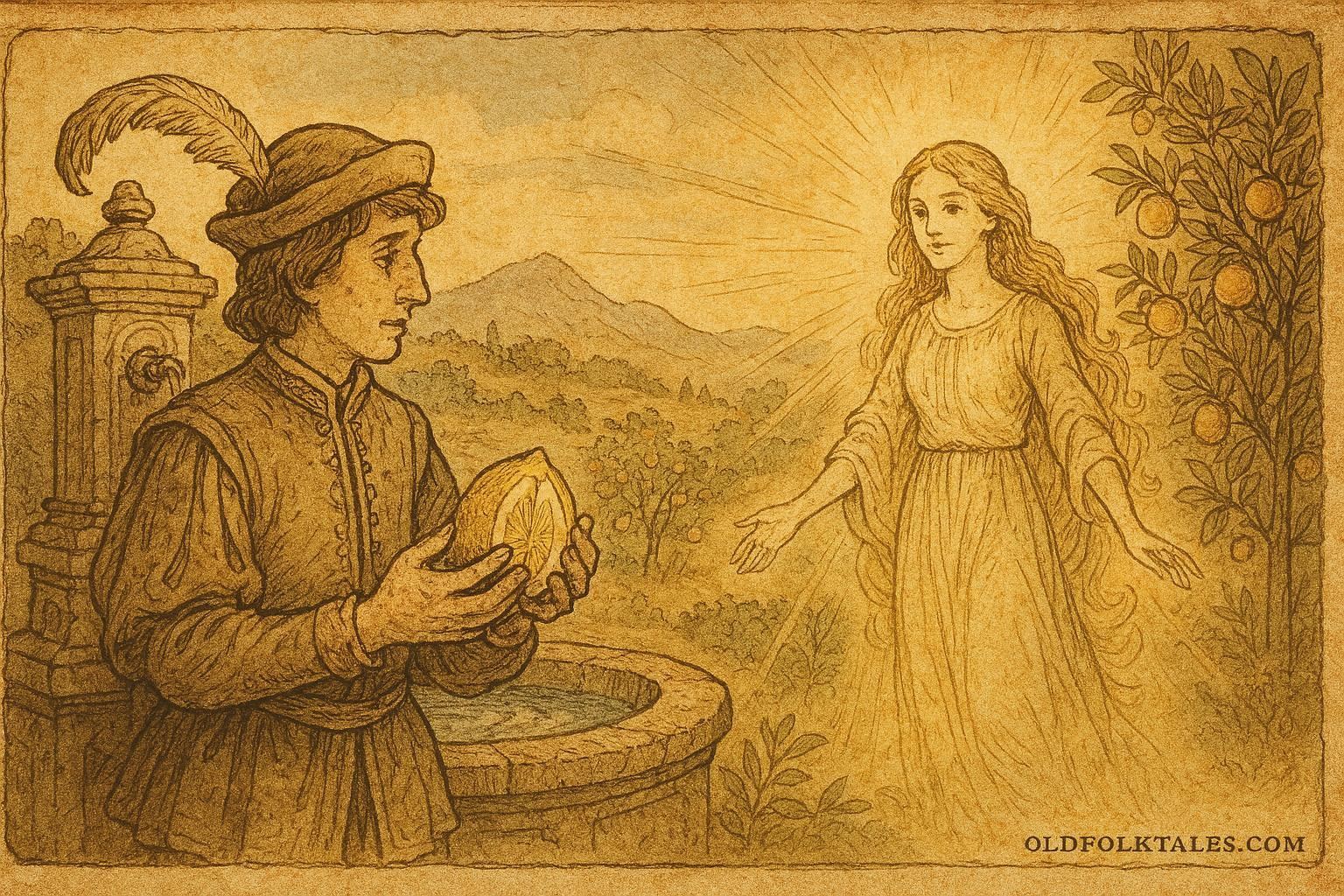
Using cunning rather than force, the prince seized the citrons and fled before the guardian awoke. Exhausted and parched, he wandered until he reached a quiet meadow with a clear fountain. There, trembling with thirst, he took out the first citron and cut it open.
Instantly, a maiden of extraordinary beauty emerged, radiant as the morning sun. She begged for water, her voice weak and fading. But the prince, overcome by amazement and confusion, hesitated too long. Without water, the maiden vanished like mist, leaving only sorrow behind.
Grief-stricken, the prince opened the second citron. Another maiden appeared, just as beautiful, just as desperate for water. Again, fate was cruel. Before he could act, she too disappeared, and the prince fell to his knees in despair.
With trembling hands, he approached the third citron. This time, he acted swiftly. As soon as the maiden emerged and pleaded for water, he rushed to the fountain and brought it to her lips. She drank, color returned to her cheeks, and life remained within her.
The prince gazed upon her and knew his heart’s search had ended. They spoke gently, learning one another’s names and fates, and pledged themselves in love. Yet the maiden was vulnerable, still bound by magic and danger. The prince left her hidden near the fountain while he returned to Naples to prepare her welcome.
But misfortune followed close behind.
A dark-skinned servant woman from the palace came to the fountain to draw water. Seeing the beautiful maiden reflected in the water, she believed it was her own image and marveled at her sudden beauty. When the maiden spoke, the servant discovered the truth, and envy took root in her heart.
Through treachery and violence, the servant displaced the maiden and took her place, disguising herself and returning to the palace as the prince’s supposed bride. When the prince returned, his joy faltered at the sight of her, yet he felt bound by fate and confusion. Trusting that magic had altered appearances, he allowed the wedding to proceed.
The true maiden, transformed and cursed, lingered near the palace in another form, silent but watchful. Slowly, through signs and small mercies, the truth began to surface. The false bride revealed her cruelty, while the cursed maiden’s presence stirred unease and recognition in the prince’s heart.
At last, through careful listening and divine justice, the deception was uncovered. The servant’s betrayal was exposed before the court. The true maiden was restored to her rightful form, her beauty matched by her gentleness and suffering endured.
Justice was delivered according to the laws and customs of the land. Order returned where chaos had ruled, and truth reclaimed its place from falsehood.
The prince married the true maiden, not only for her beauty, but for her patience, loyalty, and resilience. Together they ruled wisely, remembering the cost of deception and the value of perseverance. And the people of Naples told the tale for generations, warning against envy and praising love proven through hardship.
Moral Lesson
True love is not revealed through ease or beauty alone, but through perseverance, loyalty, and the triumph of truth over deception. Those who act with patience and integrity will see justice restored in the end.
Knowledge Check
-
What are the Three Citrons in this Italian folktale?
They are magical fruits, each containing a maiden, symbolizing fate, love, and trials. -
Why does the prince go on a quest?
He seeks fulfillment and love after learning his happiness depends on finding the Three Citrons. -
What causes the prince’s suffering during the quest?
Harsh landscapes, magical guardians, and the loss of the first two maidens. -
Who betrays the true maiden?
A jealous servant woman who deceives the prince and takes her place. -
What themes are central to the story?
Perseverance, deception versus truth, love tested by hardship, and justice restored. -
What is the cultural origin of The Three Citrons?
Southern Italy, from Giambattista Basile’s Lo cunto de li cunti (1634–1636).
Source: Lo cunto de li cunti (The Pentamerone) by Giambattista Basile (1634–1636)
Cultural Origin: Kingdom of Naples, Southern Italy