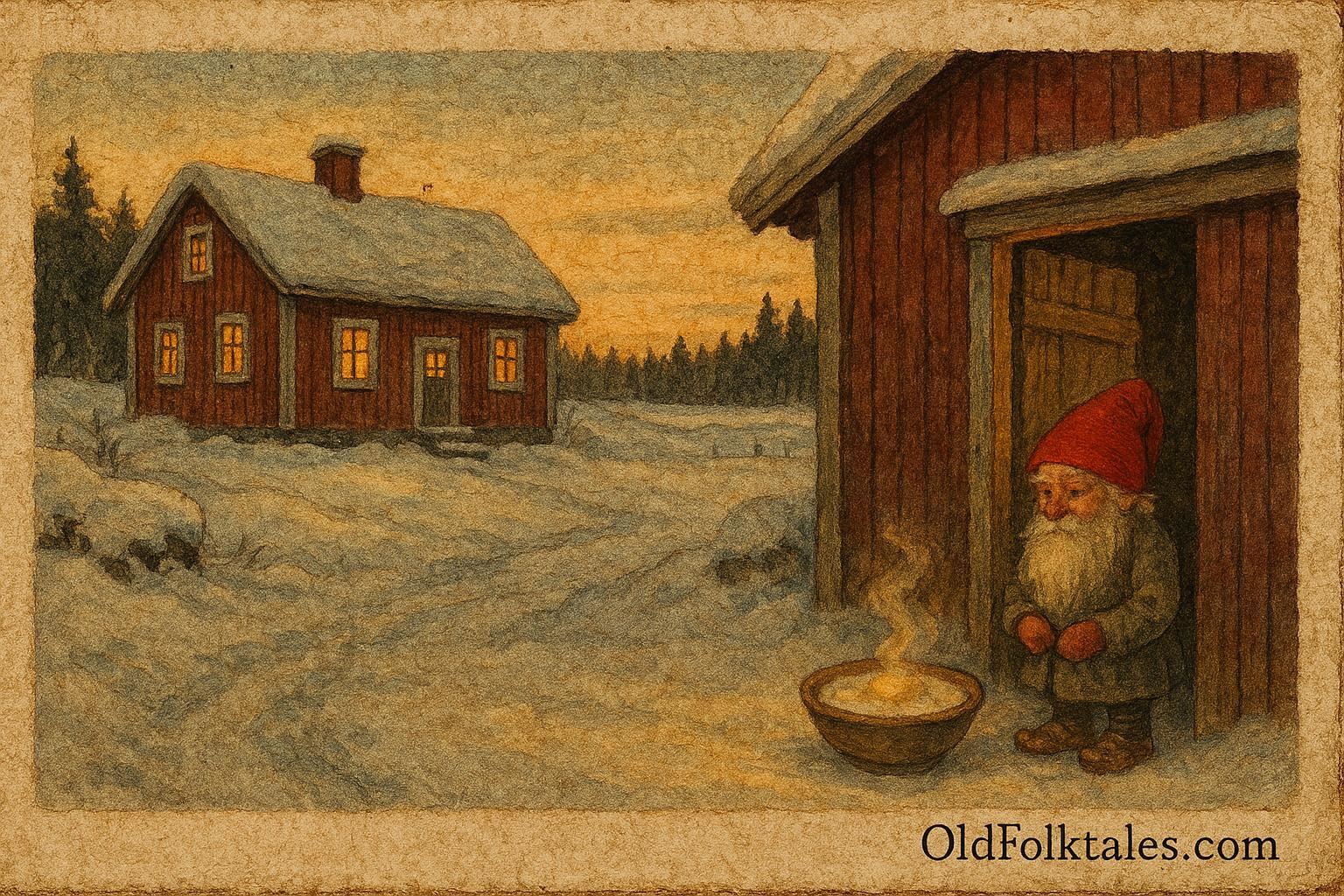
In the quiet countryside of Sweden, where red-painted cottages stand against wide fields and forests murmur beneath long winter nights, there lives, so the old people say, a guardian not often seen but always present. He is small, no taller than a child. His beard is white as frost. His cap is red. His eyes are sharp and watchful. He is the tomte.
Stories of such beings were recorded in nineteenth-century Scandinavian folklore collections, including those associated with Elias Lönnrot, who preserved many traditions of the North. Yet long before scholars wrote them down, these tales lived in the barns, kitchens, and snowy fields of Sweden.
This is one such tale, of a farmer, his land, and the spirit who guarded it.
The Quiet Guardian
There once was a farmer who owned a modest but hardworking farm. His fields yielded rye and barley. His cows gave milk. His horses pulled plow and cart with steady strength. Though not wealthy, he had enough.
What he did not speak of, but quietly believed, was that his good fortune did not come from his own labor alone.
For beneath the floorboards of the barn, in the loft above the stable, and sometimes beneath the roots of the oldest oak, lived a tomte.
The farmer never saw him clearly. Only hints.
Footprints in fresh snow that were too small for any grown man.
Hay neatly gathered though no hand had moved it.
A loose latch repaired before dawn.
The farmer understood.
And so, each winter evening, he placed a bowl of warm porridge with a pat of butter upon the threshold of the barn.
He did not speak of it loudly. He did not boast.
It was simply respect.
Prosperity Through Balance
Under this quiet agreement, the farm prospered.
The cows calved safely. The horses did not shy at shadows. Foxes kept their distance. Even storms seemed to bend around the fields.
The tomte, satisfied with proper acknowledgment, worked through the long Nordic nights. He tightened harness straps. He guided wandering livestock home. He kept watch when snow buried fences.
In return, he asked only fairness.
No mockery.
No neglect.
No broken promises.
For the tomte was no servant. He was a guardian bound by ancient custom.
A Moment of Carelessness
One year, the harvest was especially rich. The farmer, pleased with his success, began to feel pride swell within him.
“It is my skill,” he told neighbors. “My diligence.”
Winter approached again.
On the first cold night, the farmer’s wife prepared the customary porridge. Steam rose warmly. Butter melted into golden pools.
But the farmer, distracted by talk of trade and profit, forgot.
The bowl remained on the kitchen table.
Night fell.
The barn stood silent.
The tomte waited.
When no offering came, the little guardian’s eyes narrowed.
He did not rage. He did not shout.
But balance had been disturbed.
Subtle Sabotage
The next morning, the farmer found the horses restless. Harness straps were twisted. A gate hung slightly crooked.
“Strange,” he muttered.
The following night, a cow broke loose. Not dangerously, but inconveniently. Hay was scattered rather than stacked.
The farmer frowned.
By the third day, tools went missing only to reappear in odd places. Milk soured too quickly. Chickens laid fewer eggs.
No great disaster occurred. Nothing catastrophic.
Just enough disorder to unsettle.
The farmer’s wife, wiser in old customs, watched closely.
“You have forgotten something,” she said quietly.
The farmer waved her off.
“Nonsense. These are accidents.”
But that night, as wind scraped frost across the windows, he stepped outside and saw tiny footprints circling the barn door.
Then he remembered.
Restoration of Respect
Ashamed, the farmer returned inside. He took the porridge bowl, freshly prepared now, with butter melting richly on top, and carried it to the barn threshold.
He set it down carefully.
“I have been careless,” he said aloud, though no one stood before him. “Forgive the neglect.”
The air felt still.
He returned to the house.
By morning, the bowl was empty.
The butter was gone.
And the farm, once unsettled, returned to harmony.
The horses stood calm. The tools rested where they belonged. Milk remained sweet.
The tomte had accepted the apology.
The Nature of the Tomte
It is said in Sweden that the tomte can be fiercely protective. He may guard children from harm, defend animals from predators, and chase away misfortune.
But he is quick to resent disrespect.
Laughter at his expense.
Broken customs.
Greed without gratitude.
Such things offend him.
He does not destroy out of cruelty. He corrects imbalance.
For the farm, in these old beliefs, is not owned by humans alone. It is shared, with land, animals, and unseen watchers.
The farmer learned that prosperity requires humility. That gratitude must not fade in seasons of success. That partnership with the unseen demands consistency.
And so, each winter thereafter, the porridge bowl was never forgotten.
Moral Lesson
The tale of the Tomte teaches that mutual respect sustains harmony. Prosperity depends not only on human effort but on gratitude, humility, and balance with forces, seen and unseen, that support daily life.
Knowledge Check
1. What is a tomte in Swedish folklore?
A small household spirit who guards farms and livestock in exchange for respect and offerings.
2. What offering is traditionally given to the tomte?
A bowl of warm porridge with butter, especially during winter.
3. What happens when the farmer neglects the tomte?
Small disturbances and misfortunes disrupt the farm’s harmony.
4. What theme does this folktale emphasize?
Mutual respect and balance between humans and unseen guardians.
5. Why doesn’t the tomte cause major destruction?
He seeks to correct imbalance, not to act out of cruelty.
6. What cultural setting shapes this story?
Nineteenth-century Swedish agrarian life and household spirit traditions.
Source: Swedish folklore documented in 19th-century Scandinavian collections, including materials associated with Elias Lönnrot (c. 1840s–1870s).
Cultural Origin: Sweden.