Long ago, in the deep countryside of Sweden, there stood a modest farm surrounded by forests of pine and spruce. The land sloped gently toward frozen fields, and beyond them lay dark woods where wolves once howled and old stories were born. Winters here were not merely cold, they were long, demanding, and unforgiving. Snow fell early and lingered well into spring, and the people who lived on this land survived only by patience, discipline, and respect for the old ways.
The farm had belonged to the same family for generations. Each beam in the farmhouse, each worn stone in the barn foundation, carried the memory of hands long gone. And though the family did not always speak of it aloud, they knew they were not alone.
For this farm had a tomte.
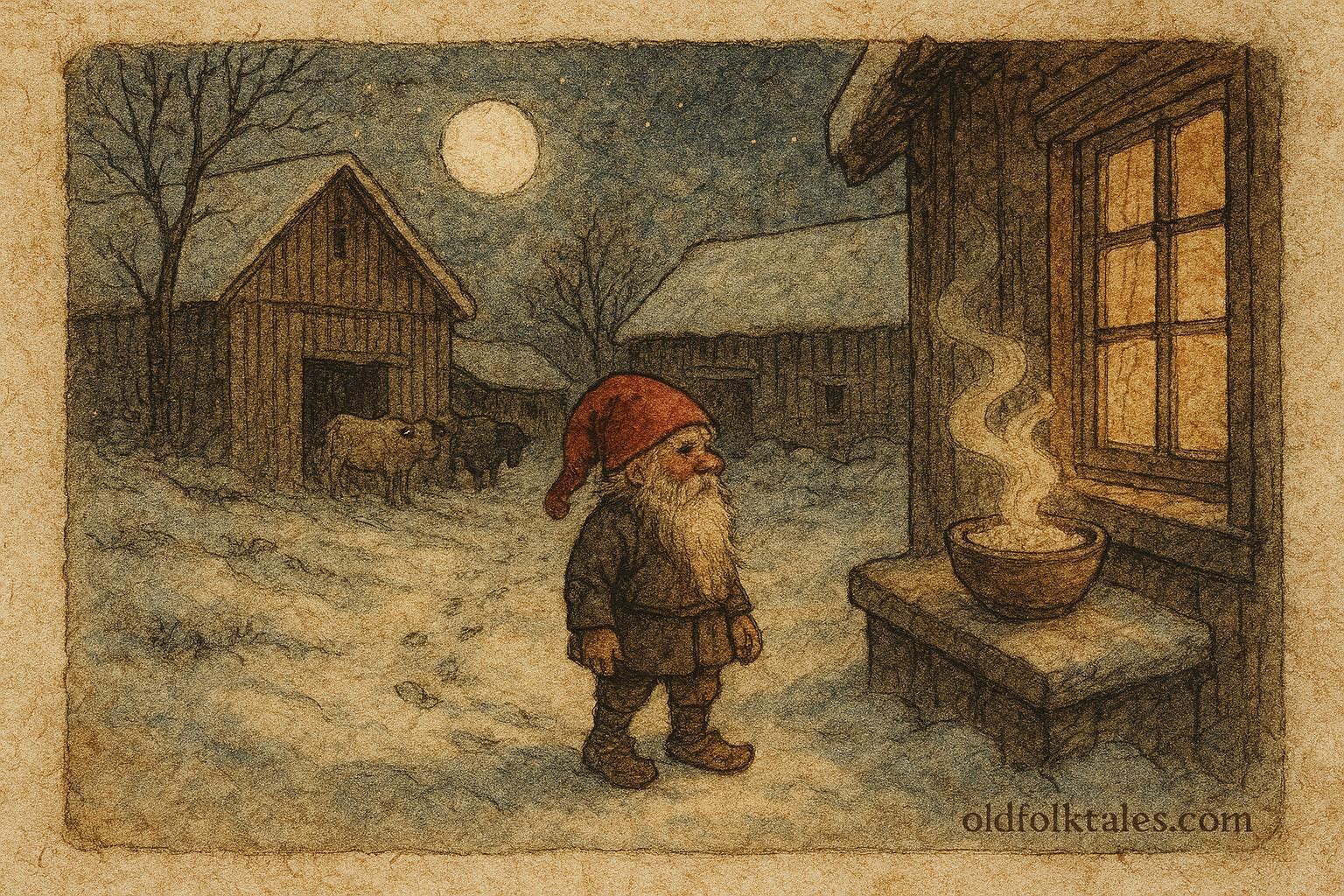
The tomte was small, no taller than a child, but strong beyond his size. His beard was long and grey, his eyes sharp and ancient. By night he walked the farmstead, unseen by most, checking locks, soothing restless animals, and keeping harm at bay. He took pride in order and fairness. A well-kept farm pleased him; laziness and disrespect did not.
The farmer knew these stories well. His father had warned him as a boy: “Treat the tomte as you would an elder, never command him, never mock him, and never forget him.” And for many years, the farmer obeyed.
Each winter night, especially during Yule, a bowl of warm porridge was left near the hearth or in the barn, with a generous knob of butter melting slowly on top. It was not superstition, the farmer believed, but courtesy. One did not ignore a neighbor, whether seen or unseen.
That year, however, winter came harder than most.
Snowstorms buried the fences. Ice thickened on the well rope. The cattle required constant care, and the farmer rose before dawn and returned home after dark, exhausted to the bone. His wife managed the household tirelessly, and though they worked with gratitude, fatigue crept into every task.
As Yule approached, the house grew busy. Bread was baked, meat salted, candles prepared. The days blurred together. And in that weariness, something was forgotten.
No porridge was set out.
That night, the tomte returned from his rounds. He noticed at once. The hearth was cold, the bowl absent. He stood silently for a long moment, his expression unreadable. Then he turned and went back into the snow.
The next day, small things began to go wrong.
The farmer searched for his axe, certain he had leaned it against the shed wall. It was nowhere to be found. A gate that had always stayed shut swung open, letting snow drift into the yard. One of the cows refused to eat and stood shivering despite the warmth of the barn.
“These winters are cursed,” the farmer muttered.
But his wife said nothing.
The following night, worse followed. A rope snapped for no clear reason. Milk spoiled before morning. Tools were misplaced again and again. None of it was disastrous, but together it felt like the farm itself had grown restless.
At last, the farmer’s wife remembered.
“The tomte,” she said quietly.
That night, she prepared a bowl of porridge with care, stirring it slowly, placing butter carefully at the center. She set it by the hearth and spoke softly, not as a command, but as an apology.
“We have been careless. Forgive us.”
When the tomte came, he stopped. The offering waited. The words had been spoken with respect. He nodded once.
From that night on, the troubles ceased.
The cow recovered. The axe returned to its place. Snow stayed outside where it belonged. The tomte resumed his quiet guardianship, unseen but ever vigilant.
And the family remembered, always, that survival depended not only on hard work, but on respect for the unseen balance of the world.
Moral Lesson
Respect and gratitude sustain balance between people, land, and the unseen. When tradition is honored, harmony endures; when neglected, disorder follows.
Knowledge Check
-
What is a tomte in Swedish folklore?
A household and farm spirit that protects land, animals, and family. -
Why does mischief begin on the farm?
The farmer forgets the traditional porridge offering. -
What role does the porridge play?
It symbolizes respect and acknowledgment of the unseen guardian. -
How does the tomte express displeasure?
Through subtle disruptions rather than direct harm. -
What restores balance to the farm?
Remembering tradition and offering sincere gratitude. -
Where does this folktale originate?
Rural Sweden, especially central and southern regions.
Source: Collected in Svenska folksagor by Gunnar Olof Hyltén-Cavallius & George Stephens, 1844–1849.
Cultural Origin: Rural Sweden, especially central and southern regions.