In the southern reaches of Poland, in the historic Silesian region, rises the monastery of Jasna Góra in Częstochowa. Its towers stand firm against wind and storm, and its walls have endured more than the passing of seasons. Within those walls rests the revered icon of the Black Madonna, long regarded as the spiritual heart of the nation.
But beneath the monastery, so the old stories say, lies a treasury not measured merely in gold or jeweled chalices. Hidden in vaulted chambers of stone, guarded by silence and shadow, there waits a company of knights who do not sleep as ordinary men do.
Explore the warmth and wit of Mediterranean storytelling, where love and wisdom intertwine
They are the ghostly defenders of Jasna Góra.
The Monastery on the Hill
For centuries, pilgrims climbed the hill toward the monastery gates. They came in humble carts or on foot, carrying candles, petitions, and burdens of the heart. They knelt before the holy icon, seeking healing, strength, and mercy.
Monks in dark habits walked the cloisters quietly, tending the chapel lamps and preserving the traditions entrusted to them. The monastery was not only a place of prayer; it was a symbol. In times of hardship, when armies crossed borders and banners changed, the people looked to Jasna Góra as a sign that their faith endured.
And beneath its stone floors, legend whispered, something older stirred.
The Hidden Treasury
It was said that long ago, during a time of invasion, the monks gathered sacred objects—chalices, manuscripts, relics, and sealed them away in underground chambers. These were not treasures of vanity but of devotion: gifts from kings, offerings from peasants, tokens of faith gathered over generations.
Yet the true guardians of this treasury were not the monks alone.
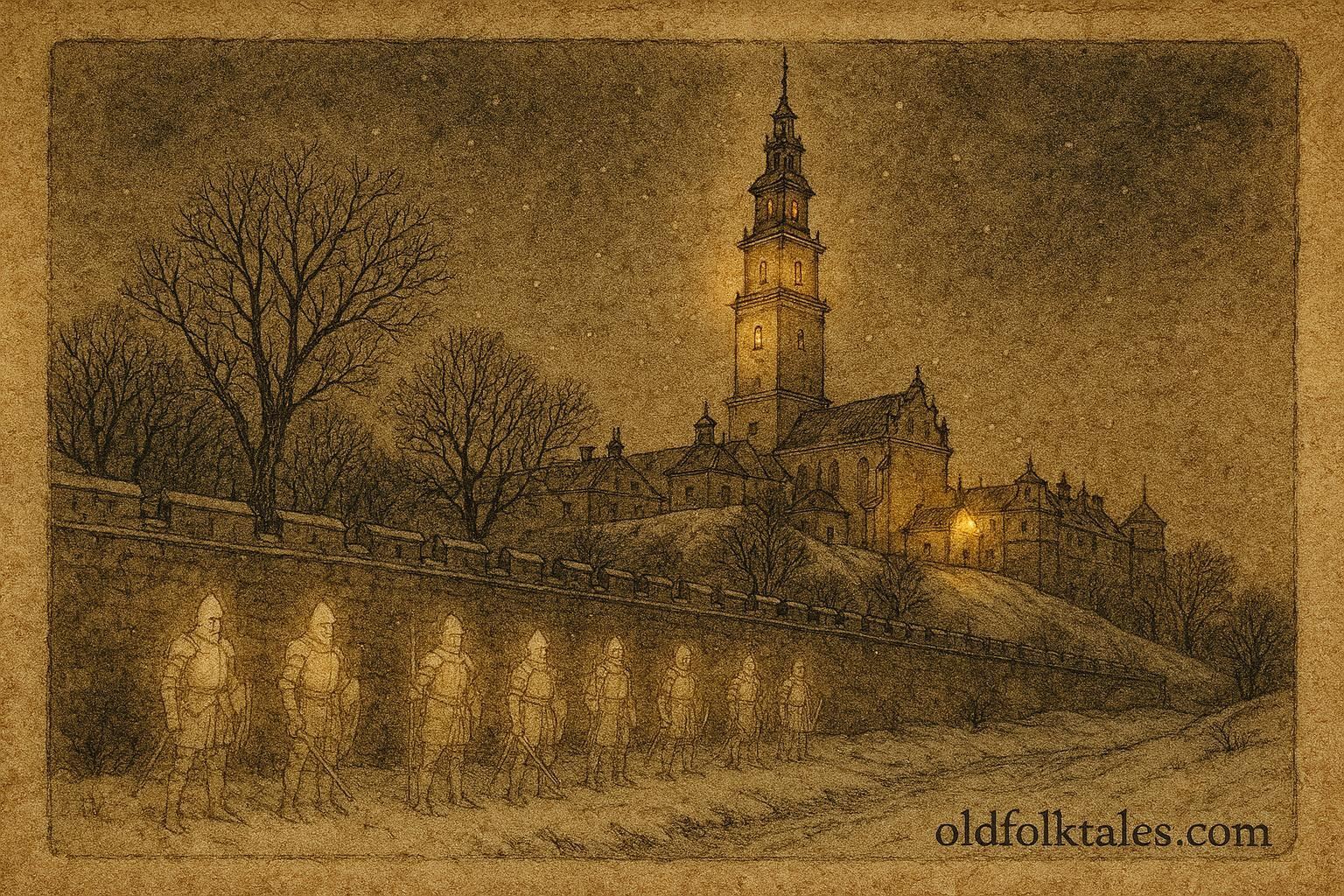
According to the legend recorded in the 19th century, when the monastery faced grave danger, the spirits of knights once sworn to defend the land rose from hidden crypts below. Clad in armor that shimmered faintly in torchlight, they stood watch where mortal soldiers could not.
No clanging of steel announced their presence. No trumpet called them to arms. They awakened only when faith itself was threatened.
A Time of Invasion
One winter, when snow lay heavy upon the rooftops of Częstochowa, foreign troops advanced toward the monastery. Their intent was not merely plunder but humiliation. To seize the sacred icon would be to strike at the heart of the people.
The monks barred the gates and prayed through the night. Candles burned low before the Black Madonna. Outside, the sound of boots and shouted orders echoed against stone walls.
Within the monastery, fear trembled in the air—but it did not break into despair.
As the enemy prepared their assault, a strange stillness settled over the hill. The wind dropped. Even the horses stamped uneasily, their breath clouding in the cold.
Deep beneath the chapel floor, in chambers unknown to most living men, something shifted.
The Awakening
In the hidden vaults, where stone arches curved like the ribs of the earth itself, armored figures stirred. Their forms were pale yet solid, their helms crowned with faint light. They rose not from coffins but from the very memory of vows once sworn, to defend faith, land, and people.
Without word or signal, they ascended through unseen passages.
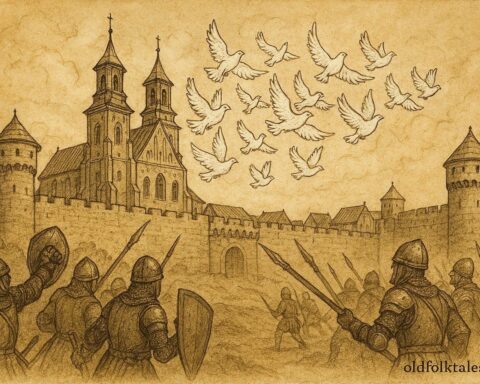
That night, the invading soldiers reported strange sights. Shadows moved along the monastery walls where no torch burned. The sound of armored steps echoed across courtyards that stood empty. Some swore they saw knights upon the battlements, silent and watchful, their armor gleaming though no sun shone.
When the attackers attempted to scale the walls, panic broke among them. Ladders slipped. Torches guttered inexplicably. Men cried out that unseen hands pushed them back.
No blade struck flesh. No blood stained the snow. Yet confusion and dread spread swiftly through the ranks.
By dawn, the invading force had withdrawn.
The monastery gates remained unbroken.
The Silent Vigil
At sunrise, the monks emerged cautiously into the courtyard. Snow lay undisturbed except for scattered footprints leading away from the hill.
There were no signs of battle.
Only one of the elder monks, descending later into the lower vaults to check the sealed chambers, claimed to have seen faint impressions upon the stone floor, marks like those left by armored boots.
He spoke of it to no one beyond his brethren. Such matters, he believed, were not for spectacle.
But word traveled nonetheless.
Pilgrims began to speak of the Knights of Jasna Góra, spiritual guardians who rose in defense of the sacred icon and the nation’s soul. The story passed from hearth to hearth, from village to city, strengthening hearts in times when political fortunes faltered.
The Meaning of the Treasure
Many have imagined the treasury beneath Jasna Góra as a chamber filled with gold and jewels. Yet those who understand the legend know that its true wealth lies elsewhere.
The treasure is faith preserved through adversity.
The knights represent vows kept beyond death, commitments so deep they outlast flesh and bone. They embody the idea that a nation’s strength is not only in armies or rulers but in shared belief and spiritual continuity.
When danger approaches what is sacred, protection rises, not always in ways visible to the eye.
Enduring Legacy
Even in peaceful years, when no army marches and no walls tremble, the legend remains alive in Częstochowa. Pilgrims still climb the hill. Candles still burn before the icon. And beneath the stone, the hidden chambers remain sealed.
No one claims to have seen the ghostly knights in recent times.
Yet in moments of national trial, when uncertainty clouds the horizon, the story returns with quiet force. It reminds the faithful that they are not alone, that beneath the visible world lies a foundation of sacrifice, courage, and spiritual resilience.
The monastery stands not merely as architecture, but as testimony.
And somewhere below, in silence deeper than sleep, the Knights of Jasna Góra keep their vigil.
Step into the enchanted forests and mystical realms of the Slavic imagination
Moral Lesson
Faith and unity form a nation’s strongest defense. Sacred heritage, when honored and protected, becomes a source of resilience that endures beyond physical force. True guardianship arises from unwavering devotion.
Knowledge Check
1. What is the Treasury of Jasna Góra in Polish legend?
It is a hidden sacred chamber beneath the monastery, guarded by ghostly knights during times of invasion.
2. Who are the ghostly knights of Częstochowa?
They are spiritual defenders said to awaken to protect the holy icon and the monastery.
3. What sacred object is central to the legend?
The revered icon of the Black Madonna at Jasna Góra.
4. When do the supernatural guardians appear?
They rise during moments when faith and national heritage face serious threat.
5. What does the treasury symbolize?
It represents spiritual resilience, faith, and the enduring strength of the nation.
6. Where does this folktale originate?
It comes from Częstochowa in the Silesian region of Poland.
Source: Polish monastic legend, Częstochowa, Poland. Documented in 19th-century accounts by Ambroży Grabowski (c. 1840s).
Cultural Origin: Częstochowa, Silesian region, Poland.