In the countryside of rural Poland, where fields stretched wide beneath open skies and villages lay nestled between forests and rivers, there once lived a poor but hardworking family. Their cottage stood at the edge of the settlement, surrounded by fields of rye and barley that bent with the wind and marked the rhythm of the seasons. Within that home lived a mother and her twelve sons, strong, lively boys whose laughter often rang louder than the creaking beams of the house itself.
Life was not easy, but it was honest. The brothers worked in the fields, tended animals, and helped one another without question. Though there were many mouths to feed, the household was bound together by shared labor and affection. The mother, worn by years of hardship, loved her sons deeply, yet exhaustion often sharpened her temper.
One harsh winter, when food ran low and storms battered the land, the strain grew heavy. The boys, restless and hungry, quarreled among themselves. Their noise filled the cottage from dawn to nightfall, until patience wore thin.
In a moment of anger, careless, unmeasured, and born of weariness, the mother cried out words she would regret forever.
“Oh, if only you were ravens,” she exclaimed, “so you would fly away and give me peace!”
The words had barely left her mouth when the room darkened.
The Curse Takes Hold
A sudden wind swept through the cottage, though no door stood open. Feathers burst from the air, black and glistening. One by one, the twelve brothers cried out as their bodies twisted and changed. Arms became wings, hands turned to claws, voices broke into harsh cries.
Before their mother could scream or beg forgiveness, twelve ravens filled the room. With frightened calls, they beat their wings against the walls and burst through the doorway, vanishing into the grey winter sky.
Silence followed.
The mother fell to the ground in despair, her careless words echoing endlessly in her mind. She searched the fields and forests, calling her sons’ names until her voice failed, but they did not return.
Time passed. Grief settled heavily in the cottage.
Years later, the mother gave birth to a daughter. From her earliest days, the girl sensed the sorrow that clung to the household like a shadow. When she was old enough to ask, her mother told her the truth, of the brothers, the curse, and the ravens who never came home.
The girl listened in silence. Something stirred within her heart, a quiet resolve stronger than fear.
The Sister’s Resolve
As the girl grew, she became known for her gentleness and determination. She worked tirelessly, helped her mother, and spoke little, but when she did, her words carried weight.
One evening, as the sun sank low over the fields, she turned to her mother and said simply, “I will find them.”
Her mother wept and begged her not to go. The world beyond the village was dangerous, filled with forests where wolves roamed and mountains few returned from. But the girl would not be swayed.
At dawn, she set out alone.
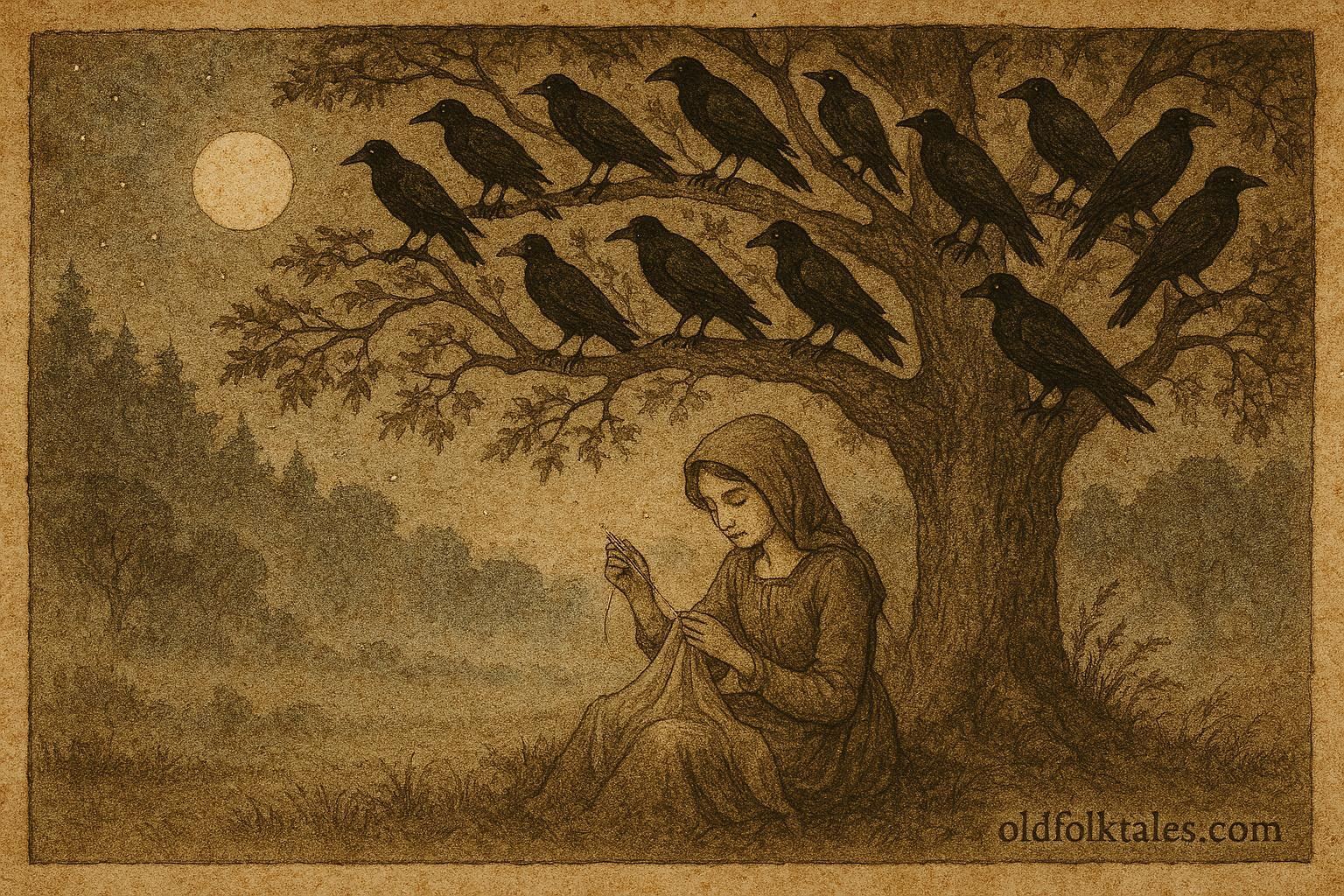
She traveled across fields and through villages, asking quietly about ravens, listening to old women and shepherds who spoke of strange black birds seen circling forests and cliffs. At last, deep within a dark woodland, she saw them, twelve ravens perched high among the branches, their eyes sharp with recognition.
They did not flee.
That night, as the moon rose, the ravens gathered around her, and one spoke in a voice rough yet familiar.
“Sister,” he said, “we are bound by a curse that only sacrifice can break.”
The Trial of Silence
The brothers revealed the condition of their redemption.
To free them, the sister must remain completely silent for twelve years. During that time, she must sew twelve shirts from star-flowers, plants that grew only at night and cut the skin like thorns. She could not cry out, could not speak, could not explain herself, not even to save her own life.
If she failed, the curse would remain forever.
The sister did not hesitate.
She returned to the forest and began her task. Each night she gathered the sharp flowers, her fingers bleeding as she worked. By day she stitched in silence, her lips sealed against pain, fear, and loneliness.
Years passed.
Her silence drew suspicion. People whispered. Some feared her, others mocked her. Yet she endured.
Suffering Without Words
One day, a nobleman passed through the forest and found the silent young woman at her sewing. Struck by her calm presence and beauty, he brought her to his home and later married her, though she spoke not a single word.
At court, her silence became her undoing.
Jealous voices accused her of wickedness. When misfortune struck the household, blame fell upon her. Still, she did not speak. She sewed.
When she was accused of dark deeds and condemned, she stood quietly, clutching the nearly finished shirts, her eyes fixed on the sky.
At the final moment, as ravens circled overhead, she placed the last stitch.
Redemption at Last
The ravens descended, shedding feathers as they touched the earth. One by one, they became men once more, her twelve brothers, restored.
The curse broke.
At last, the sister spoke, her voice clear and steady, revealing the truth. Justice followed swiftly. Those who accused her were silenced in shame, and the family was reunited at last.
The brothers returned home, wiser and humbler. The mother, aged and repentant, wept tears of gratitude and sorrow.
The ravens were gone forever.
Discover Polish, Russian, Ukrainian, and Belarusian folktales where magic and morality meet
Moral Lesson
This folktale teaches that careless words can cause deep harm, but steadfast love, patience, and sacrifice can bring redemption. True devotion endures suffering without complaint and restores what anger destroys.
Knowledge Check
-
What caused the brothers’ transformation into ravens?
Their mother’s careless curse spoken in anger. -
Who sets out to break the curse?
Their devoted younger sister. -
What conditions must she fulfill to free her brothers?
Twelve years of silence and sewing shirts from star-flowers. -
Why does she refuse to speak even when accused?
Breaking silence would doom her brothers forever. -
What role do ravens play in Slavic folklore?
They often symbolize fate, transformation, and the boundary between worlds. -
What is the story’s central theme?
Redemption through endurance and sacrificial love.
Source: Collected by Oskar Kolberg from rural oral traditions
Cultural Origin: Rural Poland (Greater Poland and Silesian variants)