Long ago, in a land whispered in morning mists and moon-lit valleys, a remarkable pair of twin brothers was born under a wondrous sign. One, the elder, emerged with the Sun shining on his brow; the other, his twin, bore the Moon upon his forehead. The people who witnessed the birth marvelled, such gifts were rare even among the tales of old. This is the story of those brothers, brave, fierce, bonded, and of how their courage and fate echoed the deep mythic roots of Albanian tradition.
Their father died while they were still young, leaving them the wide wild world as inheritance and challenge. They resolved to leave home, mount their two horses, harness their two loyal dogs, and seek adventure, glory, and the riches of heroic deeds. The brothers rode out from their father’s house, side by side, yet soon fate would cast them upon diverging paths.
As they journeyed, the elder brother, he of the Sun on his forehead, entered a town suffering a ghastly drought. The jubilant morning rays had long since vanished; the well had run dry, the river’s voice was silent, the crops withered. In the still hush of the parched land he encountered an old man, bent and weary. The man told him the terrible truth: a great serpent-demon, the fearsome kulshedra, had blocked the spring’s source and held the land in its cruel grip.
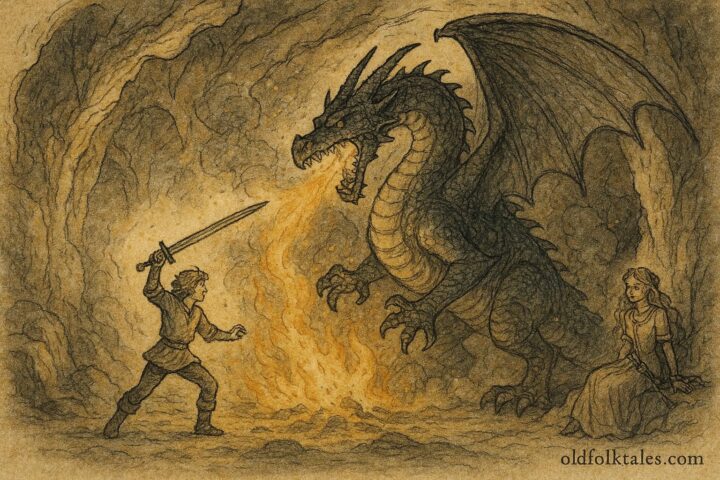
The elder brother mounted his horse, his dogs beside him, and he confronted the kulshedra in its lair, a cavern black as midnight where the water once gushed. A terrible battle ensued: the dragons’ many heads twisting, hissing, flame and shadow in wild dance. But the brother of the Sun did not falter. He struck the great beast down, freed the river’s flow, and restored life to the town. The townsfolk rejoiced, the spring gurgled anew, and they hailed him as champion.
Meanwhile the younger twin, the one with the Moon on his brow, rode onward to another land. Along his path he came where night reigned long and the zanas (the forest-nymphs of Albanian myth) whispered beneath old trees; where the ora (the guardian spirits of humans) watched invisible in the hour before dawn. He entered a kingdom tormented by a monstrous wraith of shadow and wind, a shtriga that preyed upon the villagers at night. The moonlit twin stood firm in the face of terror and overcame that dread creature. The land breathed again under his courage.
Eventually the brothers returned, each bearing tales of triumph, but still restlessly drawn onward. Their reputation grew far and wide: the twin heroes born of Sun and Moon, the slayers of dragons and demons, the saviors of kingdoms. They came to the court of a king whose land had been ravaged by a multi-headed dragon and whose princess had been taken. The two brothers accepted the quest.
Together they crossed the dragon-haunted mountain, its peaks jagged like broken spears against dawn. In the dragon’s lair they saw many heads, each spitting fire and venom. The younger brother engaged some heads while the older struck the final blow with the fiery light of his crest. The monster fell, the kingdom was freed, and the princess rescued. The people celebrated them with trumpets and banners, songs and feasts.
In the celebration the traditions of the land were honoured: the zanas danced by moon-lit springs, the ora guarded the children, and even the Earthly Beauty, “e Bukura e Dheut”, smiled upon the craning towers of the liberated castle. Myth and reality interwove.
At last the brothers returned home. The horses stood calm, the dogs no longer restless. But the Sun-marked twin and the Moon-marked twin knew their lives would always bridge two realms: the glaring day and the hush of night. And the people remembered them: the twins born with the Sun and the Moon, who fought demons, freed streams, and reclaimed kingdoms for their rightful rulers.
Moral Lesson:
Courage arises not just from strength, but from resolve and unity. Even when paths diverge, the bond of kinship and the purpose of honour carry one through darkness and through light. The heroes remind us that whether one bears the brightness of daylight or the subtle glow of midnight, heroism lies in action carried with humility and in service to others.
Knowledge Check
- Who are the two main protagonists in the story?
– They are twin brothers: one born with the Sun on his forehead, and the other with the Moon. - What demon did the elder twin defeat to restore the water to a town in drought?
– He defeated the multi-headed dragon-serpent known as the kulshedra that had blocked the spring. - Which mythological figures from Albanian folklore appear in the tale?
– The zana (forest-nymphs), the ora (guardian spirits), the kulshedra (dragon-demon), shtriga (night-witch), and e Bukura e Dheut (the Earthly Beauty). - What are the symbolic significances of the Sun and the Moon in the brothers’ birthmarks?
– The Sun mark signals boldness, daylight, strength; the Moon mark suggests mystery, night-watching, subtle light. Together they signify a balance of powers in the heroic duo. - What major story type/classification does this folktale belong to?
– It belongs to Aarne-Thompson-Uther type 303 (“The Twins or Blood Brothers”) and includes type 300 (“The Dragon Slayer”). - Where and by whom was this tale first published?
– It was first recorded by the Arbëreshë folklorist Giuseppe Schirò in Canti tradizionali ed altri saggi delle colonie albanesi di Sicilia(1923).
Cultural Origin: Albanian folktale, Albania.
Source: Adapted from the tale “The Twins” first published by Giuseppe Schirò in Canti tradizionali ed altri saggi delle colonie albanesi di Sicilia (1923) and translated into English in Albanian Wonder Tales (1936).