In the quiet villages of Bohemia, where rivers wind through meadows and alder trees lean over reflective waters, elders once warned their children never to linger too long by the banks. For beneath the calm surface of ponds and streams, they said, dwell beings older than memory, watchful, patient, and not always kind. Among them was the Vodník, the Water Goblin.
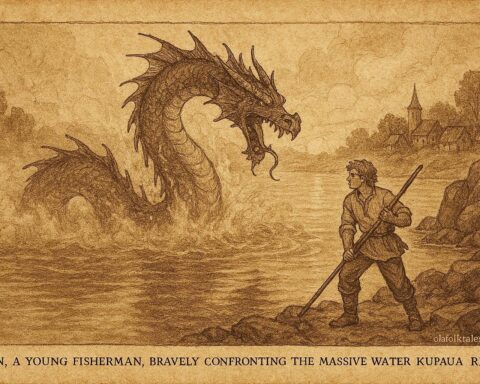
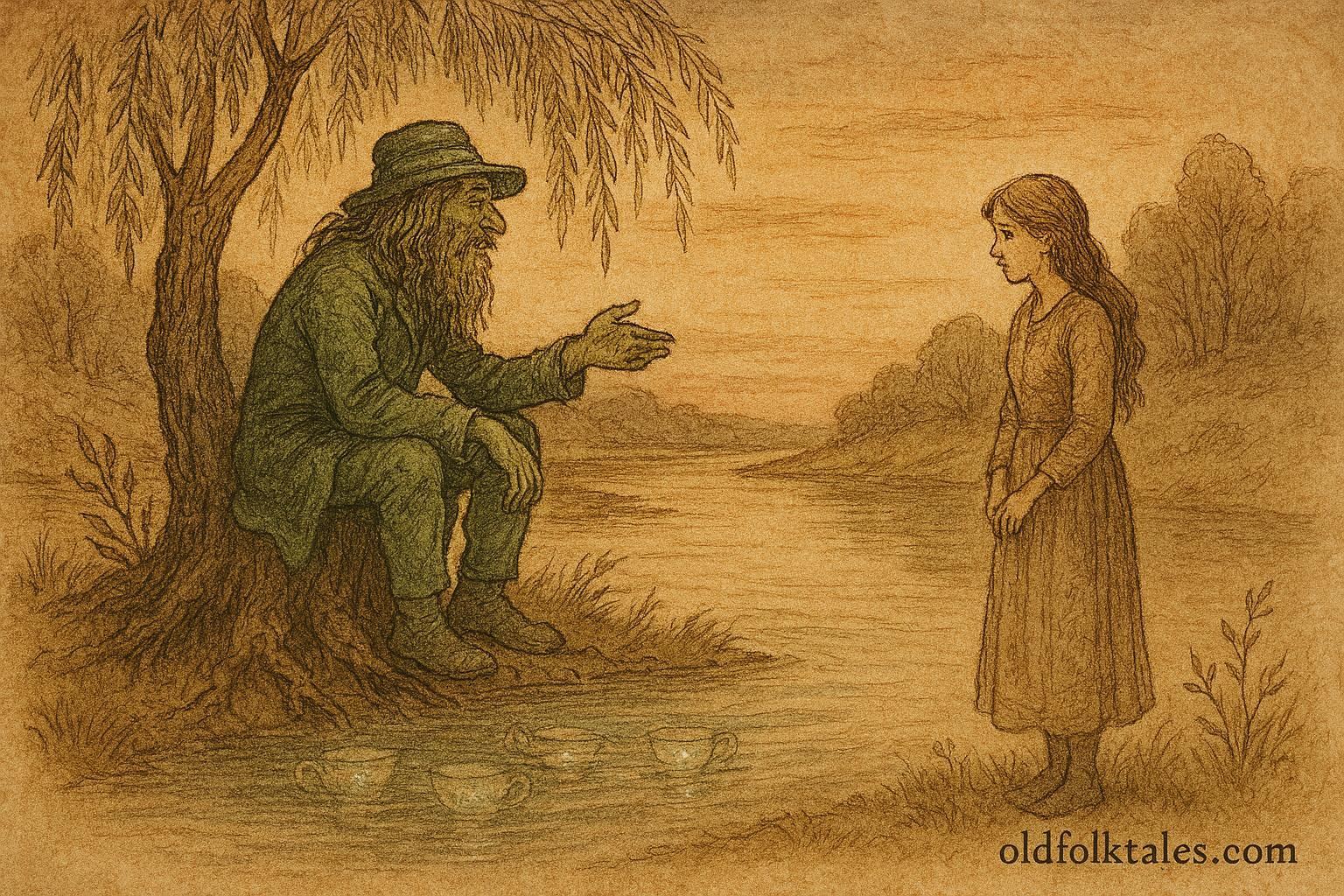
He was said to sit upon a willow stump at twilight, dressed in green moss and dripping reeds, his eyes gleaming like wet stones beneath the surface. Fishermen claimed to see him wringing water from his sleeves. Washerwomen whispered of ripples moving against the current. And children were taught that porcelain cups resting at the bottom of the river were not discarded dishes, but prisons.
For the Vodník collected souls.
In one village near a broad, quiet river, there lived a young woman whose laughter carried lightly through open fields. She was dutiful, kind to her mother, and newly blossomed into womanhood. Suitors had begun to take notice, though she gave her heart to no one.
Her mother, wise in the old ways, often warned her:
“Do not sit by the river when the bells fall silent. Water listens.”
But youth carries both beauty and boldness.
One bright afternoon, while washing linen along the bank, the girl noticed the water shimmer strangely. The current slowed. The air grew still.
A voice rose from the surface, soft, persuasive.
“Come closer.”
She froze.
At the edge of the reeds stood a small, green-clad figure with tangled hair and an unsettling smile. His fingers were long and pale; droplets fell from his coat.
“You seem lonely,” he said gently. “The river keeps secrets. Would you like to see them?”
The girl stepped back.
But curiosity flickered like sunlight on water.
He spoke of hidden palaces beneath the riverbed, of gardens that glowed in silver currents, of treasures untouched by human hands. His voice flowed like the stream itself—smooth, endless.
She turned to leave.
The ground beneath her shifted.
With sudden force, unseen hands pulled her into the cold depths.
The river swallowed her scream.
When villagers searched, they found only scattered linen drifting near the reeds.
Beneath the water, the world changed.
The girl did not drown. Instead, she found herself standing in a dim, wavering chamber lit by pale, shifting light. Around her were shelves carved from river stone. Upon them sat rows of porcelain cups, white, delicate, each sealed with a lid.
Within every cup shimmered a faint glow.
The Vodník appeared beside her, no longer distant or charming.
“You will stay,” he said.
She understood with dawning horror.
Each cup contained a human soul, the essence of those pulled beneath the water, captured and preserved like fragile ornaments.
“You belong to the river now.”
Time moved differently below the surface. Days and nights blurred into a green twilight. The girl was forced to live within the goblin’s watery domain, his unwilling companion. In time, she bore him a child, a small being with bright eyes and skin cool as river stones.
Though born of the depths, the child stirred fiercely human love within her heart.
Maternal devotion became her anchor.
She sang lullabies remembered from her mother’s hearth. She whispered stories of sunlight and fields. And in those quiet moments, the goblin’s lair felt less like prison and more like fragile refuge for her child.
Yet she never forgot the shelves of porcelain cups.
Each glimmering vessel reminded her of stolen lives, of cruelty masked as enchantment.
One day, when the goblin was distracted, counting and polishing his dreadful collection, she gathered courage.
“I wish to visit my mother,” she said carefully. “Only once. Let her see her grandchild.”
The Vodník hesitated.
He loved possession more than affection, but pride softened him.
“You will return,” he warned.
She nodded solemnly.
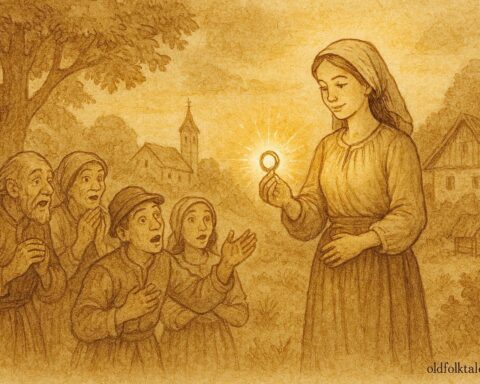
With their child in her arms, she rose from the river’s surface like mist at dawn. Villagers gasped to see her alive. Her mother fell to her knees, tears mingling with river spray.
But joy was shadowed by dread.
“The Vodník will come,” the mother whispered.
The girl knew this was true.
They barred the doors. They sealed the windows. They prayed.
When evening fell, the river churned.
A knock sounded, soft at first, then louder.
“Return what is mine,” came the voice, now stripped of charm.
The girl clutched her child.
The goblin’s patience dissolved into rage. Water seeped beneath the door. Wind rattled the shutters. His fury shook the house itself.
“Return!” he roared.
The mother drew protective symbols, invoking faith older than fear.
The goblin, bound to water’s edge, could not cross the threshold fully. But his power stretched like flooding currents.
In desperation, the girl faced the unbearable.
To save her child from being claimed entirely by the river’s dominion, she relinquished the bond that tied her to the goblin. In some tellings, the child is torn between worlds; in others, the goblin shatters something precious in wrath.
But always, the outcome reveals his cruelty plainly.
The porcelain cups below the river trembled. Souls flickered in fragile prison.
The villagers, hearing his monstrous fury, saw not a charming spirit, but a collector of suffering.
The goblin’s deception was stripped bare.
At dawn, the river returned to uneasy calm.
The girl remained on land, changed forever. Whether her child survived whole or only in memory varies in whispered versions of the tale. But her courage, her refusal to submit quietly to captivity, became the heart of the legend.
From that day forward, mothers warned their daughters not only of deep water, but of voices that promise wonder without cost.
The Vodník still waits, they say. He sits among reeds, wringing out green sleeves. His porcelain cups remain lined in silent rows.
But now, the people know.
The river’s beauty hides hunger.
And love, especially a mother’s, can break even the coldest spell.
Moral Lesson
Beware what glitters beneath calm waters. Deception often masks danger, and only courage guided by love can overcome hidden cruelty.
Knowledge Check
1. Who is the Vodník in Czech folklore?
A water goblin who dwells in rivers and traps human souls in porcelain cups.
2. What does the porcelain cup symbolize in The Water Goblin?
Captured souls and the fragility of human life beneath supernatural power.
3. What central theme defines this Czech folktale?
Maternal sacrifice and caution against nature’s hidden threats.
4. Who recorded The Water Goblin?
Karel Jaromír Erben in Kytice z pověstí národních (1853).
5. What does the river represent in Vodník legends?
Both life-giving nature and hidden supernatural danger.
6. Why is The Water Goblin considered cautionary folklore?
It warns against recklessness, temptation, and underestimating unseen forces.
Source: Karel Jaromír Erben, Kytice z pověstí národních, 1853
Cultural Origin: Czech folklore (Bohemia)