High above Sarajevo, where the hills roll into one another like waves frozen in stone, life has always moved to the rhythm of the mountains. Villagers rose with the sun, tended their flocks and fields, and watched the seasons mark their passage across terraced gardens and cobbled paths. Here, in these hills, the people knew the value of stories, stories that carried the memory of ancestors, whispered warnings, and lessons for those who would listen.
Among them lived a young shepherd named Mirsad, known not for great wealth or status, but for his patience, kindness, and courage. Every day he guided his flock along narrow paths, listening to the bleating of his sheep, the rustle of pine needles, and the soft murmur of distant streams. He knew every stone and tree along the way, yet he also believed in the unseen, that the hills, the rivers, and even the trees could hold secrets.
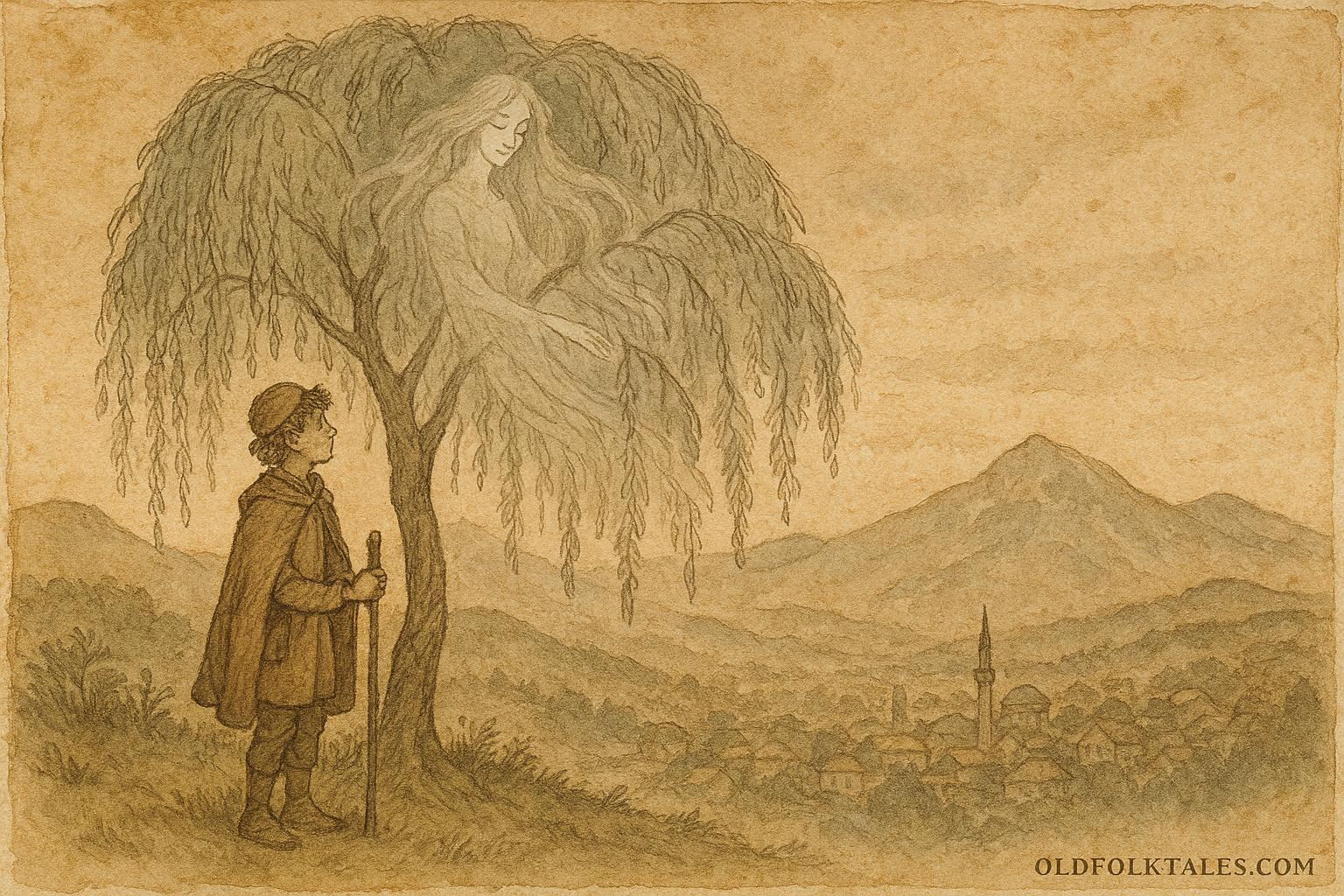
One late summer evening, as the sun began to sink behind the distant mountains, spilling copper light across the valley, Mirsad noticed something he had never seen before. At the edge of a small clearing, where the grass was thick and sweet, a willow tree drooped strangely. Its branches swayed, though no wind disturbed the air, and as twilight deepened, droplets of silver shimmered on the leaves. They sparkled as if the stars themselves had descended to rest on the branches.
Mirsad approached cautiously, his flock grazing nearby. He felt the unusual stillness that often precedes something extraordinary. Villagers had long spoken of the tree. They said it wept every night, mourning a woman whose life had been taken unjustly, long ago, by a nobleman whose jealousy and envy had brought sorrow not only to her family but to the very land where she lived. No one dared to claim knowledge of the woman’s name; it was enough to whisper that her spirit remained trapped, bound to the willow by grief and betrayal.
Mirsad, young but perceptive, did not fear the tree. He felt only a quiet resolve. If I can help her, perhaps she can finally rest, he thought. That night, he returned to the willow, carrying a small basket of wildflowers and a loaf of bread. He laid them at the base of the tree and whispered softly, greeting the spirit he hoped would hear him.
At first, the hills remained silent. The sheep rested, their bells soft in the dim light. Then, gradually, Mirsad sensed a presence, a subtle shift in the air, a warmth like a soft breeze brushing his cheek, a sense that he was not alone. He knelt beneath the willow, eyes lowered, speaking quietly. “I mean no harm. I only wish to help.”
It was then, as moonlight spilled over the branches, that the spirit appeared. She shimmered like silver mist, her face pale yet radiant, her eyes carrying centuries of sorrow. Her form was delicate, as if the wind itself had shaped her.
“I have waited long for one with courage,” she said, her voice soft but commanding. “Someone who can seek justice for me, even after all these years.”
Mirsad felt a chill, not of fear but of awe. “I will help you,” he whispered. “Tell me what must be done.”
Her story unfolded like the threads of an old tapestry. She had been a young woman of good standing, admired for her kindness and intelligence. A nobleman, jealous of her family’s success and reputation, had spread lies, seized her lands, and forced her into exile. She had died far from her home, betrayed and heartbroken. The willow had grown where she had fallen, and her spirit had been trapped there, unable to rest.
Mirsad listened attentively, his heart heavy with the weight of centuries of injustice. “I will find her descendants,” he said at last. “I will make this right.”
The task was not easy. Sarajevo was no longer under the nobleman’s control, but his descendants remained, proud, wealthy, and suspicious. Mirsad approached them humbly, recounting the story of the weeping willow and the suffering it had held. At first, they laughed, dismissing him as a shepherd telling tales. But Mirsad’s sincerity, his quiet dignity, and the undeniable presence of the willow soon drew their attention.
“They speak of spirits and curses,” one of the descendants scoffed. “Do you ask us to believe in ghosts?”
Mirsad did not flinch. “I ask you to believe in what is right. This tree weeps because a wrong has endured. You have the power to end that sorrow.”
Days passed. Mirsad returned nightly to the willow, offering flowers and bread, observing the silver tears. He continued to speak gently to the spirit, encouraging her to remain patient, while in the village below, negotiations quietly unfolded. Finally, the noble descendants agreed to restore the woman’s family lands, to offer restitution to those harmed, and to hold a small, respectful ceremony beneath the willow itself.
The night of the ceremony was calm. The air smelled of grass and stone, and the stars reflected in the dew on the willow’s leaves. Villagers gathered silently, watching as the restitution was made, feeling the weight of the old injustice lift. Mirsad knelt beneath the willow, feeling the air shimmer around him. The silver tears, which had fallen for generations, slowed and then stopped entirely.
The spirit appeared one final time, smiling faintly, her form luminous in the moonlight. “Thank you,” she whispered. Then she rose like mist, dissolving into the night sky. The willow’s branches swayed once gently, as if sighing in relief, and for the first time in centuries, there was peace.
From that night onward, the willow no longer wept. Travelers passing the hill would see only a beautiful tree, its branches trailing in the evening breeze. Yet those who knew the story, children, elders, and the kind-hearted shepherds, understood its meaning: courage, kindness, and moral action could overcome even the heaviest burdens of the past.
Mirsad continued his life in the hills, tending sheep and fields, but his reputation grew. People spoke of him as a young man whose courage and integrity had bridged centuries, who had faced fear with calm, and who had helped restore peace to the land. And each year, when the willow shimmered in the twilight, he would visit, laying flowers and bread, reminding himself and the villagers that mercy and reconciliation were more powerful than fear and vengeance.
Even the mountains seemed to remember that night. Winds carried the story down to valleys, rivers whispered it to travelers, and stars shone a little brighter over Sarajevo’s hills.
Moral Lesson
This folktale teaches that courage, respect, and moral action can restore justice even after long injustice. By approaching wrongs with humility, patience, and integrity, one can heal wounds both living and spiritual. True heroism is not measured by strength, but by the courage to confront injustice with wisdom and kindness.
Knowledge Check
-
Who is trapped within the weeping willow?
A woman wronged centuries ago by a jealous Ottoman noble, whose spirit remains bound to the tree. -
Why does the willow weep every night?
It holds the sorrow of the trapped spirit, mourning the injustice that has not been corrected. -
How does Mirsad help the spirit?
Through kindness, courage, and confronting the noble’s descendants to restore justice and honor. -
What does the story teach about courage?
True courage involves moral action, patience, and respect for the unseen or wronged. -
What role does reconciliation play in the tale?
It allows the healing of past injustices, releasing spiritual suffering and restoring peace. -
From which cultural tradition does this folktale originate?
Bosnian Muslim and Slavic folklore of the Sarajevo region.
Source: Collected from oral tradition and published in Bosnian Tales and Legends by Ivan Čolović, 1984
Cultural Origin: Bosnia (Bosnian Muslim and Slavic folklore)