Long ago, in the rolling Lowlands of Scotland where heather stretched purple beneath wide skies and stone cottages clung against restless winds, there lived a man with two daughters. One was his own child, born of his first wife, now gone from the world. The other was his new wife’s daughter, sharp-eyed, fair of face, and spoiled beyond measure.
But it was not the spoiled daughter who bore the weight of the household.
Discover the timeless charm of French, Dutch, and Belgian stories filled with cleverness and heart
The stepdaughter, gentle, quiet, and patient, rose before dawn each morning. She swept ash from the hearth, milked the cows, scrubbed floors worn smooth by generations, and fetched water from the nearby burn. Her hands were roughened by work, yet her spirit remained unbroken.
Her stepmother watched her with cold calculation.
Jealousy, in some hearts, grows like bracken, silent and invasive. The stepmother saw that though her own daughter possessed beauty, she lacked grace of character. The villagers spoke kindly of the stepdaughter’s humility. And kindness, when freely given, unsettles those who do not possess it.
One bitter morning, when frost clung to the ground like glass and the hills shimmered under pale sun, the stepmother declared that the water drawn from the nearby stream was no longer fit for use.
“You shall fetch water,” she said to the stepdaughter, “from the Well of the World’s End.”
The name itself carried weight.
The Well of the World’s End was no ordinary spring. It lay far beyond familiar paths, past moor and forest, through lands whispered of in old tales. Some claimed it was enchanted. Others warned that only those of steadfast heart could reach it safely.
The journey would take days.
The stepdaughter bowed her head and agreed. She gathered a crust of bread, a small flask, and wrapped her shawl tight about her shoulders. Though fear flickered within her, she spoke no complaint.
And so she set out.
The road wound long and lonely. Heather brushed against her skirts. Ravens circled overhead. Wind carried the scent of peat and distant rain. By the second day, her feet were blistered and her food nearly gone.
Yet hardship did not harden her heart.
On the third morning, she came upon an old woman seated beside the path. The woman’s cloak was threadbare, her hair silver as winter frost.
“Child,” the woman said softly, “have you a morsel to spare?”
The stepdaughter paused. Her own hunger gnawed sharply. She had little left. But kindness, once planted deep in the soul, does not wither easily.
She offered the last of her bread.
The old woman accepted it and smiled, a smile that seemed brighter than it should have been. “When you reach the Well,” she said, “draw water with care. And do not refuse any task asked of you.”
Before the girl could speak further, the woman was gone.
Strange though the encounter was, the stepdaughter continued.
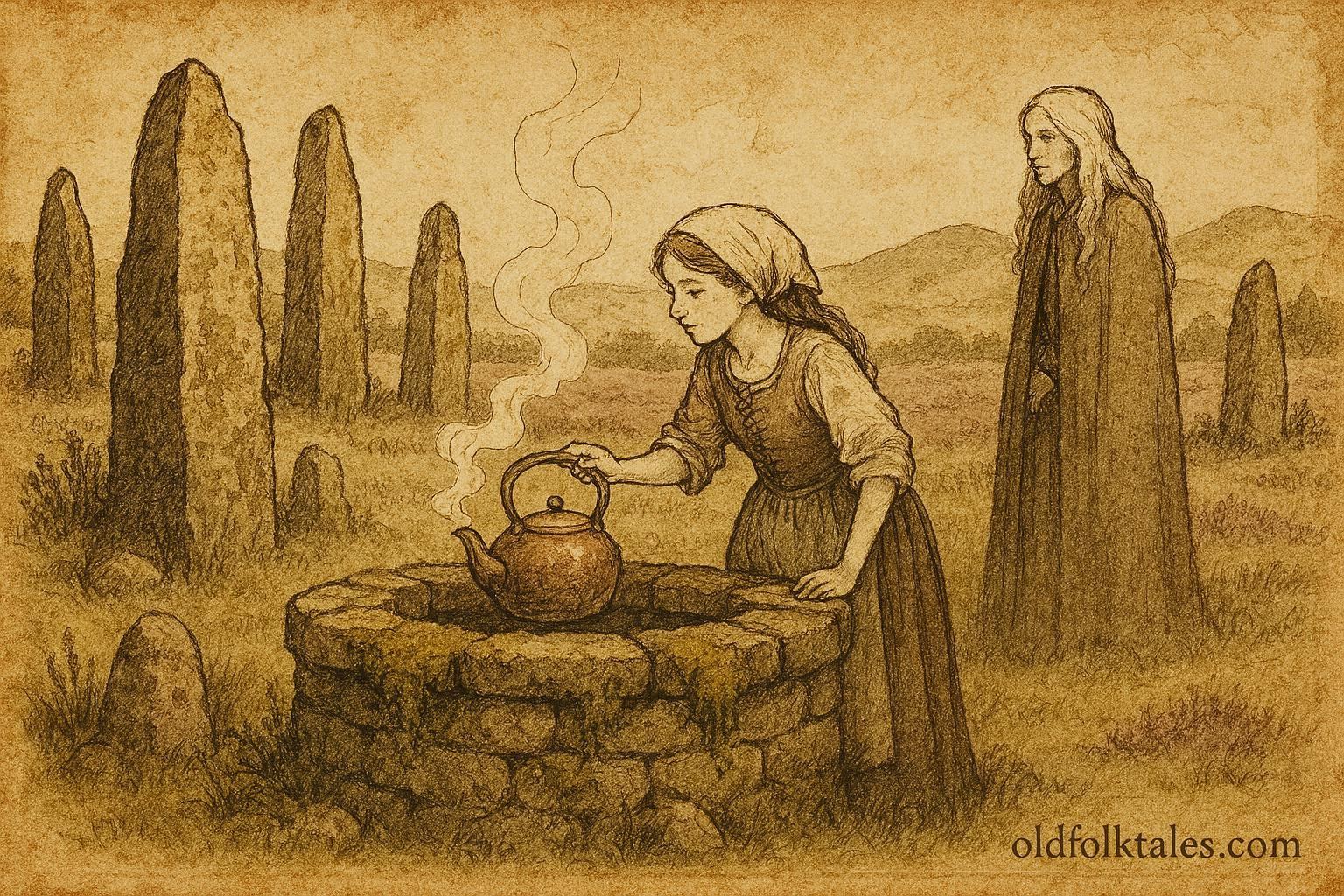
At last she reached a place where the land dipped into quiet stillness. There, surrounded by ancient stones and moss-laden trees, lay the Well of the World’s End. Its waters shimmered unnaturally clear, reflecting sky and earth alike.
But beside it stood a great copper kettle blackened with soot, and near that, a stack of firewood.
Remembering the old woman’s words, the girl did not immediately dip her bucket. Instead, she cleaned the kettle, fetched water for it, and kindled a fire beneath it. The labor was heavy, but she did it without resentment.
As the kettle boiled, the old woman appeared again, though now her bearing seemed grander, her eyes bright with hidden knowledge.
“You have done well,” she said.
From the boiling kettle rose steam that shimmered like silver threads. The old woman instructed the girl to step within the steam three times.
The first time she stepped in, her worn dress became fine as woven silk.
The second time, her hair shone like burnished gold in sunlight.
The third time, jewels fell lightly from her hair like dewdrops.
The blessing was not merely of appearance, but of fortune and grace.
The old woman then filled the girl’s bucket from the Well and sent her home.
When the stepdaughter returned, the stepmother’s eyes widened in disbelief. Her daughter stared at the jewels and fine garments.
Greed stirred.
“What did you do?” the stepmother demanded.
The girl told her plainly of the journey, the old woman, the tasks, and the steam.
The stepmother wasted no time. She ordered her own daughter to go at once and fetch water from the Well of the World’s End.
Unlike her stepsister, the favored daughter grumbled from the beginning. She packed richer food, wore finer clothes, and complained at the cold wind and rough ground.
When she encountered the old woman by the roadside and was asked for bread, she scoffed and turned away.
At the Well, she ignored the kettle and the wood. She dipped her bucket immediately, impatient to claim reward without effort.
But the old woman appeared again, this time with stern eyes.
“You have drawn without giving. You have taken without tending.”
Still, the selfish girl demanded her blessing.
The old woman gestured toward the kettle and instructed her to step into the steam.
The first time she stepped in, her fine dress turned ragged.
The second time, her hair tangled and darkened.
The third time, toads and serpents fell from her locks instead of jewels.
Screaming, she fled home.
Her mother could scarcely bear the sight. The cruelty that had once seemed clever now revealed its cost. The girl’s outward misfortune reflected the inward selfishness she had nurtured.
As for the stepdaughter, her fortune grew steadily. Her grace and kindness drew admiration. In time, a nobleman traveling through the Lowlands heard of her story and sought her hand.
She married not for jewels or gowns, but for the recognition of her character.
And the Well of the World’s End remained where it always had been, silent and waiting, blessing those who approached it with humility, and humbling those who came only to take.
Journey into the charm of British wit and Irish wonder through centuries of folk tradition
Moral Lesson
The Well of the World’s End teaches that true reward flows from kindness freely given and effort humbly offered. Blessings earned through patience endure; those sought through greed unravel.
Knowledge Check
1. What is the Well of the World’s End in Scottish folklore?
It is an enchanted well in Scottish fairy tales that rewards kindness and punishes selfishness.
2. Why was the stepdaughter sent to the Well?
Her stepmother sent her on the difficult journey out of jealousy and cruelty.
3. How did the stepdaughter earn magical rewards?
Through generosity to a stranger and by completing tasks with humility.
4. What happened to the selfish sister?
Her greed and refusal to help resulted in misfortune instead of blessing.
5. What themes define this Scottish fairy tale?
Kindness rewarded, humility, perseverance, and moral justice.
6. Where does this folktale originate?
It comes from the Scottish Lowlands and was recorded in Scottish Fairy Tales (1910).
Source: Elizabeth W. Grierson, Scottish Fairy Tales (1910).
Cultural Origin: Scottish Lowlands.