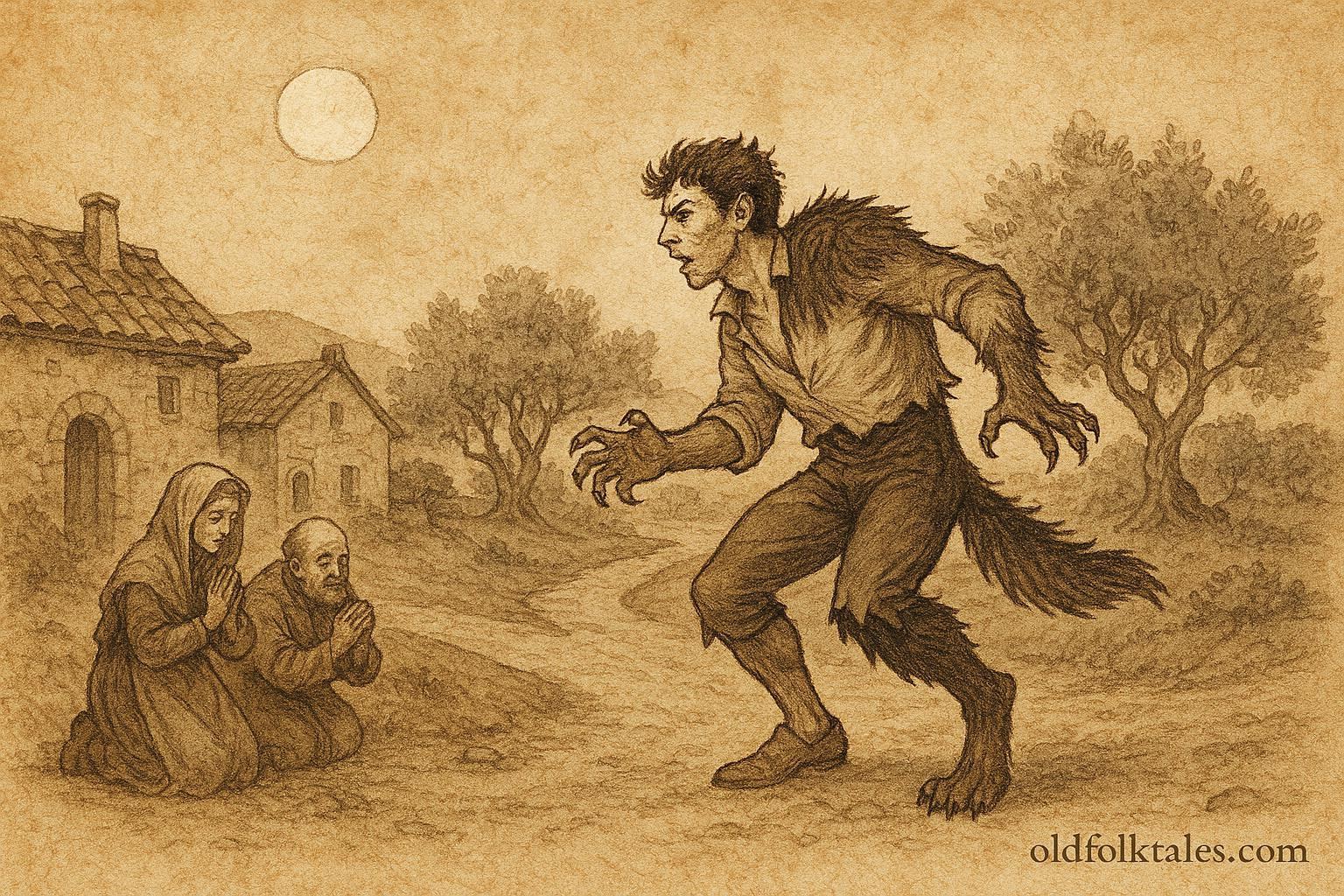
In the scattered villages of northern and central Portugal, where stone cottages leaned against the wind and fields of rye bowed under shifting skies, there lived an old and persistent belief. It was spoken quietly by hearth fires, murmured in the shade of olive trees, and repeated in lowered voices when night pressed close against shuttered windows. The belief concerned the seventh son of a family.
If a woman bore seven sons in succession, and the seventh was left unbaptized, or marked by a curse whispered in anger or envy, then destiny itself would claim him. On certain nights, under certain moons, he would not remain as he was born. At the crossroads of the village paths, he would transform into something feared and pitied in equal measure: a lobisomem, a werewolf doomed to wander until dawn.
This was not a tale of wild forests alone, nor of distant mountains. It belonged to the crossroads, the meeting place of paths, of choices, and of unseen powers.
The Seventh Son
In one such village, nestled between low hills and a winding river, a family welcomed their seventh son. Six boys already filled the small stone house with noise and dust, their boots always muddy, their laughter echoing against whitewashed walls. When the seventh child was born, the midwife counted carefully, her fingers trembling.
“Seven,” she whispered.
The mother, pale but smiling, pulled the infant closer to her chest. Yet outside the home, neighbors exchanged uneasy glances. In a land where faith marked every milestone, baptism was not merely a ceremony; it was protection, a shield against forces that lingered unseen.
But days passed, and then weeks. The winter roads were swollen with rain, the priest had taken ill, and circumstances, so small at first, delayed the sacrament. Whispers grew like ivy along the village walls.
“The seventh,” they said.
“Unbaptized.”
The child grew, strong and quiet. His eyes held a depth that unsettled some and softened others. He was no different from his brothers in daylight, he worked the fields, carried water, and learned the prayers his mother spoke each evening before the hearth. Yet as he approached adolescence, an unease settled into him, like a shadow that lengthened though the sun still shone.
The First Night
It began on a night when the moon hung pale and swollen above the hills. The air was still; even the dogs lay silent. The young man felt a restlessness rise in his blood. It was not anger, nor hunger, but something older, an invisible pull toward the place where the village paths met.
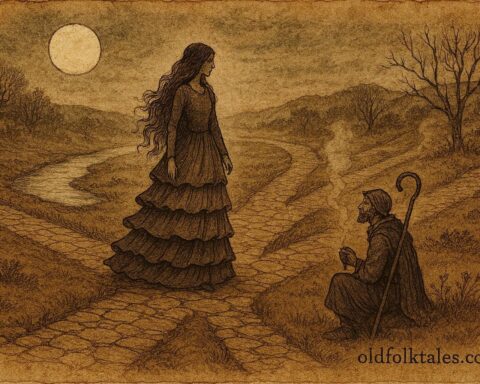
The crossroads lay just beyond the last cottage, where three dirt roads divided toward forest, field, and river. It was a place both ordinary and sacred in its strangeness. Villagers avoided lingering there after dusk. Crossroads were known to hold what did not belong wholly to one world or another.
Drawn by something he could neither name nor resist, the seventh son walked there under moonlight.
As he stepped into the center where the paths crossed, the change came upon him. It was not a thing of choice. His body trembled; his breath shortened. The warmth of his skin gave way to a chill that cut deeper than the night wind. Bones seemed to shift beneath flesh; senses sharpened until every scent and sound struck like flame.
Where a young man had stood, a creature now crouched, wolf-shaped, yet not entirely wolf. Its eyes held a trace of human sorrow. Its paws touched earth it knew well, yet the world had altered.
The lobisomem lifted its head and began to roam.
The Wandering
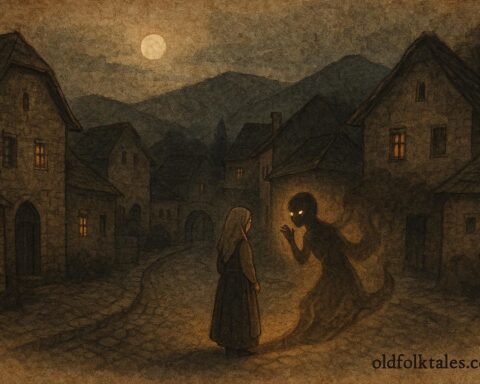
Through fields silvered by moonlight, across stone walls and narrow paths, the werewolf moved until dawn. It did not hunt as a beast of pure hunger; rather, it wandered restlessly, circling the boundaries of the village as though tethered to it by unseen cords.
Those who claimed to have seen it spoke of a shadow slipping between olive trees. Some swore it howled not with savagery but with longing. Others barred their doors tighter, clutching rosaries and whispering prayers learned from childhood.
By sunrise, when the first rooster called and light touched the hills, the creature returned to the crossroads. There, as dawn thinned the night, the transformation reversed. Fur withdrew; limbs reshaped; breath steadied. The seventh son would rise from the earth, exhausted and silent, bearing no wound yet carrying the weight of what had passed.
This fate did not claim him every night, but on certain nights, those known to villagers by custom and fear, the pull returned. Each time, the crossroads awaited.
The Village Response
Rumor traveled swiftly in rural Portugal, borne on the same paths the werewolf crossed. Soon the villagers understood what had befallen the seventh son. Pity mingled with dread. They did not speak of banishment, for he had harmed no one. Yet mothers called their children indoors sooner; men made the sign of the cross when passing him at market.
At the heart of their fear lay belief in destiny. To be the seventh son was already to be marked. To be unbaptized at birth, even by accident or misfortune, left a crack through which curse and superstition could slip.
The priest, once recovered from illness, listened gravely to the murmurs. He knew the old traditions collected in countryside lore: that prayer could shield what fate threatened; that ritual, properly observed, might undo what destiny had woven.
For in these villages, religion and superstition were not enemies but uneasy companions. Crosses stood at roadways; holy water hung near doors. The same people who feared the lobisomem also believed firmly in redemption.
Nights of Fear and Faith
As the months passed, the pattern repeated. On certain nights, the seventh son would vanish toward the crossroads. The villagers would extinguish lamps earlier than usual, speaking softly.
Some claimed that if one encountered the lobisomem at the crossroads and recognized him, calling him by his baptismal name and offering prayer, the spell might weaken. Others believed a ritual act, performed with devotion and without fear, could break the curse entirely.
Yet courage is rarer than belief. Few dared to test the legend.
Still, the seventh son endured his fate not with rage but with sorrow. In daylight he worked diligently, bowed his head at Mass, and avoided the crossroads unless compelled by night’s invisible summons. He carried within him a quiet plea: that the wandering would one day cease.
The Ritual of Release
In time, guided by the counsel of elders and priest alike, a ritual was prepared. It would not alter the fact that he was the seventh son, destiny could not be unwritten, but it might soften its grip.
On a night when the moon rose again in fullness, a small group gathered at a distance from the crossroads. They carried prayer, courage, and the conviction that faith outweighed fear. As the seventh son approached the meeting of paths, the change overtook him once more.
But this time, voices rose, not in panic, but in prayer.
Sacred words cut through the night air. The sign of the cross was traced with steady hands. The ritual was performed not in hatred of the creature, but in hope for the man within.
The lobisomem halted. Where instinct would have driven it to roam, something held it still. Dawn approached slowly, as though watching.
When light at last spread across the hills, the creature’s form gave way to that of the young man. He lay at the crossroads, breathing but unmoving. The villagers did not flee. They waited.
When he opened his eyes, the restless pull that had haunted him seemed quieter, distant, like thunder beyond mountains.
Whether the curse was fully broken or merely weakened, the tale does not say with certainty. But the wanderings grew fewer. The crossroads returned to silence.
And the seventh son lived thereafter not as a creature of night, but as a man tempered by it.
The Crossroads Remain
Even now, in villages of northern and central Portugal, the legend endures. The crossroads still symbolize the meeting of worlds, choice and destiny, faith and fear, curse and redemption.
The story of the lobisomem is not merely about transformation of flesh. It is about the weight placed upon birth order, the power attributed to ritual, and the belief that no fate is beyond the reach of prayer.
For in Portugal’s rural heart, destiny may cast a shadow, but dawn always follows night.
Moral Lesson
This Portuguese folktale teaches that fate may shape our path, but faith, community, and courage can soften even the darkest destiny. Fear divides, yet compassion and prayer offer the possibility of redemption.
Knowledge Check
1. Who becomes the werewolf in the Portuguese folktale O Lobisomem?
The seventh son of a family, particularly if left unbaptized or cursed, is believed to become the werewolf.
2. Why are crossroads significant in this legend?
Crossroads symbolize a meeting point between worlds and are the place where the transformation occurs.
3. What role does religion play in the story?
Religious protection, especially baptism, prayer, and ritual, is believed to prevent or break the curse.
4. Does the werewolf harm the villagers?
In this tradition, the lobisomem wanders restlessly but is portrayed more as cursed than malicious.
5. What themes are central to this Portuguese folktale?
Fate and destiny, religious protection, rural superstition, and fear of the unknown.
6. From which region does the O Lobisomem legend originate?
Northern and Central Portugal.
Source: Collected by José Leite de Vasconcelos in Tradições Populares de Portugal (1882).
Cultural Origin: Northern and Central Portugal.