High above the winding course of the Our River, where wooded hills rise steeply from the valley floor and mist gathers like breath at dawn, Vianden Castle stands upon its rocky throne. Its towers command the northern borderlands of Luxembourg, gazing across forests that have known hunters, soldiers, pilgrims, and kings. For centuries, the castle’s pale stone walls have endured siege and celebration alike, bearing witness to ambition, loyalty, and quiet suffering.
By day, Vianden Castle appears solemn and grand. Sunlight traces the outlines of battlements and arches, illuminating courtyards worn smooth by countless footsteps. Visitors hear the calls of birds circling the heights and the murmur of the river below. Yet when dusk settles and shadows lengthen across the valley, the castle reveals another aspect of its memory, one preserved not in chronicles or inscriptions, but in silence.
It is after nightfall that the White Lady is said to walk.
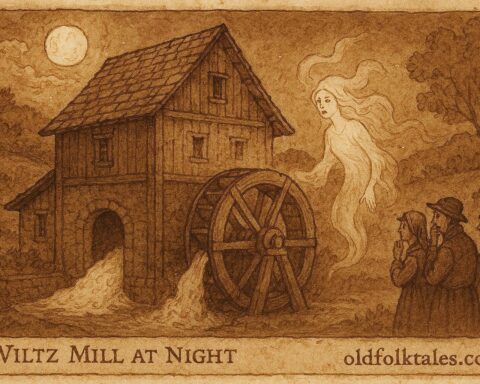
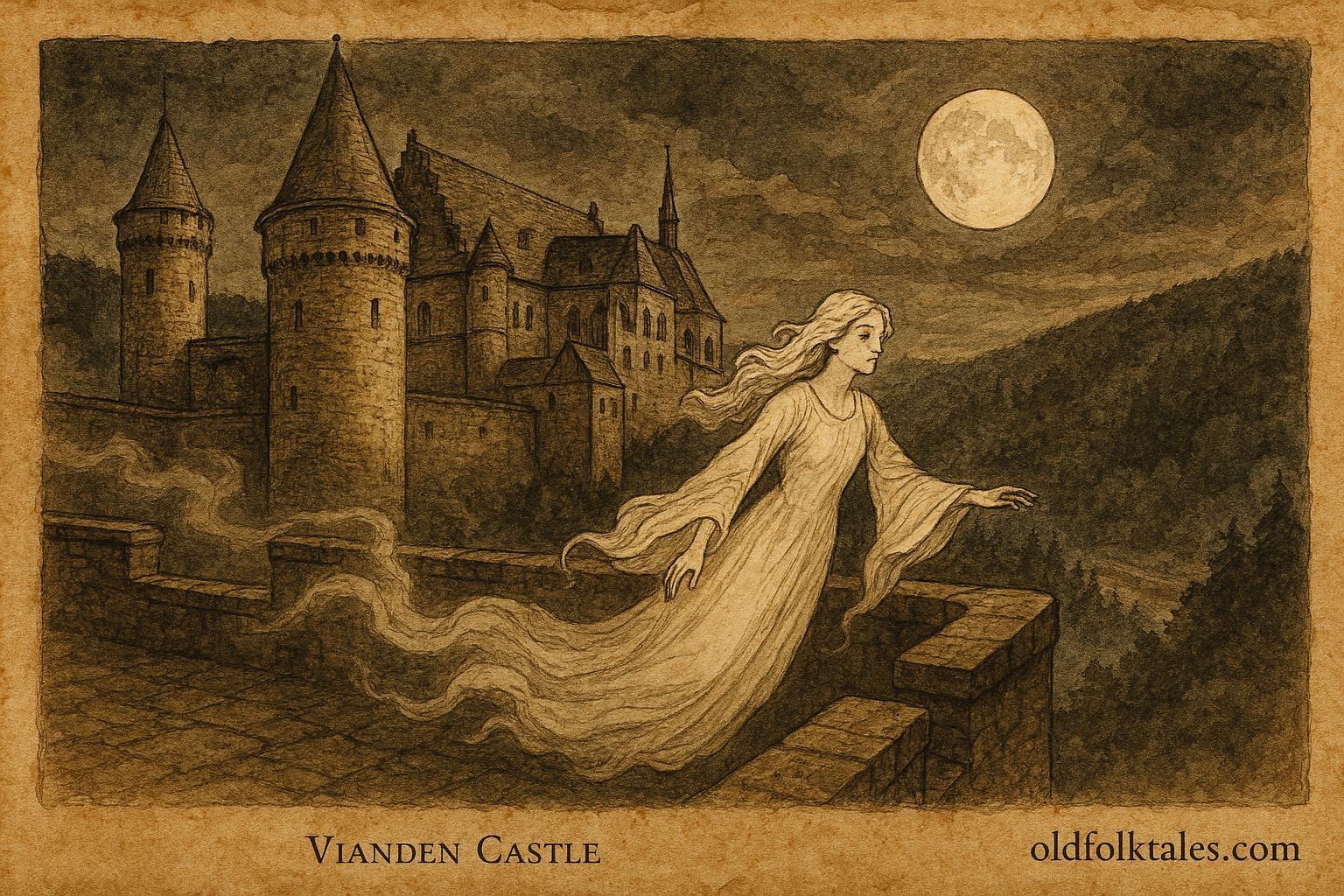
The legend speaks of a pale female spirit, her form slender and luminous against the darkened stone. She appears dressed in the garments of noble birth, long flowing robes, pale as moonlight, moving without sound. She does not rush, nor does she wander aimlessly. Instead, she glides with purpose through corridors, stairways, and ramparts, as though retracing a life once bound by duty and sorrow.
Those who have glimpsed her tell the same essential truths. She does not speak. She does not cry out. Yet her presence fills the air with an unspoken grief that presses upon the heart. To see her is not to feel terror, but weight, an awareness of something unresolved.
No single name is remembered for the White Lady. Her identity has been carried through generations only in fragments, shaped by memory and retelling. What endures is the belief that she was once a noblewoman of Vianden, bound to the castle not by choice, but by fate. She lived within its walls during a time when alliances were forged through marriage, when honor and obedience outweighed compassion, and when silence was often demanded of those with the least power.
Some traditions claim she was betrayed by a husband whose ambition eclipsed loyalty. Others whisper that she was falsely accused, confined, or condemned without defense, sacrificed to preserve family standing or political advantage. What unites these versions is not the specific injustice, but its consequence: her suffering was never acknowledged, and no restitution was made.
And so her spirit did not depart.
The White Lady is said to appear most often near the oldest parts of the castle, stone towers that once served as private chambers, narrow staircases descending into shadow, and high windows overlooking the valley below. She pauses at doorways, lingers in passageways, and stands motionless upon the ramparts, gazing outward as if searching for something lost beyond the forested hills.
Guards who once patrolled the castle by torchlight spoke of sudden stillness before her appearance. Flames would flicker without wind. Footsteps would echo strangely, then cease altogether. When the White Lady emerged, she cast no shadow, yet the stones beneath her seemed to darken, as though absorbing her sorrow.
She never acknowledged the living directly. Those who attempted to speak found their voices falter. Those who reached toward her felt only cold air. Slowly, silently, she would fade—sometimes dissolving into the stone itself, leaving behind nothing but the echo of presence and a lingering chill.
The people of Vianden came to understand that the White Lady was not a threat, but a warning. She appeared not to punish, but to remind. Her presence was strongest when the castle was treated without respect, when arrogance filled its halls, when laughter rang too loudly in places of old confinement, or when history was dismissed as irrelevant.
Servants once believed that careless behavior at night invited her appearance. Mockery, cruelty, or disrespect toward the castle’s past were said to draw her silent gaze. Yet those who worked humbly, who spoke softly and treated the ancient walls with care, often sensed her passing as a gentle cold, a breath of air that vanished as quickly as it came.
Time did not erase her.
As centuries passed, Vianden Castle fell into decline. Roofs collapsed, towers crumbled, and ivy crept across abandoned halls. Even then, villagers claimed the White Lady remained. Travelers glimpsed pale light moving among ruined battlements. Shepherds saw a white figure standing upon the heights where no living person could climb at night.
The castle, though broken, was never empty.
When restoration efforts began generations later, workers approached the task with caution. Tools were laid down respectfully at dusk. Certain chambers were entered only by daylight. Though few admitted belief openly, many felt that the White Lady still watched, guarding not treasure, but memory itself.
Today, visitors walk the restored halls, admiring the strength of medieval stone and the beauty of the surrounding valley. Guides speak of history, architecture, and noble lineage. Yet when evening falls and the crowds depart, the legend remains. Some visitors report a sudden hush in the corridors. Others sense movement where none should be.
The White Lady does not demand recognition, but she endures because memory does.
She is the echo of injustice unanswered, the presence of sorrow denied voice. In her silence lies the lesson that power does not erase wrongdoing, and that walls built to protect authority can also imprison truth. As long as Vianden Castle stands, her story continues, woven into stone, shadow, and the quiet hours between dusk and dawn.
Moral Lesson
The White Lady of Vianden Castle reminds us that injustice unacknowledged does not fade with time. When truth is denied and suffering ignored, memory itself becomes a form of justice that endures beyond death.
Knowledge Check
1. Who is the White Lady believed to have been in life?
A noblewoman of Vianden who was betrayed or wronged and denied justice.
2. Where does the White Lady appear?
Within Vianden Castle, especially along towers, corridors, and ramparts.
3. Does the White Lady harm those who see her?
No. She appears silently as a reminder rather than a vengeful spirit.
4. What does the White Lady symbolize in Luxembourg folklore?
Unresolved injustice, sorrow, and the persistence of memory.
5. Why is she bound to the castle?
Because her suffering was never acknowledged or made right in life.
6. How should the legend be interpreted culturally?
As a warning against arrogance and a call to remember the wronged.
Source: Nikolaus Gredt, Sagenschatz des Luxemburger Landes, 1883
Cultural Origin: Vianden, northern Luxembourg