Across the wide, open heathlands of the Netherlands, where the earth stretches low beneath vast skies and the wind moves freely over purple heather and pale grasses, there are places few travelers linger after dusk.
These lands, beautiful by day, take on another character when evening falls.
Mist gathers slowly, drifting low across the ground like a living veil. Familiar paths fade into shadow. Sounds become uncertain, footsteps muffled, distances distorted, directions unclear. And in these quiet, shifting spaces, stories have long been told of figures that appear where no one else walks.
They are known as the White Wives.
No one agrees entirely on what they are. Some say they are spirits of ancient women who once lived upon the land, bound to it even after death. Others believe they are guardians of the heath itself, beings neither kind nor cruel, but bound to a deeper order that humans rarely understand.
Yet all who speak of them agree on one truth:
The White Wives are not to be taken lightly.
The First Encounters
For generations, travelers crossing the heathlands told similar tales.
A lone walker, delayed by circumstance, would find himself caught upon the open land as night fell. The mist would rise, swallowing the familiar world, until even the nearest path seemed lost.
It was then that the White Wives would appear.
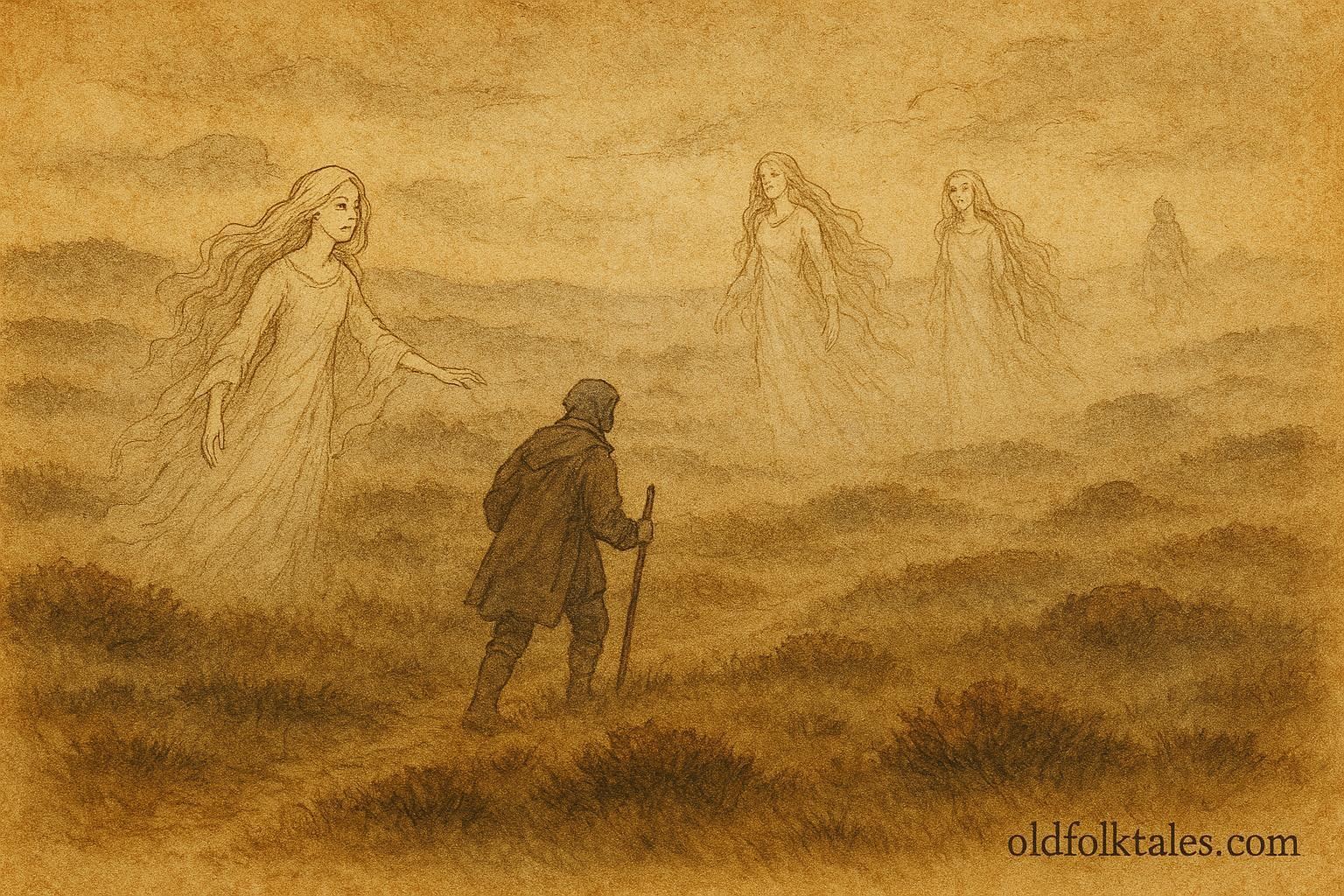
They were seen as pale figures drifting through the haze, their forms soft and shifting, as though woven from the mist itself. Their garments, long and white, moved without wind, and their presence carried a stillness that silenced the night.
They did not always speak.
Sometimes they merely watched.
Sometimes they beckoned.
And sometimes, they turned and walked away, as if inviting the traveler to follow.
Those who encountered them were left with a choice.
The Humble Traveler
There was once a traveler, a simple man from a nearby village, who found himself crossing the heath later than he had intended.
The sun had already dipped below the horizon when he reached the open land, and a chill wind swept across the grasses. He quickened his pace, hoping to reach the safety of the road before darkness fully took hold.
But the mist came swiftly.
Within moments, the path beneath his feet seemed to vanish. Landmarks disappeared. The world around him became a shifting sea of pale grey.
He stopped, uncertain.
It was then that he saw her.
A figure stood some distance ahead, her form faint but unmistakable. She appeared as a woman clothed in white, her presence both calm and otherworldly.
The traveler felt fear stir within him, but he did not run.
Instead, he lowered his gaze slightly, as one might do before something unknown yet worthy of respect.
“If you mean me no harm,” he said quietly, “I ask only for safe passage.”
The figure did not answer.
She turned and began to walk.
For a moment, the traveler hesitated. Then, trusting his instinct, he followed.
The White Wife moved slowly, her path winding through the mist with quiet certainty. Though the ground seemed uneven and unfamiliar, he found that where she stepped, the way became easier to follow.
The air felt less heavy.
The silence less oppressive.
Step by step, he continued behind her, never drawing too close, never speaking again.
At last, the mist began to thin.
Shapes emerged, the outline of a road, the distant glow of a lantern, the reassuring signs of the world he knew.
When he looked ahead again, the White Wife was gone.
The traveler found himself standing safely at the edge of the heath.
He never spoke of the encounter with pride, only with quiet gratitude.
The Arrogant Man
Not all who crossed the heath showed such humility.
There was another man, known in his village for his confidence and sharp tongue. He laughed at old stories and dismissed tales of spirits as nothing more than superstition.
One evening, he too found himself upon the heath as mist began to rise.
When the White Wife appeared before him, he did not pause in respect.
Instead, he called out boldly.
“So you are the spirit these fools speak of,” he said. “If you know the way, then show it. I have no time for games.”
The figure remained still.
Then she turned and began to move.
The man followed, though not with trust, but with impatience. He spoke loudly as he walked, mocking the silence, dismissing the strangeness of the moment.
“Is this your doing?” he scoffed, as the mist thickened around them. “A poor trick.”
The White Wife did not respond.
Her path grew more winding, more uncertain. The ground beneath the man’s feet became uneven, the air colder. Shapes seemed to shift at the edges of his vision, and the silence pressed in more heavily than before.
Still, he continued.
At last, he called out again.
“You lead nowhere,” he said. “This is nonsense.”
The figure stopped.
For a brief moment, she turned toward him.
Though her face was obscured, there was something in that stillness, something that caused even his boldness to falter.
Then she vanished.
The mist surged.
The man found himself alone.
No path lay before him. No direction seemed certain. Every step led deeper into confusion. The ground grew treacherous, the air thick and disorienting.
By the time he finally found his way back, hours later, weary and shaken, he spoke no more of mocking tales.
The Dual Nature of the Heath
Over time, the stories spread, shaped by those who experienced them.
Some spoke of guidance.
Others spoke of being led astray.
Yet the pattern remained clear.
The White Wives did not act without reason.
They did not harm without cause.
Nor did they help without measure.
They responded, it seemed, not to the need of the traveler alone, but to the spirit in which that need was carried.
Those who approached the unknown with humility, who recognized their place within a world larger than themselves, found assistance, even if it came silently.
Those who approached with arrogance, who demanded control or mocked what they did not understand, found only confusion.
The heath itself seemed to reflect this balance.
It was neither safe nor dangerous by nature, but became one or the other depending on how it was met.
The Lasting Presence
Even in later years, when roads became clearer and travel more certain, the stories of the White Wives did not fade.
Villagers still spoke of them in quiet tones.
Travelers still avoided the heath at night when they could.
And those who could not remembered the old advice:
Walk with respect.
Speak with care.
And do not assume that what you do not understand is without power.
For on the misty heathlands of the Netherlands, where the boundary between the seen and unseen grows thin, the White Wives are said to remain.
Watching.
Waiting.
And guiding, when they choose.
Moral Lesson
This Dutch folktale teaches that humility and respect for the unknown are essential when facing forces beyond human understanding. The White Wives represent the dual nature of the world, capable of both guidance and misdirection, depending on how one approaches it.
Knowledge Check
- Who are the White Wives in Dutch folklore?
They are mysterious female spirits believed to inhabit heathlands, guiding or misleading travelers. - When do the White Wives usually appear?
They appear at night, especially when mist covers the heath. - How do the White Wives treat humble travelers?
They guide them safely through the mist and help them find their way. - What happens to arrogant travelers in the story?
They are led astray and left lost in confusion on the heath. - What do the White Wives symbolize in the folktale?
They symbolize the dual nature of the supernatural and the importance of respect for nature. - Where does The White Wives of the Heath originate from?
It originates from the heathlands and rural regions of the Netherlands.
Source: Collected in Legends of the Low Countries by Joseph Jacobs, 1892
Cultural Origin: Netherlands (heathlands and rural regions)