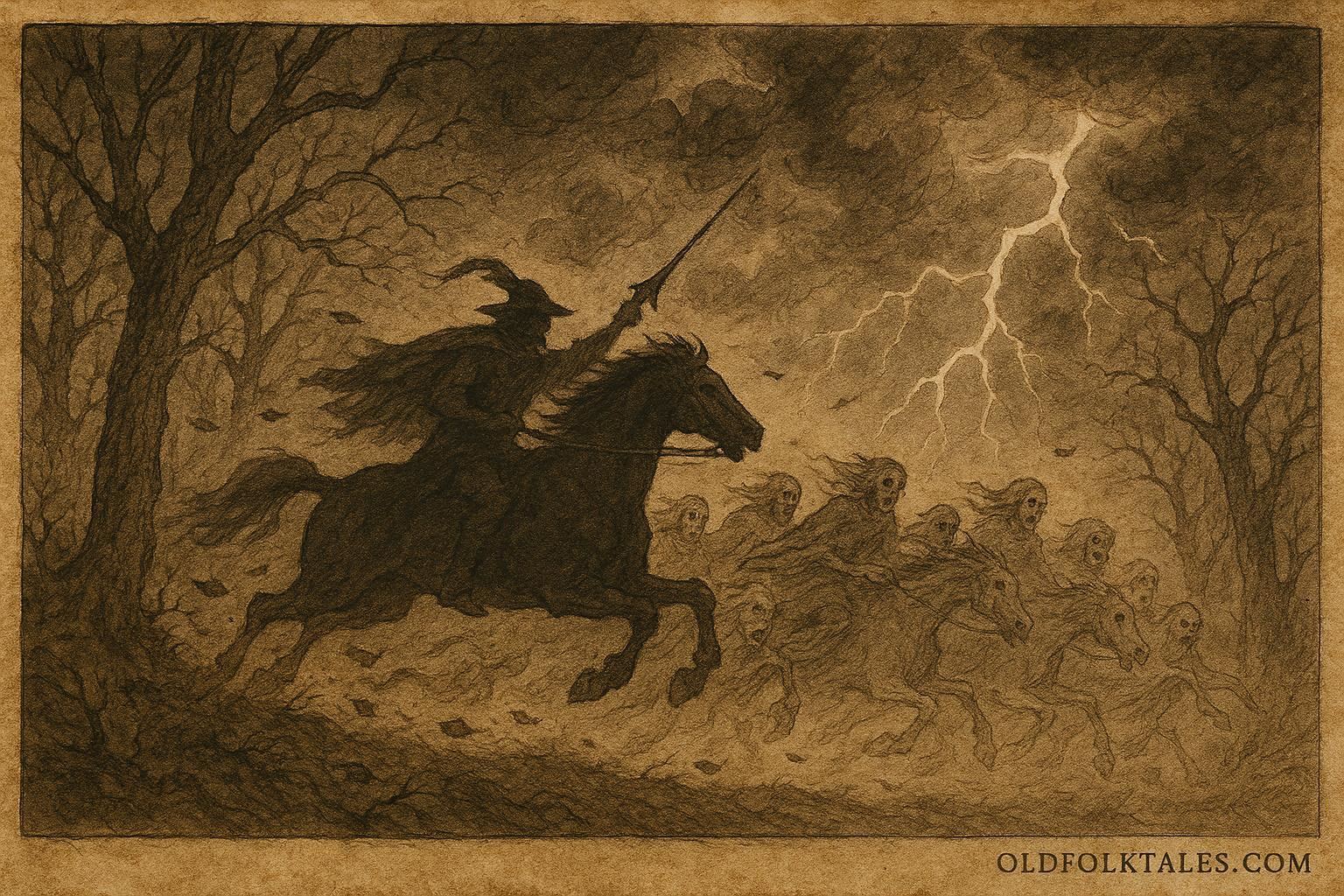
In the northern highlands of Luxembourg, where the Ardennes forests stretch across rolling hills and deep valleys, the land has long been wrapped in mystery. Dense woods cloak the region known as the Éislek, and mist often gathers between ancient trees whose roots sink deep into soil layered with memory. For generations, villagers have believed that the forest is not merely a place of timber and game, but a realm governed by unseen laws, laws older than churches, borders, or kings.
On storm-lashed nights, when the wind howls through the treetops and thunder echoes across the hills, the people of the Ardennes speak in hushed tones of the Wild Hunt.
It is said that when the sky darkens unnaturally fast and the air turns sharp and restless, the Hunt is near. Doors are shut, windows barred, and fires dimmed. Travelers abandon the road if they can, knowing that no destination is worth the risk of crossing paths with what rides through the forest after nightfall.
The Wild Hunt is not a single rider, but a ghostly procession, spectral horsemen racing through the woods at terrifying speed. Their horses’ hooves strike the earth with thunderous force, yet leave no tracks behind. The sound of hunting horns pierces the storm, echoing from all directions at once, as if the forest itself were calling out.
At the head of this phantom cavalcade rides a cursed hunter.
Long ago, according to the old tales, this hunter was a mortal man renowned for his skill. He knew the forests of the Ardennes better than any other, tracking deer and boar with ease. His arrows never missed, and his dogs obeyed him without question. Yet his mastery over the hunt bred arrogance. He believed himself superior not only to other men, but to the natural order itself.
The elders warned him that the forest demanded respect. Certain days were not meant for hunting. Certain places were sacred, belonging not to humans but to spirits and ancestors. Storms, they said, were signs to stay indoors, for such nights belonged to forces beyond human control.
The hunter ignored every warning.
He hunted when others laid down their weapons. He rode out during violent storms, mocking both weather and tradition. He laughed at stories of spirits and cursed riders, calling them excuses made by fearful men. To him, the forest was nothing more than a challenge to be conquered.
One night, as black clouds gathered and lightning split the sky, the hunter mounted his horse and rode into the depths of the Ardennes. The wind roared like a living thing, bending branches low and scattering leaves across the path. His horse hesitated, sensing danger, but the hunter forced it forward.
Then the horns sounded.
The call was long, hollow, and unearthly. It did not echo as a mortal horn would, but seemed to come from everywhere at once. The ground trembled beneath pounding hooves, though no riders could yet be seen. The air grew colder, heavier, as if the forest itself were holding its breath.
Out of the storm emerged the Wild Hunt.
Shadowy riders burst through the trees, their forms flickering like smoke and lightning. Their horses moved faster than any living creature, eyes glowing with unnatural fire. At their head rode a figure cloaked in darkness, bound to the storm itself.
The hunter realized too late that he had crossed a boundary that could not be undone.
Surrounded by the spectral riders, he was seized by forces beyond human strength. His horse reared in terror, and the world seemed to twist around him. He was not struck down, nor allowed to flee. Instead, he was condemned to ride with them, to become one of the Hunt.
From that night onward, the hunter was cursed to lead the Wild Hunt through the Ardennes forests. His great skill became his eternal burden. Night after night, storm after storm, he rode without rest, hunting endlessly yet never finding peace. He could never dismount, never return to the warmth of hearth or home.
The Wild Hunt did not fade with time.
Villagers continued to hear it on certain nights: the sudden rise of violent winds, the thunder of hooves, the chilling call of horns. Dogs would cower, livestock panic, and even the bravest souls felt dread grip their hearts.
Those unlucky enough to glimpse the Hunt spoke of pale riders with hollow eyes and tattered cloaks, racing through the forest sky. Some claimed to recognize the cursed hunter at the front, his face drawn with eternal regret, eyes burning with restless sorrow.
To encounter the Wild Hunt was a grave omen. Illness, madness, or death often followed. Those who mocked tradition, disrespected the forest, or broke sacred customs were especially vulnerable. The Hunt was believed to punish not at random, but according to ancient moral law.
Children were warned never to call out in the forest at night, for a shout might be mistaken for a hunting horn. Hunters were taught to offer thanks to the land and to stop when storms approached. Travelers learned to read the signs of the sky and respect the boundaries between human and spirit worlds.
Over centuries, the Wild Hunt became a powerful symbol rather than merely a tale of fear. It reminded the people of Luxembourg that nature was not something to dominate, but something to live alongside with humility and caution.
Even as time passed and belief in spirits waned, the story endured. Woodsmen spoke of sudden winds carrying the sound of hooves. Shepherds claimed to see shadowy riders cresting distant hills during violent storms. Though dismissed by some, the legend never disappeared.
For in the Ardennes, the forest still remembers.
Moral Lesson
The Wild Hunt of the Ardennes teaches that arrogance toward nature and sacred laws leads to irreversible punishment. Respect, humility, and balance are essential to living in harmony with forces greater than oneself.
Knowledge Check
1. Who leads the Wild Hunt in the Ardennes legend?
A cursed hunter condemned to ride eternally as punishment for defying sacred laws.
2. What triggers the appearance of the Wild Hunt?
Stormy nights marked by violent winds, thunder, and supernatural horn calls.
3. What moral transgression caused the hunter’s curse?
Disrespect for nature, sacred customs, and spiritual boundaries.
4. What happens to those who encounter the Wild Hunt?
They may suffer misfortune, illness, madness, or death.
5. What does the Wild Hunt symbolize in Luxembourgish folklore?
Divine or spiritual justice enforcing balance between humans and nature.
6. Where is this legend traditionally rooted?
The Ardennes forests of northern Luxembourg, particularly the Éislek region.
Source & Cultural Origin
Source: Nikolaus Gredt, Sagenschatz des Luxemburger Landes (1883)
Cultural Origin: Luxembourg (Éislek / Ardennes region)