In the northern reaches of Ukraine, where forests stretch wide and the winter sky often hangs low and gray, there once lived an old man who earned his bread by honest labor and quiet endurance. His beard was white as birch bark in frost, his back bent from years of work, and his hands roughened by soil, wood, and wind. Though poor in possessions, he was rich in understanding, for he had lived long enough to know that the world listens when spoken to with respect.
Late one autumn evening, as the last geese flew south and the air sharpened with cold, the old man set out along a forest road. He was traveling from one village to another, hoping to spend the winter with distant kin. The sun dipped early behind the trees, and the path ahead darkened quickly. Leaves rattled underfoot, and the wind whispered through the branches like voices remembering old songs.
The old man pulled his worn cloak tighter around his shoulders and continued on, leaning on his staff.
The First Encounter: The Wind
As twilight deepened, the air suddenly stirred. What had been a gentle breeze grew stronger, circling the old man, tugging at his cloak, lifting fallen leaves into whirling spirals.
Then the wind spoke.
Its voice was low and moving, sometimes close to his ear, sometimes far away.
“Old traveler,” said the Wind, “why do you walk so late, when the forest grows restless and night sharpens its teeth?”
The old man stopped. He did not shout or curse, nor did he clutch his cloak in fear. Instead, he bowed his head slightly, as one does when greeting a respected elder.
“I walk because I must,” he answered calmly. “The road is long, and winter does not wait. I greet you, Wind, who knows all paths and carries news between villages.”
The wind circled him more slowly now, curious rather than cruel.
“You are not afraid of me?” it asked.
“I have felt you all my life,” the old man replied. “You cool the fields in summer and clear the air before snow. You can be harsh, but you are never without purpose.”
At these words, the Wind softened. It lifted the old man’s cloak not to steal warmth, but to wrap it closer around him.
“Walk in peace,” said the Wind. “I will guide you through the dark and keep the wolves away.”
And with that, the forest grew quieter, the path clearer.
The Second Encounter: The Frost
Not long after, the temperature dropped suddenly. The air became sharp as glass, and the old man’s breath turned white before his face. The ground stiffened beneath his feet, and every branch glittered faintly.
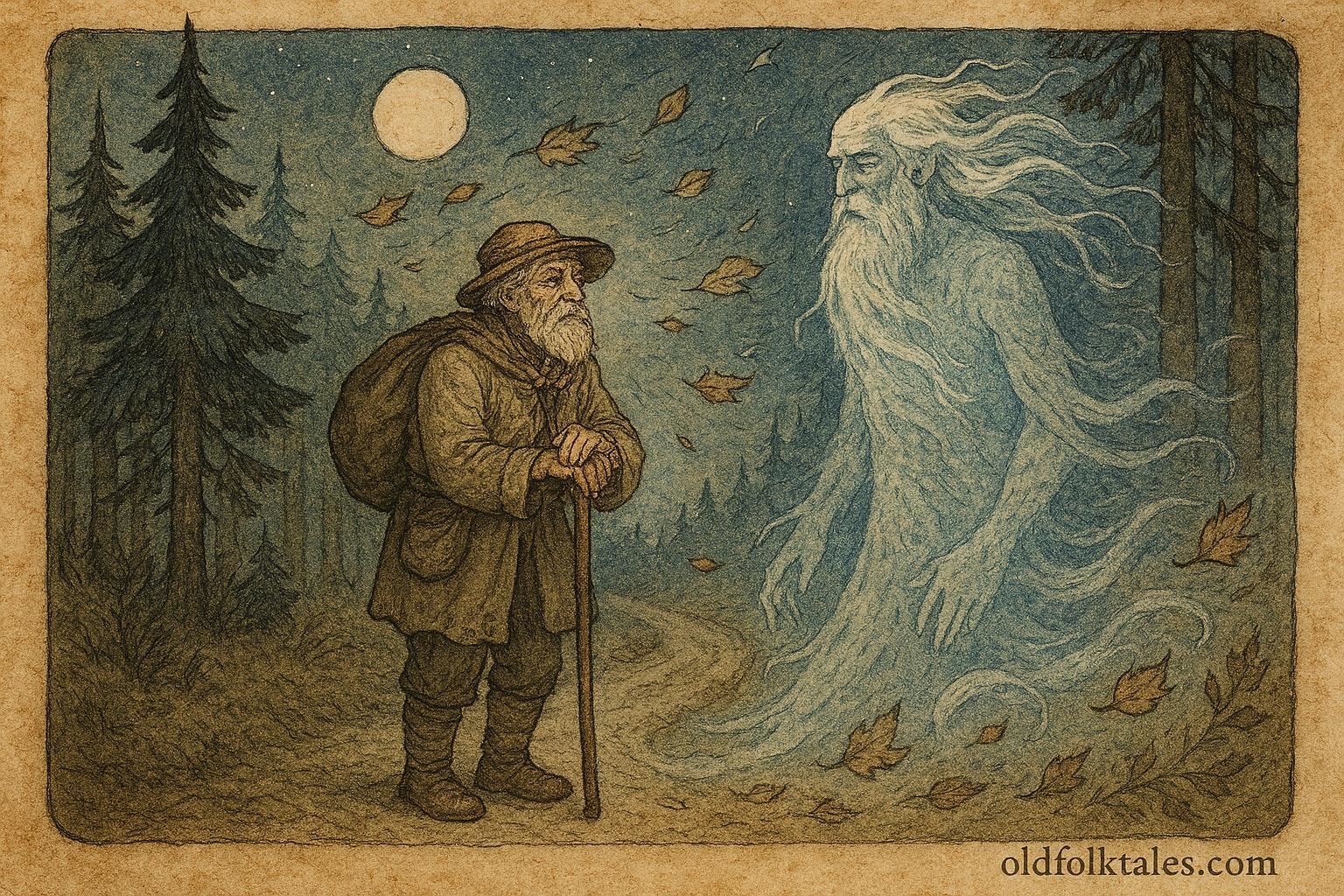
From the shadows stepped Frost himself, tall, pale, and shining, his beard sparkling with ice, his eyes cold and clear as frozen rivers. Wherever he placed his foot, the earth hardened.
“Old man,” Frost said, his voice cracking softly like ice on a pond, “why do you wander when my breath freezes the careless?”
The old man felt the cold bite his bones, but he did not tremble. He placed his staff firmly on the ground and inclined his head.
“I greet you, Grandfather Frost,” he said, using the respectful name known in the villages. “You test the strong and humble the proud. Without you, the land would not rest.”
Frost studied him closely.
“Many curse me,” Frost said. “They hide from me and speak my name with fear. Why do you greet me kindly?”
“Because you teach patience,” the old man replied. “You remind us that life moves in cycles, and that nothing grows without rest.”
Frost’s stern face softened slightly.
“You understand more than most,” he said. “Go on, then. I will not touch your bones tonight.”
The frost eased around the old man, no longer cutting, merely crisp.
Shelter and Protection
As night fully fell, the Wind guided the old man toward a hollow beneath thick pine trees, where the branches blocked the worst of the cold. Frost kept the air dry and still, preventing dampness from seeping into the old man’s cloak.
There, the old man rested, warmed not by fire but by the balance of nature itself.
Before dawn, Wind whispered a final blessing and moved on. Frost faded into the pale light, leaving the forest quiet.
The old man rose with the sun and continued his journey safely, reaching the village by midday.
The Arrogant Traveler
Not many days later, another traveler set out on the same road. This man was younger, stronger, and far prouder. He laughed at the forest and boasted loudly of his strength, mocking old tales of spirits and forces unseen.
When the Wind rose, the man cursed it.
“Blasted air!” he shouted. “Clear out of my way!”
The Wind answered him, not with words, but with fury. It tore his cloak from his shoulders and drove him off the path.
When Frost appeared, the man spat and laughed.
“Cold cannot touch me,” he said.
Frost smiled thinly.
By morning, the traveler was found frozen stiff beside the road, his strength useless, his pride unanswered.
The Lesson Remembered
The villagers spoke of both travelers for years to come.
They remembered the old man who greeted the world with humility and passed safely through it. And they remembered the younger man whose arrogance closed his ears to warning.
From that time on, people taught their children to greet the Wind, to thank the Frost, and to walk the land with care.
For nature, they said, is not cruel, but it does not forgive disrespect.
Moral Lesson
This folktale teaches that wisdom lies in humility and respect for forces greater than oneself. Those who recognize nature as living and worthy of honor move through the world safely, while arrogance invites destruction.
Knowledge Check
1.Why does the old man survive his journey safely?
Because he shows respect and understanding toward Wind and Frost.
2. What do Wind and Frost represent in Ukrainian folklore?
Personified natural forces with moral awareness.
3. Why is the younger traveler punished?
His arrogance and mockery disrupt harmony with nature.
4. What cultural value does the story emphasize?
Respect for elders, nature, and unseen forces.
5. Why is Frost called “Grandfather”?
As a sign of respect and acknowledgment of ancient power.
6. What lesson is passed to the villagers?
Humility ensures protection; arrogance invites harm.
Source: Recorded from northern Ukrainian oral storytelling traditions. Published in 1908
Cultural Origin: Ukrainian animistic folklore. Reflecting agrarian worldviews and personified nature