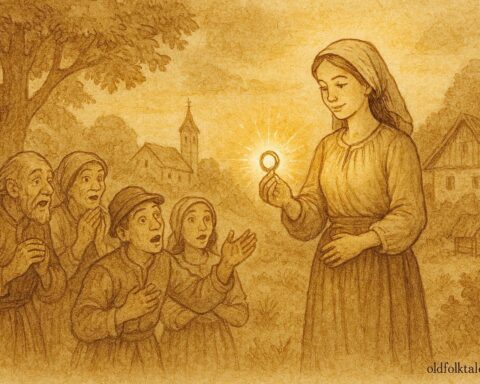
In a humble village in Belarus, there once lived a poor peasant who had a daughter of remarkable intelligence and beauty. Her name was Marusya, and her wisdom was renowned far and wide; people traveled from distant villages just to seek her advice.
In the same land, a wealthy nobleman prided himself on his knowledge and took great delight in testing others with riddles. One day, he summoned all the peasants from his estate and declared:
“Who among you is the wisest? Answer my riddles correctly, and I shall reward you with gold. Fail, and you shall work for me for three long years without pay!”
Fear and hesitation rippled through the crowd. None dared risk such a challenge. Yet the poor man with the wise daughter stepped forward.
“Let me go, my lord,” he said, “for I have a daughter cleverer than any scholar in your court.”
The nobleman laughed heartily.
“Very well. If your daughter can answer my riddles, I will reward you with a sack of gold. Fail, and you shall lose your land.”
The peasant returned home in despair, pacing the small room.
“My child,” he said, “we shall be ruined! I am no scholar, and these riddles are beyond me.”
Marusya, calm and gentle, smiled at her father.
“Do not worry, father. Tomorrow, I will tell you what to say. Trust me.”
The next morning, the nobleman posed his riddles.
“Tell me,” he demanded, “what is the strongest thing in the world, what is the swiftest, and what is the most precious?”
The peasant, recalling his daughter’s instructions, replied:
“The strongest thing in the world is truth, the swiftest is thought, and the most precious is time.”
The nobleman’s eyes widened in astonishment.
“Who taught you this?” he asked sharply.
“My daughter, Marusya,” said the man humbly.
Intrigued and somewhat amused, the nobleman smiled cunningly.
“Bring her to me,” he commanded. “I wish to see if she is as wise as you claim.”
When Marusya appeared before him, the nobleman posed a challenge:
“If you are truly clever, prove it. Come to my court tomorrow, not on foot, not on horseback; neither naked nor dressed; carry no gift, yet bring something.”
Marusya bowed with composure.
“It shall be as you say, my lord,” she promised.
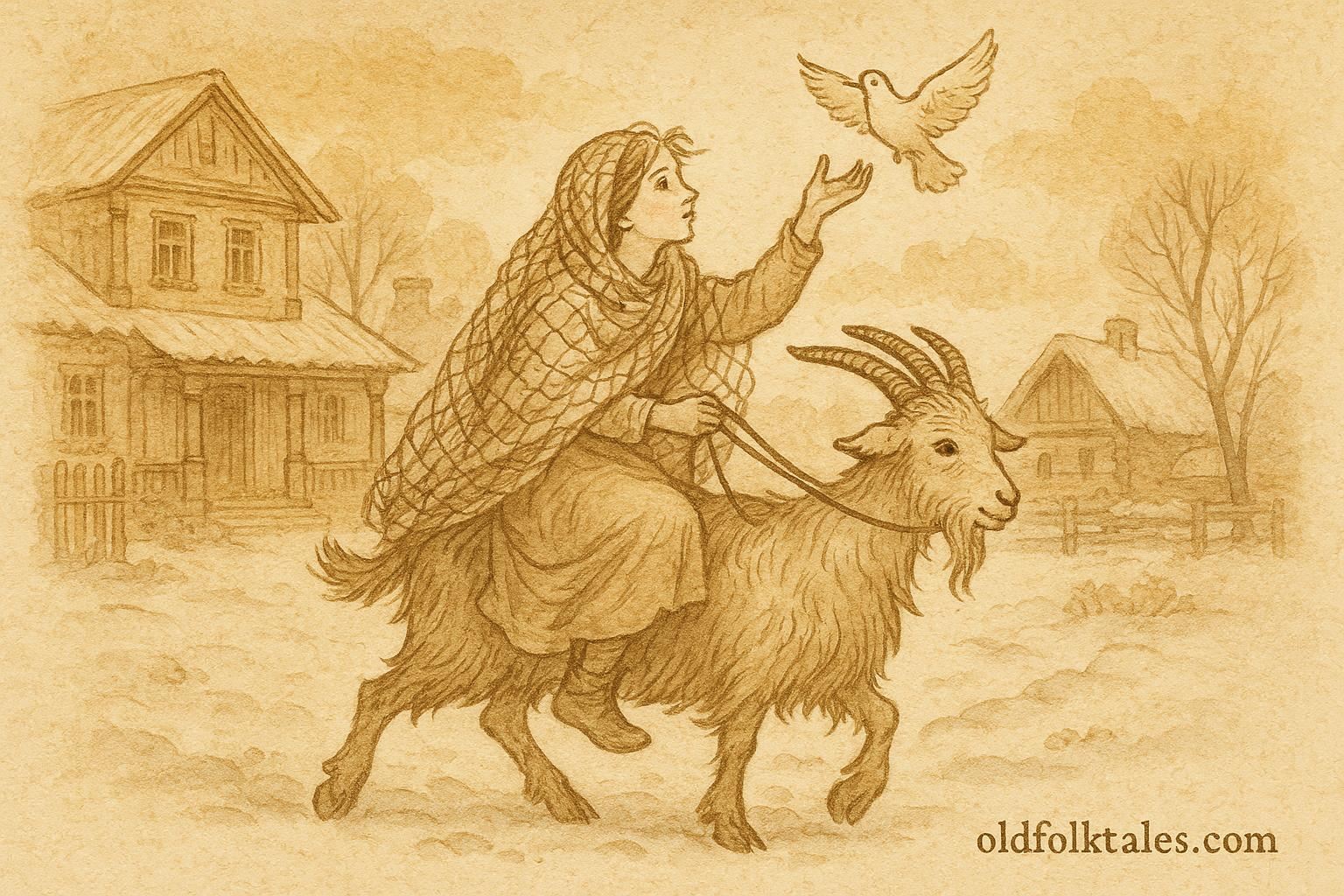
The following day, she arrived at the court wrapped carefully in a fisherman’s net, thus neither dressed nor undressed. She rode atop a sturdy goat, neither walking nor riding. In her hands, she carried a pigeon, neither a gift nor empty-handed. As she entered the courtyard, she released the pigeon, which circled gracefully above the nobleman’s head.
The nobleman could not contain his laughter.
“You have answered well, Marusya! Your cleverness surpasses any nobleman in my court.”
In admiration of her wit, he rewarded her father with a sack of gold. From that day forward, he frequently sought Marusya’s counsel in matters of wisdom and justice. In time, he grew to admire her for both her intelligence and her good heart and made her his wife.
Thus, the poor peasant’s daughter became a noble lady, not through wealth or beauty, but through the strength of her mind, her ingenuity, and the honesty of her heart.
Click to read all Eastern European & Slavic Folktales — grand tales of heroes, witches, and moral heart from the lands of Eastern Europe
Moral Lesson
True wisdom and virtue are more valuable than wealth or beauty. Cleverness, honesty, and integrity can elevate a person and earn respect across social boundaries.
Knowledge Check
-
Who is Marusya, and why is she famous?
Marusya is a clever and beautiful peasant’s daughter known for her intelligence and wise counsel. -
What challenge did the nobleman present to the villagers?
He posed riddles, offering gold for correct answers and three years of unpaid labor for failure. -
How did Marusya answer the first set of riddles?
She instructed her father to say: “The strongest thing is truth, the swiftest is thought, and the most precious is time.” -
What clever solution did Marusya use to meet the nobleman’s impossible conditions?
She came wrapped in a fisherman’s net, rode a goat, and carried a pigeon, meeting all conditions without breaking any rule. -
What does this folktale teach about intelligence and virtue?
It demonstrates that wisdom, ingenuity, and integrity are more important than wealth or social status. -
What is the cultural origin of this story?
It is a Belarusian folktale emphasizing cleverness, moral values, and social lessons.Source: Adapted from the Belarusian folktale “The Wise Daughter” in Belarusian Fairy Tales – Detskie-Skazki.com, English public-domain translation.
Cultural Origin: Belarus (Belarusian folklore)