Once upon a time in a quiet Portuguese town, there lived a wealthy merchant, a kindly man, who each year, on a fixed day of a fixed month, would depart for a distant city to collect money owed him on a business account. When he left, his wife and their three daughters, of which the wise little maid was one, remained at home. All went well year after year, until one fateful season when his wife died. That year, the merchant dreaded his journey more than ever: he would have to leave his three young daughters alone in the house.
“My heart aches to go away,” he said to them. “I fear something dreadful may befall you in my absence.”
He paced the courtyard, tugged at his beard, and worried long into the night. The business was important, he had no one he trusted sufficiently to tender the matter in his stead. And yet to leave three pretty, unguarded girls alone in the house was no small matter.
“Do not fret for us, dear father,” the daughters offered together. “Nothing will harm us while you are gone.”
“How can you say that?” he asked gently. “I am older and wiser than you, there are many dangers. For example, in this city there are bold thieves who would be only too ready to enter an undefended home and rob everything I possess.”
“We will lock ourselves securely in the house and admit no one,” they told him.
“Promise me that no one shall enter,” he commanded firmly.
They promised, and with a heavy heart the merchant set forth on his journey. All was quiet at home at first, but lurking just beyond the city’s outskirts a band of daring robbers watched for his departure. Their captain kept his eyes on the merchant as he left, and when the man was safely away, the robber stepped into action.
That evening, the captain of the thieves disguised himself as an old beggar, ragged coat about his shoulders, leaning on a stick. He and his gang crept into a nearby street, and at dusk he knocked at the merchant’s front door.
“Have pity on a poor, unfortunate one!” he called. “It is raining outside, and who with any mercy could turn away one who begs shelter in such a storm? Let me enter your roof for the night.”
The eldest daughter, the house watched from within as the wind rattled the tiles and torrents of rain hammered the windows. “It’s a terrible night to send a beggar away,” she said with concern.
The second daughter peered through the window at the old man. “He is poor and aged,” she said. “Our father always taught us to be kind to the elderly.”
“Remember our promise to our father!” the youngest cried softly. “We gave him our word we would admit no one. We can give this poor beggar alms and send him away with a blessing.”
The eldest frowned. “It’s not for the youngest, the most childish one among us, to dictate the plan,” she said. “We two are older and wiser,” added the second. “If we decide to show mercy, it is our duty to act, and you must not oppose us.”
“But, we mustn’t forget our promise to our father!” insisted the youngest.
Despite her protests, the elder sisters unlocked the door and let the beggar inside. They led him into the kitchen, dried his wet coat, prepared a bed for him, and gave him supper. They then sat down themselves to eat.
“What a fearful night to refuse a beggar shelter,” said the eldest sister.
“I am glad we have at least made him comfortable for the night,” said the middle sister.
“I cannot help feeling that our father would be anxious if he knew how easily we broke our promise,” said the youngest, trembling.
“For shame!” scolded the eldest. “I do not think it was breaking one’s promise to show kindness to a poor old beggar,” argued the second. “Still, a promise is a promise,” said the youngest, quietly.
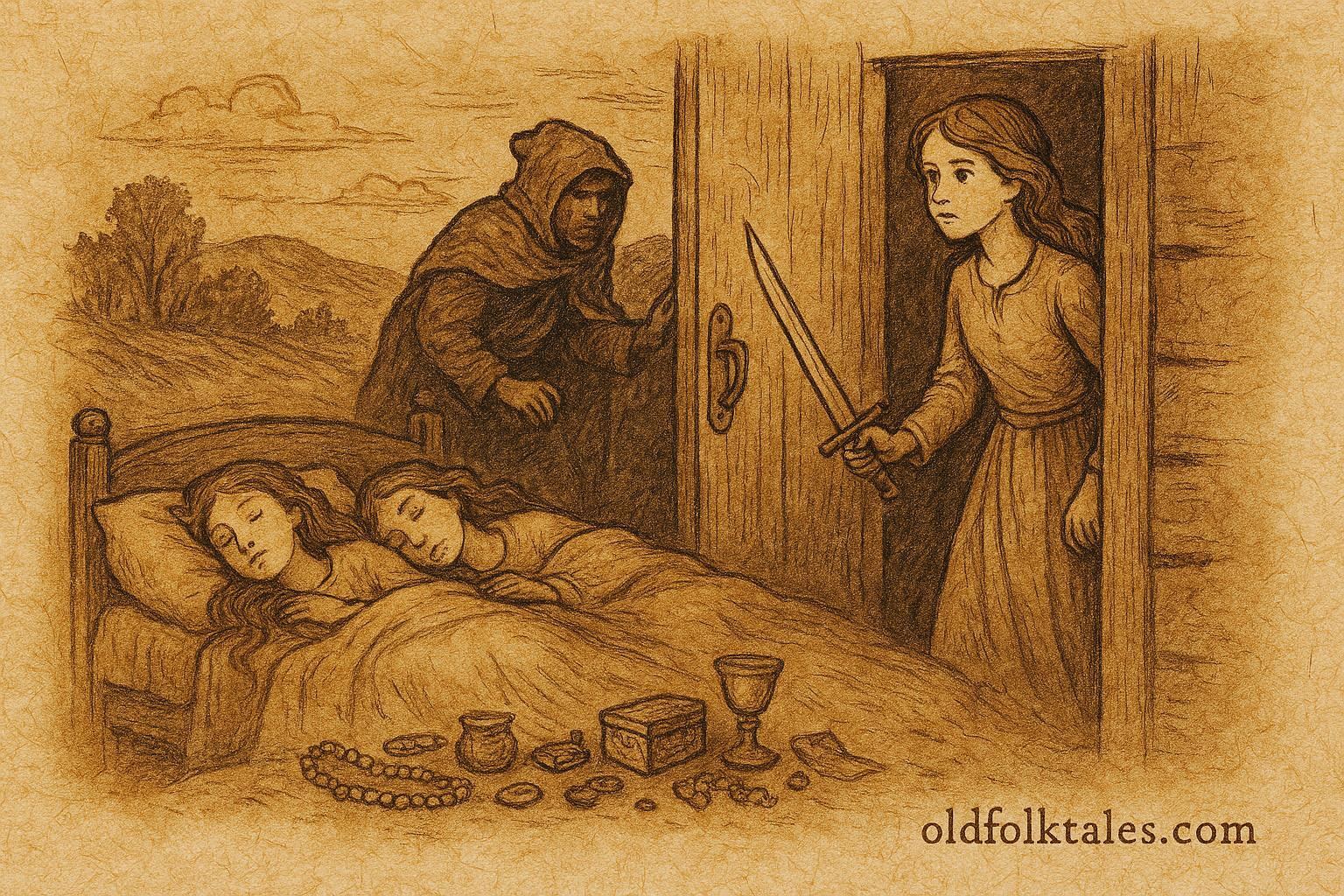
While they dined, the disguised robber sprinkled a sleeping powder into the apples set out for dessert. The two older sisters ate eagerly, but the youngest, unsettled, refused the apple and tossed it aside. After supper they went to bed. Before they had even settled beneath the covers, the two eldest slipped into deep slumber. The youngest, however, was too frightened to sleep a wink.
She heard footsteps. The beggar, now revealed in shadow, entered their bedroom. The youngest feigned sleep. The man approached the eldest sister’s bed and stuck a pin into her foot, no movement. Then the second sister’s, again, no stirring. Then the pin into the youngest sister’s foot, but though it hurt, she did not stir. The robbers believed all three were unconscious.
Through heavy eyelashes she peered at the intruder. She saw him remove his ragged coat: beneath it he wore a robber’s outfit, sword at his hip, pistols strapped to his side, dagger in hand. Her heart hammered with fear; only her courage kept her teeth from chattering.
She heard him move through the house, selecting valuables to steal. Then the bolt of the heavy store‐door clattered as he unfastened it. Quietly she crept from the room, down the stairs, to the dining room, and saw the sword the thief had discarded on a chair.
Swiftly, she dashed down to the store doors at the bottom. Though big and heavy, her fear lent her strength and she secured both bolts. She whispered to herself: He’ll find it hard to enter again.
Footsteps approached: the leader had brought his men back. They cursed and raged when they discovered the doors locked firm.
“It was the youngest girl who deceived me!” cried the robber chief. “From the first I suspected her.”
“Perhaps you can still outwit her,” replied another. “She may not be as wise as she seems. You never can tell.”
The robber captain moved close to the keyhole and whispered through: “Kind lady of the house, have pity on me.”
At first the girl did not answer. But as he persisted, she asked: “What is it you want?”
“I left my charm behind,” he whispered. “Please let me in to retrieve it. I promise you I will do no harm.”
“I do not trust your promise,” she answered. “You shall not come into my father’s house.”
“Then send the charm through the door,” he urged.
“It’s in the fire,” she replied.
“Go throw vinegar on the fire and put it out,” came his whisper.
Now there was a small hole in the door, just large enough for a man’s hand to pass through (the kind of hole beggars thrust hands out of to beg alms). “Pass your hand through the hole, then I’ll give you your charm,” she said.
The robber didn’t see the trap until it was too late. The clever girl ran upstairs, retrieved the discarded sword, returned, and waited. When his hand slid through the hole, she struck it with a mighty swing and severed it with the sword. The robber’s cry echoed through the night; his gang battered the doors in vain. At dawn the thieves fled.
Morning came. The two older sisters awoke from the sleeping powder’s spell. When they heard the youngest’s tale, they were amazed.
“I don’t believe a word of it!” cried the eldest. “You are dreaming.”
“You must have had a nightmare,” said the second. “I have a headache and nothing more.”
Only when the youngest showed them the severed hand and the great sword did they believe. “Oh, why did we ever let that man into our house!” cried the eldest.
“Oh, why didn’t we keep our promise to our father!” lamented the middle.
When their father returned from the long journey and embraced his daughters, he exclaimed: “I feared harm might befall you, yet you are safe.”
The eldest hung her head. “Great danger threatened us,” she said. “We are saved thanks to our youngest sister.”
“Our little sister was wiser than we,” said the second.
Hearing the whole story, the merchant pronounced: “From this day onward we must all heed the wisdom of this little maid, she is wise beyond her years.”
Moral Lesson
True wisdom does not always come with age. Even the youngest can possess the sharpest mind and bravest heart. And a promise made should not be broken—neither should kindness be shown without care for one’s safety.
Knowledge Check
- Who is the youngest daughter and what promise did the sisters make to their father?
They promised their father that no onewould be admitted into the house while he was away. - What disguise did the robber captain use to approach the house?
He disguised himself as an old beggar seeking shelter from a storm. - How did the youngest daughter recognise the intruder’s true nature?
She stayed awake, observed him reveal his robber’s garments (sword, pistols, dagger) and watched him move through the house stealing. - What clever trick did the youngest daughter play on the robber when he asked for his “charm”?
She told him the charm was in the fire, then tricked him into putting his hand through a hole in the door, where she severed it with the sword she had retrieved. - What cultural origin does this tale come from and what is its classification in the folktale index?
It is a Portuguese folktale from the Azores region of Portugal. It is classified under folktale type ATU 956B: The Clever Maiden Alone at Home Who Kills the Robbers. - What is the moral lesson of the story?
That wisdom and courage can come from the most unexpected people, and that keeping one’s promise and exercising wise caution are virtues by which safety is won.
Source: Adapted from the Portuguese folktale “The Little Maid Who Was Wise” in Portuguese Folk-Tales, collected and compiled by various Portuguese sources.
Cultural Origin: Portugal (Azores)