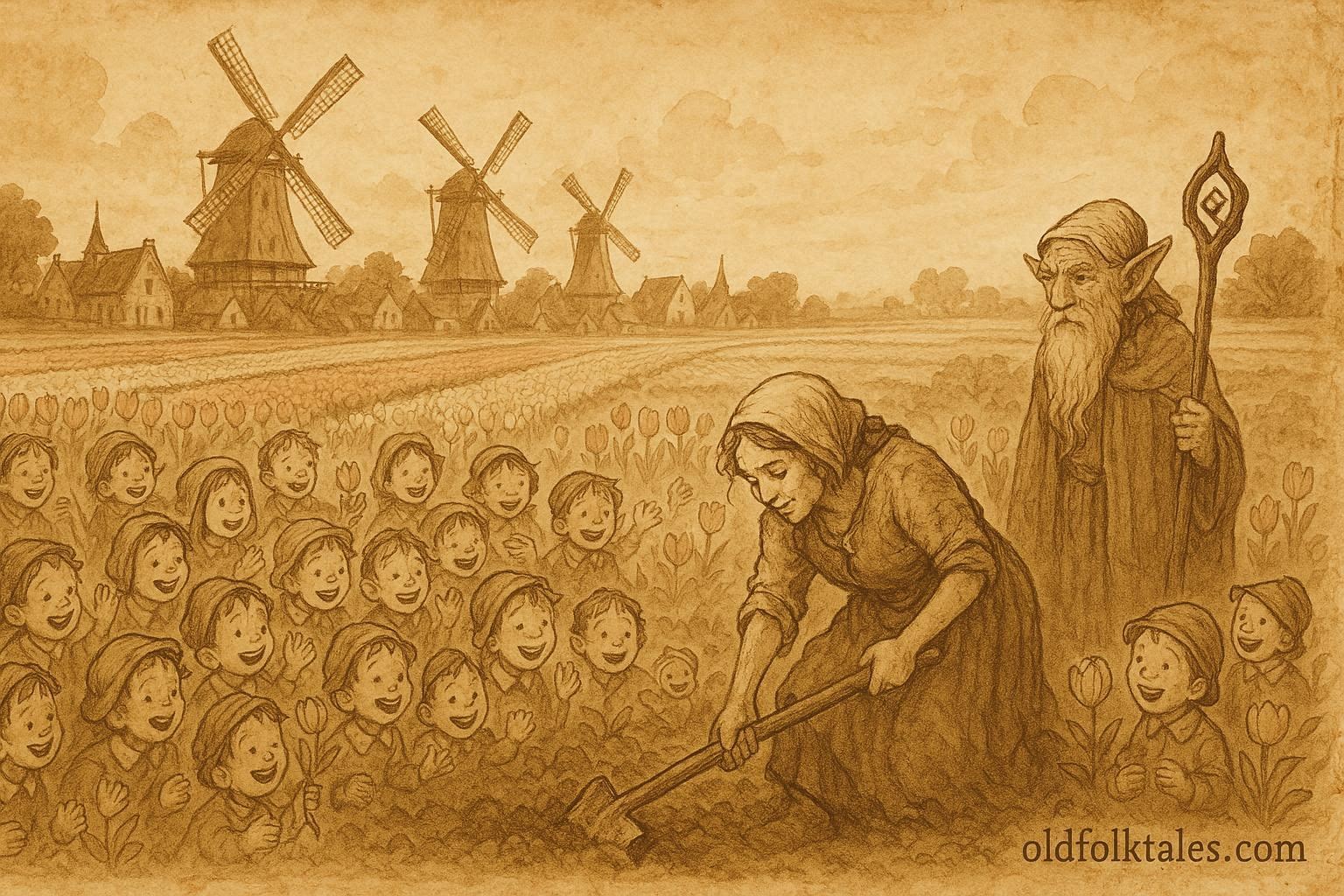
In a quiet Dutch village nestled among windmills and tulip fields, there lived a poor woman and her husband. They were humble folk, earning their bread by tilling the land and mending clothes for their neighbors. Though they were poor in silver and gold, they were rich in kindness and good humor. The woman often said that she would gladly welcome any blessing God saw fit to send, but one day, that blessing came in a most astonishing form.
It began on a crisp spring morning when the woman gave birth, not to one, nor two, nor even a dozen children, but to three hundred and sixty-six! The midwife nearly fainted, the husband ran shouting through the village, and soon the entire town gathered at their door, unable to believe their eyes. Tiny infants lay side by side, wrapped in scraps of linen, filling every corner of their small cottage. The woman, pale and bewildered, could only whisper, “What am I to do with all these little souls?”
The villagers murmured in awe and laughter. Some said she must have angered a spirit; others declared it a miracle. The husband, though proud, soon realized that pride would not fill three hundred and sixty-six hungry mouths. He stood outside his home, staring at the crowded windows where small faces peered out like sparrows in a nest. “Even if I worked day and night,” he groaned, “I could not feed so many!”
Days turned into weeks, and the woman’s joy turned to worry. Milk and bread ran out. The children’s cries echoed like a storm through the night. The neighbors helped at first, bringing loaves, soup, and kind words, but soon they, too, grew weary. The family’s misfortune became a village joke, a curious tale told to travelers at the tavern.
“Have you heard of the woman with three hundred and sixty-six children?” they laughed. “She could make her own army if she wished!”
Yet laughter could not ease the mother’s despair. One evening, as she sat outside her cottage weeping beneath the stars, she heard a gentle cough behind her. Turning, she saw a small, stooped figure wearing a green cap and carrying a staff carved with runes. His eyes twinkled like moonlight on the canal.
“Good evening, mistress,” said the stranger. “Why such tears on so fine a night?”
She told him her story, how her joy had turned to burden, how her husband toiled without rest, and how the villagers now mocked their plight.
The little man nodded slowly. “I am an elf of the old dunes, and I know of both trouble and treasure. You say you have three hundred and sixty-six children. That is one for every day of the year, and one more for good measure. That is no curse, woman. It is a lesson.”
“A lesson?” she cried. “I can barely feed them!”
The elf smiled. “Then teach them to feed themselves. A single hand is weak, but three hundred and sixty-six together can move a mountain.”
With that, he struck his staff upon the ground, and a gentle light spread across the fields. “Tomorrow,” he said, “your children shall wake with strength and wisdom enough to work together. Guide them well, and your sorrow will turn to joy.”
And before she could thank him, the elf vanished into the mist.
The next morning, the mother awoke to find her children already at work. Some fetched water, others tilled the soil, and others baked bread. They moved in harmony, laughing and helping one another as though guided by invisible hands. The eldest organized the youngest; the swift aided the slow. By noon, the barren patch of earth behind their cottage had been transformed into a thriving garden.
Within a week, the family had enough food not only for themselves but for the entire village. The once-mocking neighbors now stood amazed, and the husband, who had nearly lost hope, could not stop smiling.
As months passed, the family’s small plot grew into a cooperative farm, each child tending a task, each sharing the harvest. The village prospered alongside them, for the woman taught others how unity could turn scarcity into plenty. People came from far and wide to see the miracle of the three hundred and sixty-six children who worked as one heart and one mind.
In her old age, the woman often sat beneath the elm tree by her home, watching her grown children labor joyfully. She would smile softly and say, “What once felt like a curse became the greatest blessing of my life. When hands and hearts unite, even the heaviest burden becomes light.”
Moral Lesson
True strength lies not in the few, but in the many who stand together. Cooperation and unity can transform even the greatest hardships into abundance and peace.
Knowledge Check
- Who are the main characters in “The Woman with Three Hundred and Sixty-Six Children”?
The story centers on a poor Dutch woman, her husband, their three hundred and sixty-six children, and a wise elf from the dunes. - What challenge does the woman face after giving birth?
She struggles to feed, clothe, and care for her enormous number of children, leading to hardship and ridicule from the villagers. - How does the elf help the family overcome their troubles?
The elf blesses the children with wisdom and cooperation, teaching them to work together and support one another. - What transformation occurs after the elf’s visit?
The once-chaotic household becomes organized, forming a cooperative farm that provides food for both the family and the village. - What is the moral of this Dutch folktale?
It teaches that unity and cooperation can turn overwhelming burdens into shared blessings. - What cultural value from Dutch folklore is reflected in the tale?
The story reflects Dutch communal values, teamwork, perseverance, and the belief that prosperity arises from working together.
Source: Adapted from Dutch Fairy Tales for Young Folks by William Elliot Griffis (1918).
Cultural Origin: Netherlands (Dutch folklore)