Long ago in a faraway land, there reigned a pious emperor who was loved for his wisdom and devotion. Among his many gifts to his people, he built a magnificent church, one that shone with gold, marble, and precious stones. Its columns gleamed like snow, its chandeliers were of silver, and its altars were adorned with rare gems. Yet, despite all his effort and faith, the steeple of this splendid church could not be completed. Each time it rose, it collapsed again.
In his despair, the emperor prayed and ordered that prayers be read throughout his realm. That very night, he dreamt that if the wonderful bird from the far shore were brought and its nest placed atop the steeple, the church would finally stand.
When morning came, he gathered his three sons and told them his dream. Each volunteered to undertake the perilous journey, but only one could go first. “My eldest shall go,” said the emperor. “If he fails, the second shall follow, and if both fail, the youngest will go.”
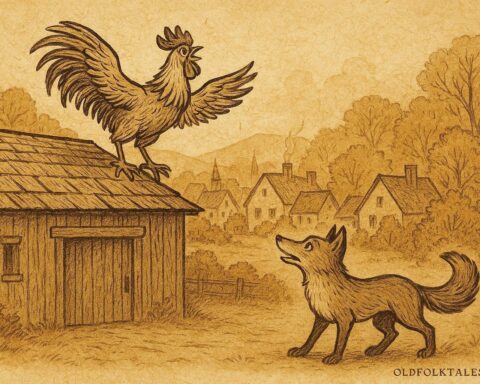
The eldest prince departed at once. Beyond the empire’s borders, he stopped to rest in a quiet grove, built a small fire, and prepared his meal. As he sat down, a fox appeared and spoke, “Good prince, tie your hound, give me a crust of bread and a glass of wine, and let me warm myself by your fire.”
The prince laughed. “A talking fox? I’ll catch you and have your fine fur instead!” He loosed his hound, but before the dog could reach it, the fox uttered a spell. Instantly, the prince was turned to stone.
When months passed without news, the second prince set out. On the same spot, he too met the fox, and when he also refused its request, he met the same fate, turned to stone beside his brother.
Time passed, and sorrow grew heavy in the emperor’s heart. Seeing his father’s grief, the youngest son knelt before him. “Father, let me go. If I fail, you will lose nothing, but if I succeed, your dream shall be fulfilled.”
The emperor hesitated. “Your brothers have perished; I am old. If you go too, who will remain to guide the people?”
But the young prince persisted gently. “You taught me to trust in God. Let me do this one thing to bring you peace.”
Moved by his son’s courage, the emperor consented. The prince chose a noble horse, a loyal dog, and set out with faith in his heart.
Days turned into weeks before the two elder princes suddenly returned, bringing with them the wonderful bird and a beautiful maiden. The bird’s feathers glimmered like sunlight on water, but it was silent. Though the church’s steeple now stood firm with its nest placed atop, sorrow lingered in the emperor’s heart because the bird did not sing, and because his youngest son was gone.
Then, one morning, a poultry-maid came rushing to the emperor. “Your Majesty, the wonderful bird has begun to sing! It sings only when a certain shepherd enters the church, no sooner he steps in than it bursts into joyful song.”
The emperor sent guards to bring this shepherd before him. When the young man appeared, his noble bearing and gentle manner stirred something in the emperor’s heart. “Tell me, my son,” he asked, “why does the bird sing only when you are near?”
“Majesty,” the youth replied humbly, “to answer that, I must tell you my story.”
The shepherd began:
“I am your youngest son. On my journey to find the wonderful bird, I stopped in a meadow to rest. There, I met a fox who asked to share my fire. I tied my dog, shared my bread and wine, and spoke kindly to it. The fox promised, ‘I will help you succeed, for you have freed me from an enchantment. I was a man once, cursed to live as a fox until one would show me mercy.’
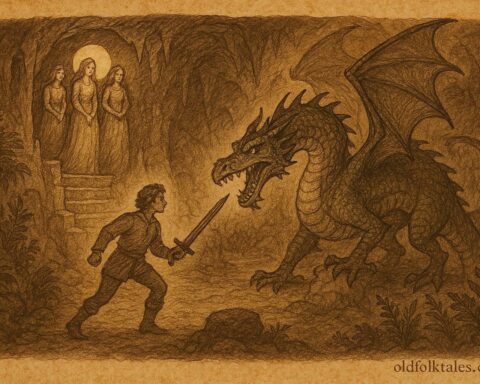
He turned three somersaults and became a handsome warrior. We traveled together until we reached a mountain valley, the realm of the dragons. The fox warned me that the wonderful bird was guarded by them.
We entered a grand palace of silver and gold, where fountains sang and walls glittered with carved flowers. A beautiful maiden met us there — a captive of the dragons. She begged us not to linger and told us that the bird we sought was held by other dragons nearby. I swore to free her once my quest was done.
At the next palace, I found the wonderful bird caged in the hall. I mounted one of the dragons’ own steeds, seized the cage, and fled. The dragons chased me in fury, but my fox-companion raised his hand, and they froze into stone.
We returned for the maiden. She cracked her whip three times, and the dragons’ palace shrank into an apple, which she placed in her pocket. Again, dragons pursued us, but my companion turned them too into stone.
When we reached the meadow, my fox-friend revealed that the statues of stone nearby were my brothers, the ones who had scorned his kindness. At my pleading, he restored them to life, though he warned I would regret it.
We set off home together. But when we stopped by a pond to drink, my brothers betrayed me. While I leaned forward, they cut off my feet and left me to die.
For three days I lay by the water until a blind man passed by. He too had been betrayed by his brothers. We joined forces, I would be his eyes, he would be my feet. Together we slew a great scorpion whose blood healed both our wounds. Once whole again, I disguised myself as a shepherd, trusting God to reveal the truth.”
The emperor, overcome with emotion, embraced his son. “My child, you are my youngest son returned to me!”
He summoned the maiden, who told her story, how the elder brothers had brought her to court and made her a poultry-maid. To prove her tale, she took the apple from her pocket and cracked her whip three times. A palace more magnificent than any in the empire rose before their eyes.
The emperor declared a great feast, but the prince said solemnly, “Father, before joy, let us seek God’s judgment.”
The three brothers stood before the church. Each cast a stone from a sling while standing in a beehive. The elder brothers’ stones fell upon their own heads and struck them dead; the youngest prince’s stone fell harmlessly before him. Justice was done.
The emperor rejoiced and gave his throne to his youngest son, who ruled with wisdom beside his faithful bride.
Moral Lesson
Kindness and faith are stronger than deceit and pride. Mercy shown to others will one day return to the one who gives it.
Knowledge Check
1. Who was the wonderful bird, and why was it important?
It was a magical bird whose presence completed the emperor’s church and symbolized divine blessing.
2. What did the fox represent in the folktale?
The fox embodied wisdom, loyalty, and the rewards of compassion.
3. Why did the eldest brothers fail in their quest?
They refused to show kindness to the fox, showing pride and greed instead of humility.
4. How was the youngest prince rewarded for his kindness?
He gained the fox’s friendship, succeeded in his quest, and eventually became emperor.
5. What role did the maiden play in the story?
She symbolized purity and truth, later proving the prince’s innocence.
6. What moral does the folktale teach?
That mercy, faith, and righteousness triumph over envy and betrayal.
Source: Adapted from the Romanian folktale “The Wonderful Bird” in Roumanian Fairy Tales, collected by Mite Kremnitz (1882), London: George Allen.
Cultural Origin: Romania (Romanian folklore)