In the golden age of myth, when gods and mortals walked the earth side by side, the city of Athens suffered under a dark obligation. Every nine years—or in some accounts, every seven, a terrible tribute was demanded by King Minos of Crete: seven youths and seven maidens, chosen from Athens, were sent across the sea to the island of Crete. There, they faced the labyrinthine prison of the Minotaur, a monstrous creature, half-man and half-bull, who devoured them without mercy.
The Athenians lived in fear, and their hearts weighed heavy with guilt and sorrow. Families watched as their children were chosen, praying against the cruel lottery that none could escape. Ships set sail under the shadow of doom, carrying the innocent to the island fortress where stone corridors twisted like snakes, and whispers of screams echoed endlessly.
Explore the wit and wisdom of Western Europe, where humor and virtue often go hand in hand
Among the young people of Athens was a prince, Theseus, son of King Aegeus. Unlike others who trembled before the shadow of the Minotaur, Theseus was filled with determination. He would not allow his city to be enslaved by fear. “I will go,” he said boldly, standing before his father. “I will end this terror, and no more Athenian child shall suffer under this cruel tribute.”
His father’s face paled with worry. He loved his son dearly, yet he knew the risk. The labyrinth was said to be unsolvable, a place from which no mortal returned alive. Still, Theseus’ courage shone brighter than any fear.
The prince set sail with the other youths, his mind already planning the impossible task: to find and slay the Minotaur, a creature of brute strength and relentless hunger. The voyage to Crete was long, and the sight of the towering palace and its surrounding labyrinth filled all hearts with dread. Here, in this twisted maze of stone walls and echoing corridors, death waited patiently for each step.
When Theseus arrived, he encountered Ariadne, the daughter of King Minos. She had watched the terror unfold from within the palace and had fallen in love with the young prince’s courage and nobility. Seeing his determination and understanding the hopelessness of the task, she devised a plan to aid him. She handed him a ball of fine thread and whispered instructions: “Tie one end to the entrance and unwind it as you move through the labyrinth. It will guide you back when your task is done.”
Armed with this clever tool, Theseus entered the labyrinth. Stone walls loomed like shadowed cliffs, turning endlessly, twisting in disorienting patterns. Torches flickered in sconces, casting uncertain shadows that seemed to move on their own. The air was heavy, damp, and filled with the faint metallic scent of the Minotaur’s presence. Every corridor held a threat. Every echo carried the promise of death.
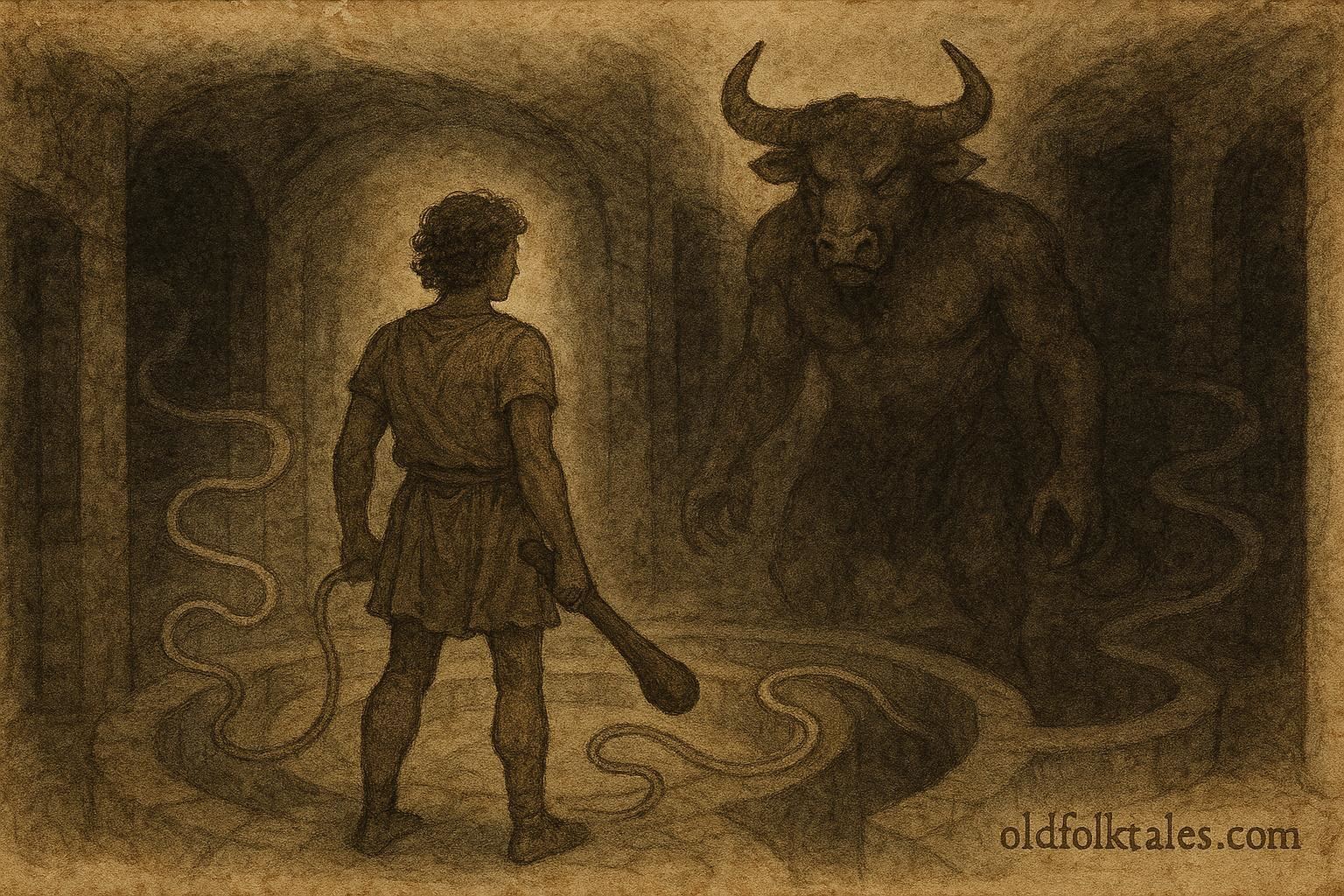
At the heart of the labyrinth, the Minotaur awaited. Its head was that of a fierce bull, horns curved like sharpened crescents, eyes glowing with primal hunger. Its chest and arms were human, muscular and terrifying in their strength. The very floor seemed to tremble beneath its weight.
Theseus approached with caution, every step measured, every breath controlled. He remembered Ariadne’s thread and the promise of escape, yet he also felt the weight of Athens’ hope upon his shoulders. The Minotaur roared as it sensed intruders. Its roar was a sound of fury, of hunger, of centuries of wrath trapped behind walls of stone. The young prince’s heart pounded, yet his resolve did not waver.
When the Minotaur lunged, Theseus did not falter. He dodged its sweeping horns and seized a large club he had carried. The battle was ferocious: the clash of strength against cunning, of instinct against strategy. Theseus moved with precision, striking when the Minotaur’s guard faltered, retreating when the beast swung with deadly force. Every strike was guided by intelligence, not brute force alone.
Finally, with a decisive blow, Theseus struck the Minotaur down. The monster fell, its roar echoing one last time through the stone corridors, and the labyrinth was silent. Courage, skill, and cleverness had triumphed over raw power.
Theseus then retraced his steps, following Ariadne’s thread back through the twisting maze. Each corridor that had once seemed endless now guided him safely to the entrance. Outside, the sunlight broke through the walls of the labyrinth, warm and reassuring. Freedom awaited him, and the horror that had haunted Athens was finally ended.
Ariadne rejoiced, but Theseus knew that his journey was not yet complete. He had freed his people, yet a warning remained, a reminder that triumph could be fleeting if pride or carelessness arose. He carried the lesson in his heart as he returned to Athens, where his father, King Aegeus, welcomed him with tears of relief. The tribute was no more. Athens could breathe again, liberated from the shadow of the Minotaur.
Thus, the tale of Theseus reminds us: courage, intelligence, and the clever use of resources can overcome even the deadliest challenges. Heroism is not measured by strength alone but by the courage to face fear, the wisdom to plan, and the resolve to act when the moment demands it.
Discover the spiritual depth and wisdom hidden in the ancient folklore of Eastern and Balkan Europe
Moral Lesson
True courage combines intelligence and bravery. Strength alone cannot overcome every obstacle; success comes from clever strategy, resourcefulness, and the willingness to face danger for a just cause.
Knowledge Check
-
Q: Who is Theseus?
A: The hero and prince of Athens who volunteers to face the Minotaur. -
Q: What creature lives in the Labyrinth?
A: The Minotaur, a monstrous half-man, half-bull. -
Q: Who helps Theseus navigate the Labyrinth?
A: Ariadne, daughter of King Minos, who gives him a ball of thread. -
Q: What is the main theme of this folktale?
A: Courage, intelligence, and justice overcoming fear and tyranny. -
Q: How does Theseus defeat the Minotaur?
A: Using a combination of bravery, clever strategy, and physical skill. -
Q: What does the myth symbolize for Athens?
A: Liberation from oppression and the triumph of intelligence over brute force.
Source: Bibliotheca by Apollodorus (c. 1st–2nd century CE)
Cultural Origin: Ancient Greece (Attic–Cretan tradition)